


Saab Gripen E Canada fighter jet update and Saab’s expanding partnerships in Canada
Saab recently announced that it is considering Canada as a place to assemble Gripen fighter jets to meet demand from Ukraine, with Micael Johansson, CEO of Saab, mentioning Kyiv’s interest in purchasing 100+ Gripen fighter jets that would double the defence company’s production requirements, with plans to expand production capacity, possibly within Canada.
READ: Saab to Consider Canada for its Gripen Jet Assembly
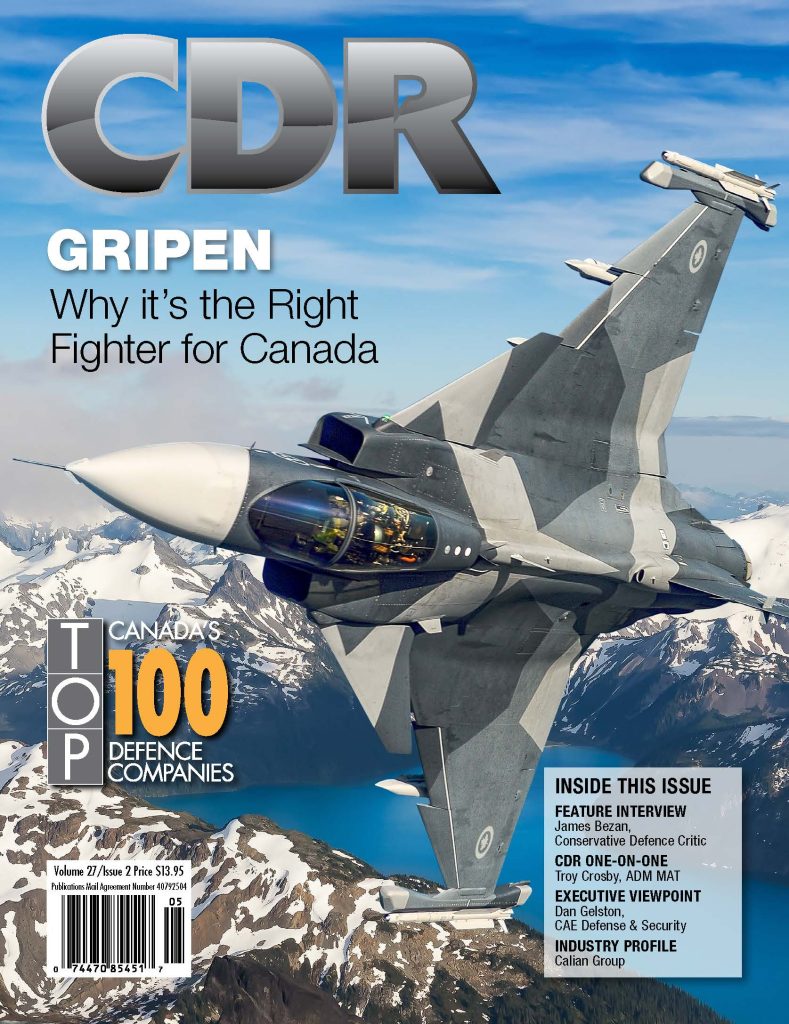
With renewed interest in the RCAF operating a mixed fleet of F-35s and Gripens, CDR is revisiting one of our most popular features– Vol. 27, Issue 2 Cover Story on Saab’s Gripen fighter which can be read here.
Saab carries on business throughout the world as a defence and security company that aims to keep its customers and their communities secure from threats wherever and however they arise. And, it does all that via products like fighter aircraft, airborne early warning systems, radars, electronic warfare, submarines, ground combat, and missile systems.
The company has been operating in Canada for nearly 30 years and has products in service across the Army, Navy and Air Force, along with the commercial aviation sector. One important example is the Combat Management System and surveillance and fire control systems onboard the Halifax Class frigates of the Royal Canadian Navy. These systems are at the heart of these ships as they carry out their NORAD maritime warning missions.
Now, in response to Canada’s FFCP (Future Fighter Capability Project) RFP, Saab Canada has proposed the cutting edge Gripen E fighter jet as their solution to replace the venerable CF-18 Hornet.
Gripen has been developed in a very agile manner, which was made possible by the close cooperation between the Swedish Air Force and industry. Among the key features of the Gripen E that make it particularly well suited for FFCP, are ability to assemble the aircraft in Canada, technology transfer to Canada, a design built to withstand and thrive in Canada’s harsh climate, NATO interoperability, low maintenance and sustainment costs, as well as a small operational footprint, to name but a few.
We recognize that most RCAF fighter pilots have never flown a Gripen so, to address this, CDR reached out to Johan Linder, a fighter pilot who flew the Gripen A/B/C/D models and the F/A-18C/D Hornet. His comparison of both aircraft lays the foundation for a discussion on the Gripen E, which is much more advanced than the Gripen he flew.
READ: COVER STORY ON SAAB GRIPEN E

Sweden’s Saab offered its Gripen fighter fleet as a replacement for the CF-18s but lost to U.S manufacturer Lockheed Martin‘s F-35 fighter jets. While Canada’s acquisition of 88 F-35 jets remains under review, rising program costs poses an important question — should Canada reconsider the Gripen E as an alternative or added fleet to the CF-18 replacement? And could Canada realistically afford/be able to manage a mixed fighter fleet? Before the CF-18s were acquired, the RCAF operated three different types of fighter jets. Ultimately, operating a mixed fleet was considered too expensive due to the costs associated with different training, infrastructure, and supply chains.
“The federal government has not ruled out a mixed fighter fleet. One option for Ottawa is to move forward with a small fleet of F-35s and also acquire a separate fleet of Gripens.”
Minister Mélanie Joly told The Canadian Press
With recent Canadian partnerships announced, Saab is looking to continue increasing its operations in Canada, including more assembly work on the GlobalEye. The GlobalEye is a leading Airborne Early Warning and Control (AEW&C) solution that combines the best of Swedish and Canadian expertise and quality. At the heart of the GlobalEye system is the Bombardier Global 6000/6500 aircraft, a Canadian-built platform that delivers long range, high endurance, and superior performance at all altitudes.
READ: Saab ready to offer GlobalEye for Canada’s Airborne Early Warning and Control program
Saab and CAE Advance GlobalEye
Saab and CAE announced the signing of a global cooperation agreement to collaborate on advanced training specifically tailored to Saab’s Airborne Early Warning (AEW) platforms, including the GlobalEye Airborne Surveillance Platform.
READ: Saab and CAE Advance GlobalEye Worldwide with New Global Cooperation Agreement
The agreement, formalized during the week of the state visit of Their Majesties the King and Queen of Sweden to Canada, marks a significant advancement in the long-standing relationship between the two companies and strengthens international cooperation in airborne surveillance, situational awareness, and integrated mission platforms.
Building on Saab’s expanding partnerships in Canada, the collaboration will combine Saab’s decades of expertise in multi-domain sensing, command and control, and AEW system integration with CAE’s global leadership in simulation-based training. Together, the companies will deliver comprehensive, high-fidelity training environments that replicate the complexity of modern airborne surveillance missions for GlobalEye operators.
ADDITONAL INFO:
- Saab ready to offer GlobalEye for Canada’s Airborne Early Warning and Control program
- Saab, Boeing and BAE Systems to collaborate on Next-Gen pilot training
- GA-ASI and Saab to Demonstrate AEW&C on MQ-9B in 2026


20 thoughts on “Saab Gripen E Canada: Is It the Right Fighter for Canada?”
Win win for Canada and Sweden. Excited that Canadian jet development and production will be involved. The add ons in electronics security available from Saab are super exciting.
It’s time for Mr. Carney to make a decision. We have here a once in a generation choice, do we do what’s best for Canada or do we appease Donald Trump and the USA.
The last time we had this choice the prime Minister of the day, John Diefenbaker scrapped the Avro Arrow.
Does Mr. Carney want to become the new John Diefenbaker?
Dief folded and sold Canada down the river because Eisenhower did not want Canada to become a power in fighter jets. 2500 engineers left AV Rowe. Many went to the US where they designed the F4 Phantom which is a scaled down Avro Arrow. Others put America on the moon heading NASA. Until about 30 years ago, the airframe of that Arrow was still competitive. Carney is a banker by thinking. He lacks insight and great foresight. I doubt he will step up to the plate. Expect another boat trip down the river!!!
I think you may be underestimating Mr Carney’s wisdom, he is a strategic thinker and pragmatist, I believe he will move Canada forward to become more self determined, which I think all Canadians want and expect.
Choice based on requirements is clear F-35. Gripen is a 4th gen fighter that cannot match latest designs today and will be even more out matched in the future.
This is a huge decision with an incredible array of consequences and problems ! Canada is already producing a huge amount of pieces for the F35 across our country ! It is I operation in the air forces of many NATO Countries and the potential spinoffs for Canadian Manufacturing is huge and still going !
Lastly and u fortunately very important I’d that the US and Trump in particular would blow a gasket if we went with the Grippen ! On the other hand , Canada can make up our own mind ! We do not like threats , never have never will ! It would be awesome if we could tell the Orange Menace to “ take a hike !”
The total partnership with Saab and the manufacturing of the orders that Saab for the Grippen would be great for our Aerospace industry and would only be the beginning of an amazing partership with one of our longest friends ! Would the investment they are promising make up for the backlash from America ? Not sure it would ! To bad we cannot just build a fully a Canadian designed and built fighter but that ain’t going to happen ! I hate that that the US is bulking us , I hate that they are threatening us , I hate that they will hold this over our head as long as the Orange Monster is around ! The consequences of breaking away from the US is huge ! If we could be sure it would change if and when he leaves office , that is if he ever does , it would be worth it !on this file , weighing all the complications I say , renegotiate the current F35 deal to give Canada far more insurances and benefits , ensure that the cost satays the same , ensure that the control is in our hands , not the US !
In other words , tell them to give us all of the benefits that Sweden is Promising ! If they say know , make them understand that they can shove the F35 ! Donald can bullshit and blister all he wants , we are a Sovereign Nation , we are not nor ever will be his vassel !
Let’s give Sweden our full support and enjoy an incredible victory and opportunity to grow together !
Let’s face it, whichever is chosen it’s not going to make a decisive impact on any future conflict given that Canada’s contribution is low in any scenario. Secondly future warfare will rely more on autonomous aircraft especially drones. So go for the lower cost option and use the savings on future forward armament.
I believe it’s time for Canada to step up and step away from American domination. We have been dependent on the US for far too long. We are a competent people in a beloved nation. Let’s keep it that way. Buy the Griphen jets from Saab to add to our existing fleet and start building them here. In time and after testing we can eventually faze out the older F35s as well as increases our own fleet for much less money. We will be able to defend our sovereignty and not have to wait for US approvals to do so.
GO CANADA!!!;!
Yes, Canada is absolutely ready for Saab Gripen fighter jets. Swedish/Canadian collaboration….bring it. No proprietary secretiveness here.
Lets keep one thong in mind here. Mr Trump can, if he is inclined, to scuttle the Saab deal due to the use of US supplied engines. It’s not like he can’t be vindictive when he doesn’t get his way.
In reply to Ron Bouchard: Well, Saab is reportedly looking at switching to a Rolls Royce engine in order to distance itself from US influence over it’s sovereign defence matters. I strongly suspect that will factor into the Canadian decision.
In reply to Ron Bouchard: Saab is considering using the Rolls-Royce engines that are made in Montreal.
Yes it is a expensive choice to have 2 jets it will be up to our air force i guess to decide i see it’s seams the air force wants the f35s .
Lots to think about, Saab and Canada need to get by American equipment in the Grippen especially the GE engines. A Rolls Royce alternative may be the deal maker. We cant afford American influence in the Saab jets as Trump could be still in control. Secondly with Saab and Canadian aviation groups working together I believe catching up and surpassing the F35 is an obtainable goal . Something that both groups would be striving for, and which will give especially Canada the independence and industry growth in aviation we lost. Yes today the F35 is the jet , but at what costs and for how long is the question. Remember it was Canadian engineering that established the Arrow which has been a guiding design jets over the last 60 yrs or so, LETS do it again for a lasting long term together with Sweden.
Go for the Grippen contract!!!! Canada took an idea for a fighter aircraft the Arrow and made it a tremendous success, we can do the same with the griffen.
Why is the Canadian Government not purchasing the Saab Fighter Jets? It’s a jet built for our Arctic needs with no ties to Washington. The jet will also create highly skilled jobs unlike the F35 program. Saab would like to establish a full time assembly plant here in Canada using all of our expertise, aluminum and steel to produce this sought after promised Ukrainian military jets as our first customer.What is Canada waiting for?
Saab Fighter Jet is a jet built for our Arctic needs with no ties to Washington. The jet with it’s will new Rolls Royce engine will create highly skilled workforce unlike the F35 program. Saab would like to establish a full time assembly plant here in Canada using all of our expertise, aluminum and steel to produce this sought after promised Ukrainian military jets as our first customer.What is Canada waiting for?
In reply to Warren Thomson: There are no plans to swap out the GE engine for the Rolls Royce. The US cancelled Gripen sales to Columbia recently. Rafale anyone??
I am in favour of a mixed fleet. The F-35 is well suited for Europe, but over the vastness of Canada…..not so much. There will never be a dogfight over Canadian air space, but there will be Russian bomber incursions trying to glean information on defensive systems. For all intents and purposes, the AVRO Arrow could still handle that mission.
This would not be the first time Canada fielded a mixed fighter fleet. I joined the RCAF in 1958; we had F-86 Sabre day fighters in Europe as well as the homegrown CF-100 in Canada and overseas. The ill-fated Avro Arrow was scrapped, only to be replaced by 66 F-101 Voodoo interceptors, castoffs from the USAF. Later in the 60’s the Sabres disappeared, to be replaced by the US – designed F-104, along with many other NATO nations. By the way, the USAF had no use for the F-104, so North American Aviation mad a bundle flogging it to Canada and NATO. Then, apparently to keep Canadair(now Bombardier) alive, we bought the dinky little F-5, sold half to Venezuelan, then invented a use for the rest.
Comments are closed.