


Made-in-Canada Armoured Vehicles from ROSHEL
It’s time for Canada to become self-reliant in meeting its own defence needs
BY JAMES CARELESS
With the Trump’s tariffs having thrown Canada’s historic alliance with the United States into doubt, the time has come to strengthen Canada’s defence self-reliance and export capabilities. That’s the message from Roman Shimonov, CEO and Founder of Roshel. Based in Brampton Ontario, with manufacturing facilities in the GTA, Roshel specializes in the design, manufacturing, and deployment of Senator armoured vehicles for defence, public safety, and commercial security applications.
For the record, Roshel is the leading supplier of armoured vehicles to Ukraine, with more than 1,700 Senators having been donated to that country by Canada and other western nations to date. Available in a range of configurations, the Senators are built using commercial Ford chassis and motors with Roshel’s rugged armoured bodies installed on top. This approach speeds up manufacturing and reduces user purchasing/maintenance costs, without sacrificing security. The proof can be found defending the people of Europe and the West on the battlefields of Ukraine today.
READ: Roman Shimonov, Roshel – 2025 DEFENCE EXECUTIVE OF THE YEAR
WHY CANADA NEEDS TO BE SELF RELIANT
WHEN IT COMES TO DEFENCE
A 15-year veteran with the Israeli army, Roman Shimonov came to Canada 12 years ago to build armoured vehicles that were better designed, efficiently built, and cutting-edge while being easy to maintain. The result is Roshel’s Senator family of vehicles. They are tough, affordable, and equipped with advanced electronic components that support remote connectivity and encryption capabilities in support of reconnaissance and surveillance operations.
Roshel delivered its first Senator armoured vehicle to the market in 2018. It soon won orders from the US government and Canada, including the U.S. Departments of Homeland Security and State.
Today, Roshel does so much business stateside that it has opened a factory there, a move that proved prescient given the subsequent arrival of Trump’s tariffs. But despite this success, Roman Shimonov is a devoted Canadian citizen, and one who sees an urgent need for Canada to become self-reliant in meeting its own defence needs.
“We are the world’s second largest country when it comes to territory, and now we share a border with a very unfriendly and unpredictable neighbour,” Shimonov told CDR. “As well, our Arctic is now being coveted by Russia and China. Yet despite these facts, we’re still behaving like a colony when it comes to defence budget planning and allocations of resources. We can’t afford to do this any longer, not when our sovereignty is at stake.”
THE NEED FOR SPEED
12 months ago, the notion that Canada’s longstanding ally could become its greatest threat would have seemed so far-fetched, it would have been dismissed out of hand by most Canadians. But that was then, this is now — a fact that underscores the strategic importance of our domestic defence industry being able to respond quickly to shifting national security needs.
“The keyword here is quickly,” Shimonov observed. “We now see the reality of Europe, where countries were living in a dream world in which the US ‘Big Brother’ was taking care of all of their defence needs. All of a sudden, there is a new boss in the office, and Europe is facing a new reality where there’s no Big Brother that those countries can rely on. Well, the same is true for Canada. We must address our own security needs and do so in a timely manner. Right now, our procurement processes are extremely long. By the time a procurement has been finalized, the technology may have become outdated and obsolete.”
So, what can be done to speed up Canadian defence procurement? “Canada’s approach should be focussed on understanding how much time and effort is actually required to identify the need and then to execute it in a reasonable time period,” replied Shimonov. “We need to allocate the time required – but no more than that – in order to get the Canadian Armed Forces the equipment they need as soon as possible.”
WALKING THE TALK
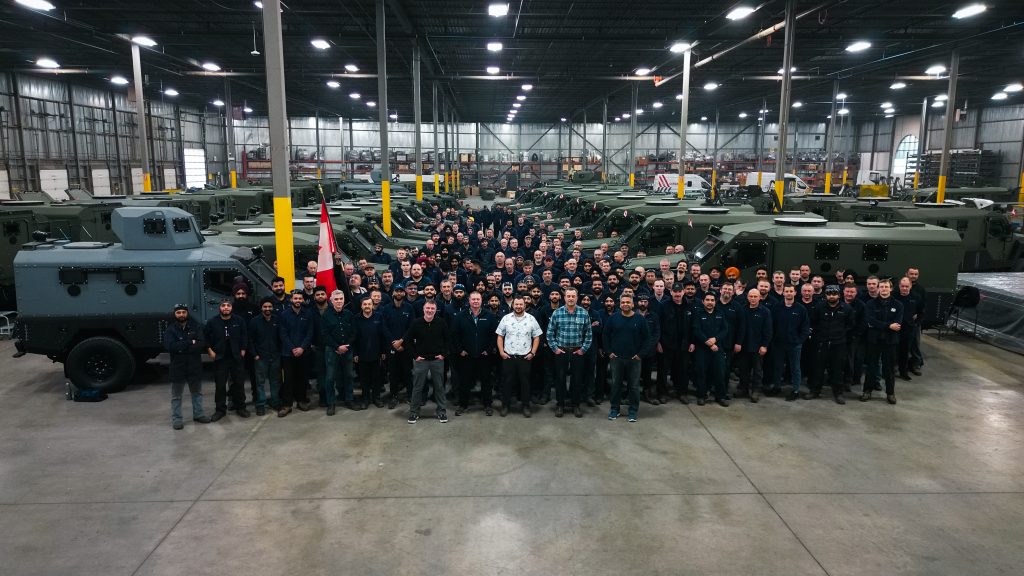
Of course, the fastest procurement processes won’t help if manufacturers can’t keep up with them. That’s a lesson that Roshel has taken to heart. It has created a production process that is both fast and efficient without compromising quality, by adopting a few key business practices. First, Roshel does everything it can in-house, from the design of its armoured vehicles through the fabrication and assembly of them within its own facilities. Second, the components that it does require from third parties, such as commercial Ford truck chassis and motors, are sourced from Canadian suppliers as much as possible. Third, Roshel has a pool of highly skilled employees who know how to do their jobs building its products. This ensures that the work is done properly the first time.
“Roshel is a fully vertically integrated company,” said Shimonov. “We basically control the whole end-to-end process. This gives us the ability to ramp up and be agile to respond to customer needs, without ever compromising the quality of what we make. As a result, Roshel can cope with changing times. When the pandemic occurred, we were able to double our revenues because we were able to quickly shift our efforts into products that were now in demand. When the war in Ukraine happened, we were able to start producing over 120 vehicles per month, which was more than any other company in our industry.”
Roshel’s preference for using Canadian suppliers delivers a lot of benefits to its customers and the company itself. “For example, using local materials that don’t have to cross international boundaries is the most efficient and cost-effective way to control the whole process,” Shimonov told CDR. “We don’t have to rely on international supply chains that are out of our control, and it minimizes our exposure to fluctuating currency exchange rates. Buying domestically also strengthens Canada’s defence industry as a whole, which is exactly what needs to be done in the current trade war situation. Now more than ever, it is vital for companies in our industry to band together to support Canadian jobs and the Canadian economy. Of course, what would help is for the federal government to provide more support to our domestic industry, to help all of us weather the coming storm in better condition.
In contrast, the United States provides this level of support to its domestic defence companies, said Shimonov. “We received a lot of incentives to build a factory in the United States,” he noted. “We’re now receiving hundreds of millions of dollars of orders from the United States customers as a result, even though we are a Canadian company. Still, I would prefer to have our operations entirely based in Canada, but we can only do that with the active support of the federal government.”

WHY OTTAWA MUST SUPPORT
CANADIAN COMPANIES
Based on Roman Shimonov’s own experience, there is a big gap between the claims and commitments that the Canadian government is making when it comes to supporting our allies and the realities of what is actually occurring. In Roshel’s case, less than 10% of the orders that the company is receiving are coming from the Canadian government.
“As a Canadian company, we would be happier to support Canadian needs before addressing the needs of any other country,” said Shimonov. “If I were in the government, I would definitely give priority to Canadian manufacturers, especially now with tariffs because these companies are the real backbone of the economy. Providing real support to the domestic defence industry, for example, would allow all of us to increase employment and our contributions to the economy. But we’re not asking for any favours here: We just want the federal government to buy Canadian as much as possible, whether in defence or in any other areas of the economy.”
Ironically, the existential threat that Donald Trump is posing to Canada’s sovereignty may well motivate Ottawa to take this approach. “Given that buying from US companies means supporting an economy that now poses a threat to our existence, I think that the Canadian government now has no choice but to buy Canadian as much as possible because there is really no alternative,” Shimonov told CDR. “As well, when it comes to defence procurement in this country, the time has come to do a hard reset of our selection process and the decisions we make for equipping the Canadian Armed Forces. We have to trim away the bureaucracy and move procurement decisions through the system in an efficient yet fair manner. We cannot afford to wait decades to get equipment that our military needs now. Otherwise, we risk helping Donald Trump in his quest to make Canada his 51st state.”
EXPANDING CANADA’S DEFENCE EXPORTS
As Roshel’s success in providing armoured vehicles to Ukraine has proven, it is possible for Canadian companies to compete successfully in the global defence marketplace. This is why government support for the Canadian defence industry is so vital to our economy, because there are sales to be made internationally. In particular, the European Union’s drive to defensively rearm the continent in response to America’s de facto abandonment of their traditional relationships and the ongoing threat of Russian aggression presents a very real opportunity for Canadian defence suppliers.
“It’s no secret that a healthy defence sector can make a substantial contribution to the Canadian economy,” said Shimonov. “It creates jobs, it drives technological innovations, and it benefits all of us.”
Given the current geopolitical situation in the world, and the growing perception of the United States as an unreliable partner, the time has come for Canada to expand its defence exports. Not only would this expansion benefit the security of our nation and our trustworthy allies, but it would also help offset the impact of US tariffs and Trump’s stated intent to use them as a way of bringing us to our knees. And after all, Canada has the industrial base and skilled workers capable of supporting such exports on a significantly expanded basis. We also have a track record for being suppliers that our customers can count on.
This being said, Canada’s continuing slowness in meeting its 2% GDP NATO funding commitment does harm our image in this respect. This is why Roman Shimonov believes that the federal government — no matter which political party is in power — must move to live up to this commitment as soon as possible, and even move beyond it.
“When it comes to the 2% spending target, we have to ensure that our allies see us as a reliable partner that keeps its word, rather than just a country that underfunds its military,” he said. “In order to boost our credibility in this respect, Canada has to be seen as a country that takes its defence commitments seriously. At a time in global politics where trust has become a serious issue, paying our way in NATO is vital to enhancing our credibility with our allies, and our potential customers.”
PROTECTING CANADA’S NORTH
Although the noise being generated by the Tariff Trade War and the United States’ retreat from Europe has been occupying the headlines of late, there are other serious defence concerns facing Canada going forward. One of these is a threat of Russian, Chinese and even US encroachment in the thawing Canadian Arctic — a challenge that was put front and centre in ‘Our North, Strong and Free’, aka the Defence Policy Update (DPU) that was released in May 2024.
“The most urgent and important task we face is asserting Canada’s sovereignty in the Arctic and northern regions, where the changing physical and geopolitical landscapes have created new threats and vulnerabilities to Canada and Canadians,” said the DPU’s Executive Summary. “Underpinned by additional funding of $8.1 billion over the next five years and $73 billion over the next 20 years, Our North, Strong and Free prioritizes the defence of Canada by investing in a ready, resilient and relevant Canadian Armed Forces.”
Mobility in Canada’s northern and remote regions is an ongoing issue for the Canadian Armed Forces, and a pressing priority as Canada steps up its defence in this area. Without a doubt, rugged and reliable all-terrain vehicles will be a must in securing our sovereignty here. Fortunately, Roshel thinks it can help.
“We’re about to announce a major and strategic partnership with one of the largest companies in the world that focuses on the development, design and production of Arctic vehicles,” Shimonov said. “We are also going to announce that Roshel is going to produce these vehicles here. The north is a difficult environment to operate in, and global warming is going to add to the challenges. The right vehicles will help the Canadian Armed Forces be where they need to be; not just 4x4s but 8x8s and tracked solutions as well.”
Although the official announcement remains in the future, Roman Shimonov did reveal that the vehicles in question are already in existence and will be produced under license. “These are vehicles that are already field proven, and in fact have been combat proven by many European countries,” he said. “This is a technology that we’re going to domesticate and localize here in Canada.”
Roshel will be revealing the details of its new all-terrain vehicles at CANSEC 2025,
which will be held in Ottawa May 28-29, 2025. The company will also be displaying a sample of this vehicle, which Roshel will have assembled domestically in time for the show.
A BRIGHT FUTURE
Given all the issues that are swirling around Canada these days, such as tariffs and the worsening global security situation, it may seem strange that Roman Shimonov has an optimistic view of the future. But he does, both in terms of his confidence and the enduring strength and determination of the Canadian character, and the many promising prospects for Roshel and its employees and products going forward.
“The future is bright as much as it is challenging,” said Shimonov. “For Roshel specifically, 2025 will be a major breakthrough year with respect to the different types of vehicles that we’ll be offering. We will be making advances in our range of armoured vehicles, and our expansion into all-terrain vehicles as well. We are working on executing significant plans to grow our operations to serve the Canadian and export markets. And with that being said, we will always give priority to our domestic market and our local suppliers first. After all, Canada is Roshel’s home, especially given that we and our defence industry partners can work together to make our nation stronger and more independent, and less vulnerable to threats from other countries.”
Still, the Canadian defence industry cannot do this on its own, he warned. In order to stand up to the threats to our sovereignty and our economy, the federal government must step up with the funding and policy necessary to help this industry realize its full potential, and to protect and grow the jobs that it provides.
“I think it’s very important to emphasize the spending part, because it’s really painful to see how our government is giving funds to other governments that use this money to support their own domestic manufacturers,” Shimonov concluded. “Now more than ever, we would encourage our government to focus more on Canadian existing solutions rather than giving very important funds that are not unlimited to third parties that won’t benefit the country — certainly not in the way that Canadian defence companies can if that money is spent wisely here. In troubled times such as these, Roshel and our Canadian defence partners can do a lot to tangibly enhance Canada’s sovereignty, security, and prosperity. All we need is government support to help us make this happen.”
James Careless is CDR’s Ottawa Bureau Chief


2 thoughts on “Made-in-Canada Armoured Vehicles from ROSHEL: Cover Story”
As much as I am disappointed that Roshel is selling their vehicles to ICE, knowing how they are operating within their own country, it is good to read that we do have the domestic capability to manufacture military style equipment in Canada, that will support our own military capabilities, once the government gets off their ass and makes up their mind as to what the CAF is going to do in the defence area, and the equipment they are going to require.
In reply to Grumpy Bear. They could use canadian steel
Comments are closed.