


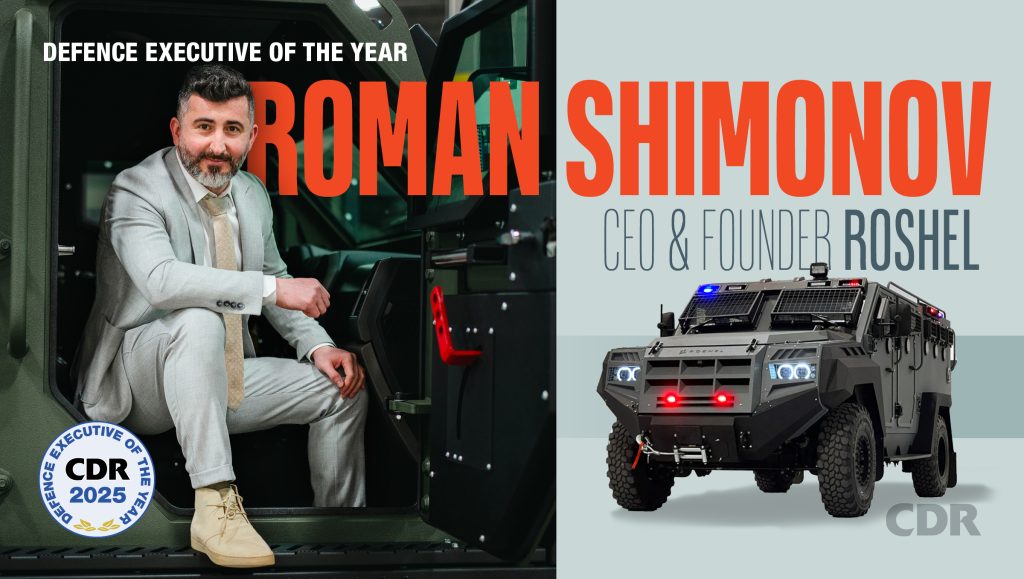
ROMAN SHIMONOV CEO & FOUNDER – ROSHEL – 2025 DEFENCE EXECUTIVE OF THE YEAR
You’d probably recognize the Senator armoured vehicle from reporting of the war in Ukraine, showing scenes from the frontlines. Afterall, over 1,500 of these vehicles have been donated to Ukraine and have become the preferred choice of the embattled Ukrainian military. What you may not know, is that these armoured vehicles are produced right here in Canada. For CDR’s annual DEOY feature, we asked Ottawa Bureau Chief, James Careless, to profile Roman Shimonov, Founder & CEO of Roshel Inc. – manufacturer of the ‘Smart Armoured Vehicle’. Within just 12 years, Roman has grown his company into one of the country’s largest armoured vehicle manufacturers, which speaks to the company’s compelling value proposition. Shimonov’s background serving in the Israeli Ground Forces, his company’s innovative spirit, and the pursuit of Canadian defence procurements such as LUV, were all discussed as part of our in-depth profile. Please join us in celebrating Canada’s Defence Executive of the Year for 2025!
The power of a clear, simple insight should never be underestimated. When it comes to Roman Shimonov, CEO and Founder of Roshel Inc., that insight was based on combining a commercially available Ford F-550 Super Duty truck chassis with a suite of modular armoured vehicle solutions.
The result was Roshel’s family of economically-priced Senator armoured vehicles built for use in a host of military and civilian security applications. Since being founded in 2012, Roshel has built thousands of these vehicles at its Brampton facility for customers around the world. The Senator line has proven so popular that Roshel recently opened its first U.S.-based production facility in Shelby Township, Michigan.
It is for these and many other reasons that Canadian Defence Review magazine has selected Roman Shimonov as CDR’s 2025 Defence Executive of the Year (DEOY). “It’s an incredible honour,” he said. “This award is a recognition of the hard work being done by the entire Roshel team, not just me.”
READ: COVER STORY – ROSHEL Smart Armored Vehicles
THE ORIGIN STORY
Prior to moving to Canada in 2012, Roman Shimonov had worked in the defence and security sector in Israel. His family immigrated there from the Soviet Union when Shimonov was 12 years old.
“I served in the Israeli Ground Forces and started my career over there,” said Shimonov. “I decided to move to Canada for many reasons. They included finding a place where I could create an advanced company with a focus on modern defence and security needs, while raising my kids in a country that I share values with. I had the option to move to almost any country. It was easy for me to choose Canada because it was the best place for me and my family to move to.”
By combining commercially-made truck chassis with custom-made armoured passenger modules, Roman Shimonov has found a way to produce armoured vehicles more affordably and quickly than his bespoke competitors can. This is precisely what he had in mind when he created the company.
“After many years in the defence and security sector, I noticed a gap between the technologies that exist out there in the world and how they were being implemented in the security and defence market,” Shimonov said. “This gap basically allowed me to identify areas of opportunity, first of all in the cash transit industry where many companies had basically replicated the same approach for almost a hundred years, and then in public security and defence. Roshel brought in a completely different approach leveraging modern military technology, and we changed the game.”

THE POWER OF THE SENATOR
As anyone who’s been inside one knows, the Senator armoured vehicle is a compelling mix of advanced military technology and commercial truck industry know-how. The fact that Roshel has sold thousands of these vehicles in slightly more than a decade speaks to how compelling their value proposition is.
“We’ve been pretty successful in finding a balance between a cost-effective vehicle and one that offers a protection level of STANAG Level 3 for blast and STANAG Level 2 for ballistics,” said Shimonov. “The way we were able to achieve that is by developing a new approach where on the one hand you have a commercial frame chassis, and on the other hand a monocoque V-shape hull capsule that is installed on its frame. And basically, we are not dependent on the chassis: It is only used to transport the capsule from Point A to Point B.”
In other words, although the Senator usually uses the Ford F-550 chassis, Roshel is not chained to it. “We’re able to switch the chassis to any other chassis that makes sense,” Shimonov said. “We’re also able to modify the capsule for different purposes. For example, we have vehicles for personal transportation, medical evacuation, different logistics requirements, support, cabling, and so on. None of these applications require deep modifications because the platform itself is fully versatile and modular. So, we are able — in a very short time — to address the immediate needs of end users by offering a family of different vehicles, including vehicles for medical missions, recreation, and special operations. That’s one of the reasons why so many agencies, including the Army, National Police, Border Patrol and different law enforcement organizations within NATO are using our platforms.”
VALUE FOR MONEY
This point bears repeating: Roshel’s Senator armoured vehicles are typically far less expensive than comparable vehicles made by bespoke manufacturers. “Our vehicles are thus the ultimate solution to have a cost-effective vehicle that can achieve the same objectives as a multimillion dollar vehicle that takes much longer to produce,” said Shimonov. This fact, plus Roshel’s success in producing thousands of vehicles in short order, are key reasons why the company’s CEO and Founder won the Defence Executive of the Year award.
“One of the major points and objectives in creating Roshel was to find the model and the people that will allow us to create a vehicle that will be different — and by different, I mean the price,” Shimonov told CDR. “Price is a crucial factor in defence purchases, and every procurement process is decided by the ratio between the cost of how much you are buying and what you’re getting for your money. I think Roshel’s success in balancing this ratio is why we have done so well as a company.”
FAST TURNAROUND
Military procurements are legendary for taking years to be delivered. But this isn’t the case with Roshel: “When we got an order from the Canadian government for 200 vehicles for Ukraine, we delivered and shipped all 200 vehicles in less than three months,” said Shimonov. “This is something that no one else did before us, and I doubt that there are many companies that have the same capabilities and capacities to fulfill this scale of volume in such a short time while still being able to meet all of NATO’s standards and compliance requirements. Well, we did.”
Roman Shimonov credits Roshel’s responsiveness to its highly integrated and centralized management system. “Yes, our company is big, but at the same time we have a very efficient and lean administration thanks to an ERP system [Enterprise Resource Planning is a software system that helps businesses manage their core processes] that we have developed in-house,” he said. “Our ERP system basically is the key to Roshel’s success and performance. It’s a sophisticated tool that allows us to accurately record and track the thousands of vehicles that we have deployed over the years. As well, every single part that we produce has a serial number, and we’re able to trace them all the way back to the very first vehicle that we ever produced. We’re able to drill down into the details of each part, we are able to recreate and produce the same part that will be identical, and we can commit to same day delivery of any part to our customers.”
Roshel’s capable ERP allows the company to meet its customers’ demand for minimal vehicle downtime. As well, their vehicles are backed up by comprehensive and complete documentation: “For example, each and every wire that we have in the vehicle is a part of the diagram,” said Shimonov. “Everything is labeled and numbered, and we have diagrams that every end user can access in their own language through a dedicated online portal. Using this portal, they’re able to create tickets and resolve most of their issues remotely. That’s a big advantage for end users that are in remote locations where logistics are a challenge.”
At the same time, Roshel has a very sophisticated procurement process that allows the company to be extremely efficient in sourcing parts. “We identify the ultimate source of each vendor that we deal with to verify quality and integrity, while ensuring that these materials and components come from legitimate and friendly sources,” Shimonov said. “Obviously, it is extremely important, when it comes to the types of products that we’re making, to be able to identify the origin of each component right back to its source. Doing this degree of due diligence
ensures that when we deliver a vehicle, we are delivering something that we can stand behind.”
A third factor in Roshel’s favour is the fact that it is a vertically integrated manufacturer. In plain language, “we control the production process from the very beginning, including R&D, through metal fabrication, mechanical and hydraulic works, assembly, and quality control — everything is done in-house,” said Shimonov. “As a result, we don’t rely on subcontractors. And so, while many companies struggle with supply logistics — as we saw during the pandemic — we don’t. In fact, we were able to double our revenues during the pandemic because we didn’t rely on anyone. Doing everything ourselves also allows Roshel to control our turnaround time on building new vehicles, and contributes to the company being so competitive, efficient, and lean.”

PURSUING THE LUV PROCUREMENT
The replacement of the Canadian Army’s Mercedes G-Wagon SMP and Chevrolet Silverado vehicles with new light utility vehicles (LUVs) is a procurement that Roshel is very, very interested in. Small wonder: The LUV procurement will encompass 2,000 or more vehicles in total and be worth anywhere from $700 million to $1 billion.
Roshel is one of four qualified bidders for the LUV procurement, along with AM General, Armatec, and Oshkosh Defense. “This project is an important one for Canada in many respects, both on a national level and especially now with shifting and challenging changes in global geopolitics,” said Shimonov. “We understand how crucial it is for our country to rely on its own defence capabilities. This is particularly true now, given rushing tensions with our southern neighbour. By choosing to produce the LUVs using the highest degree of Canadian content with minimal supplier issues — which is what Roshel has to offer — the federal government can fulfill this procurement in the most beneficial and efficient way possible for the Canadian Army, and the Canadian taxpayer.”
CONTRIBUTIONS TO UKRAINE
When it comes to the continuing defence of Ukraine against Russian aggression, Roshel has been making a difference on the battlefield for years. “We are one of the largest suppliers to Ukraine when it comes to armoured vehicles, Shimonov said. “We have deployed over 1,500 vehicles to date in Ukraine, out of which 208 were donated by Canada.”
Roshel has also been helping Ukrainians who have been displaced to Canada as a result of the Russian invasion. “We have hired hundreds of these Ukrainians at our factory,” said Shimonov. “In doing so, we have been allowed to help them do something meaningful, not just to get paychecks but also to build vehicles that save the lives of their fellow citizens and even family members. True story: One of our displaced Ukrainian employee’s mother was evacuated in a Roshel vehicle in that country, which he had helped to build back here in Canada. Meanwhile, we’re working on several projects that include localizing some of our products in Ukraine. And this process is in its final stages.”
On August 5, 2022, the Russian Ministry of Foreign Affairs included Roman Shimonov on a list of 62 Canadians denied entry to that country on the basis of ‘personal sanctions’. Roshel COO, Maria Tkacheva, and Senior Mechanical Engineer, Dmitry Gorin, were also banned.
Asked if he views this ban as a ‘badge of honour, Shimonov replied, “Definitely, yes. It’s definitely a badge of honor because it’s not just a recognition but also a sign that we’re doing something good.”
LOOKING TO THE FUTURE
Despite winning CDR’s 2025 DEOY award and Roshel’s continuing success in the armoured vehicle space, Roman Shimonov is keeping a keen eye on the future.
So, what does he see? “I think this year will be challenging not just for companies like ours but for all Canadians,” he replied. “The reason for it, in my opinion, is the limited and challenging approach that the Canadian government has taken to national defence in the past where the importance of protecting us was not taken seriously, especially when it comes to the allocation of federal budgets. Unfortunately, we Canadians accepted the notion that we don’t really need to protect ourselves, which we now understand to be wrong.”
This being the case, it’s not too late for the country and the decision makers to take a completely different approach to defence procurement that will include reevaluating everything. “And by everything, I mean everything,” said Shimonov. “For instance, it’s been very convenient to use a procurement process that takes years and years, so that by the time the procurement finally takes place, the product being procured is not relevant anymore. We don’t have this privilege anymore, so we need to have some kind of a plan, as a country, to give priority and support to local companies to enhance the defence capabilities of the country without relying on anyone else. I am proud to be a Canadian, but I have a lot of questions about government policy and the lack of seriousness in making procurement decisions when it comes to the allocations of funds and production of defence products. And I’m not talking about Roshel products — I’m talking in general about all defence products, that need to ensure that Canada can continue being a free, independent and sovereign country.”
This being said, Roman Shimonov is bullish about Roshel’s prospects for the year ahead, especially given its recent expansion into the United States; a move that should give the company some leverage with the Trump Administration.
“Roshel has a lot of plans, all of which are extremely challenging and I’m sure that we will continue positively surprising the industry with the decisions that we’re taking that are not obvious,” he said. “For instance, our expansion into the United States is not over, plus we are expanding into Europe. We are increasing our product lines and the verticals that we’re acting in. And we are waiting for numerous major contract awards that we are extremely optimistic about this year. As such, Roshel’s plan going forward is to continue investing in people. We’re always looking for great talents to share in and advance the success that we have achieved to date. But at the same time, we’re not waiting for miracles to happen. We understand that this current Age of Uncertainty is a challenging period of time, but at the same time, that uncertainty offers huge opportunities to companies that are into R&D and that create new and innovative technologies.”
James Careless is CDR’s Ottawa Bureau Chief

1 thought on “Roman Shimonov, Roshel – 2025 DEFENCE EXECUTIVE OF THE YEAR”
As a 77-year-old musician and teacher, this information about Roshel is not my standard reading material. However, having stumbled across the name of this company and some extremely interesting information about this company, I was struck by the fact that I had never heard or read anything about Shimonov or his company.
Considering recent world events, I wonder why, as it seems from what I have read in the past 20 or so minutes, that Roshel is making an essential contribution to the war in Ukraine. Why have I never heard any news or editorial coverage on the CBC of Roshel? It seems to me that Canadians need to know more. How are the contributions of Roshel factored into Canada’s financial investment in our defence and contributions to NATO and the UN. When the government of the USA (specifically President Trump) complains about Canada’s investment on armaments and personnel being inadequate, is the equipment manufactured by Roshel factored in? Or, does the company choose to quietly “fly under the radar” in order to avoid triggering negative responses from Trump and Company?
Anyway, as an elderly Canadian with only minimal knowledge of Canada’s military history other than what my family members and their friends related of their experiences, I find that I am now very curious about the rô le Canada plays internationally .
I find I am now frustrated by what I hear and read in the news and also the complacency of too many given what is happening. We should all be concerned and searching for as much information as possible for the information that should be considered knowledge essential for making our decisions at the polls when marking our ballots.
I hope to find more information about Roshel and this company’s rôle in Canada’s participation in defence of the free world.
Comments are closed.