


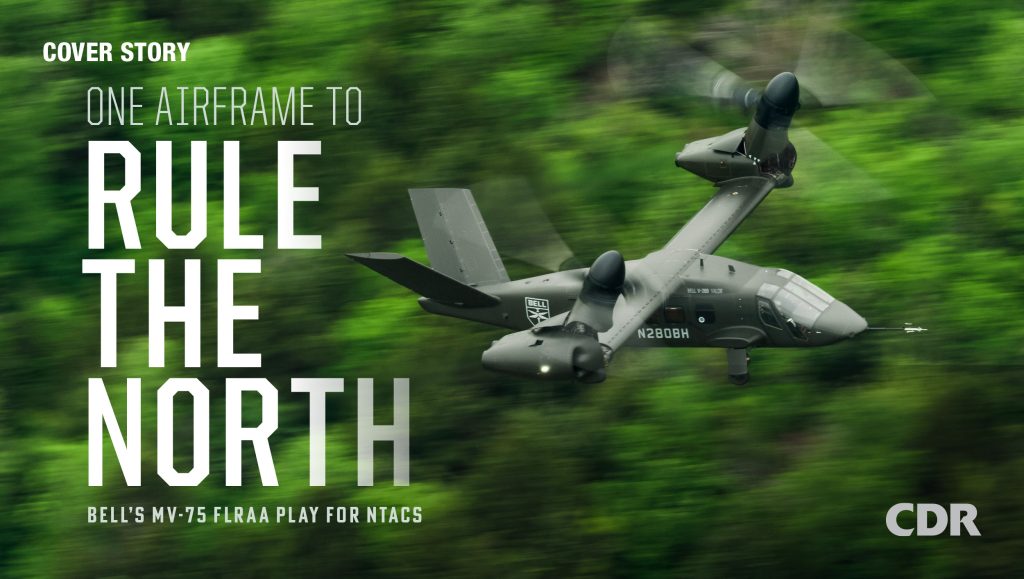
Bell’s MV-75 Play for nTACS: One Airframe to Rule the North
BY TIM MAHON
Look at how any armed force has evolved since the early 2000s and one modern truism stands out: helicopters have become a clear marker of a force’s sophistication, complexity, and breadth of capability. Once a relatively simple workhorse, the helicopter has diversified along several development lines. As with most platforms that prove their utility, operators have pushed for successive modifications and upgrades to adapt rotary-wing fleets to a widening set of tasks: transport, battlefield logistics, reconnaissance, electronic warfare, assault, anti-armour, and casualty evacuation, among others. The result, in many services, has been procurement approaches that field multiple specialized types in parallel—delivering tailored capabilities, but also creating avoidable burdens in maintenance, training, and long-term sustainability.
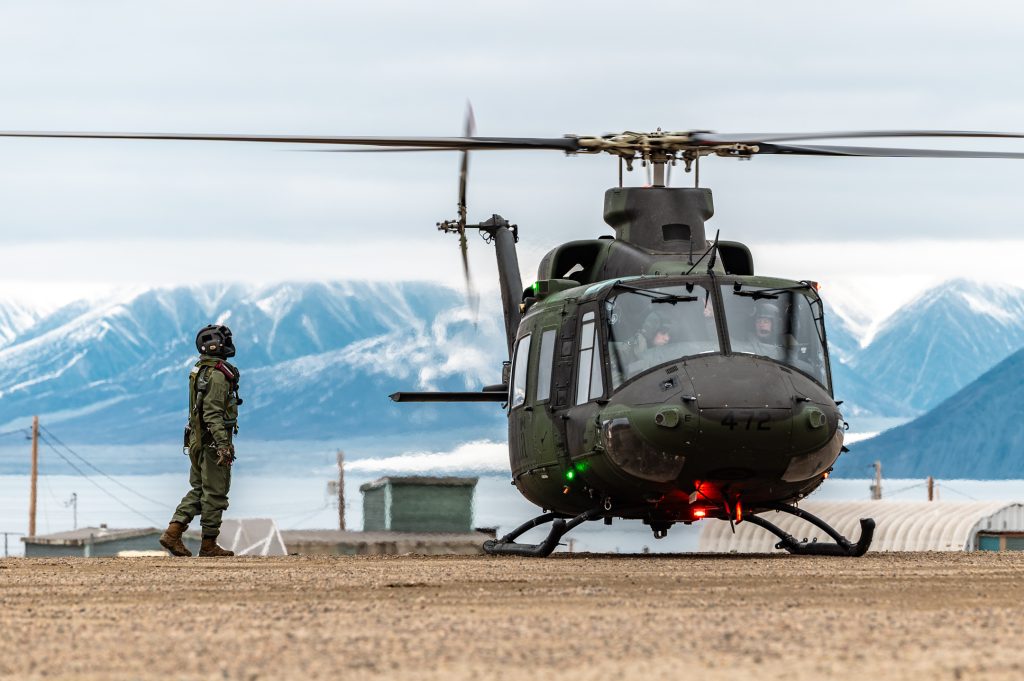
Canada’s defence policy update, Our North, Strong and Free, places the Arctic at the centre of future defence planning. Operating there imposes a uniquely demanding environment for helicopters—an issue discussed later in this article—and, alongside DND’s $18.4 billion commitment to recapitalizing tactical aviation, has driven the creation of the nTACS (next Tactical Aviation Capability Set) program to replace the CH-146 Griffon fleet in the next 15 years. While the formal requirement is slated for release next year and remains only partially defined, industry observers anticipate a detailed and technically complex requirement.
That is understandable when viewed through the lens of Canada’s recent major defence procurement programs, some of which have been more successful than others. Taking care to dot every ‘i’ and cross every ‘t’ is an entirely appropriate thing to do when seeking to get the greatest possible bang from the taxpayer loonie. With this in mind, potential contenders have already started lining up what they see as compelling use cases for their bids, addressing the perceived challenges and detailed requirements even before they have been made public. In some instances, this may be seen as being premature but, given the likely pace of the program as it unfolds, resolving challenges before they are voiced may be the most intelligent thing to do.
ONE PLATFORM, MULTIPLE MISSIONS
If Bell’s pitch could be summed up in a single phrase (that accounts for the complexity and interrelatedness of the solution space) it might well be “One platform, multiple missions.” Marc Bigaouette, Director of Canadian Government Programs for Bell, based in Mirabel, Quebec, certainly sees this aspect of the aircraft as one of the leading key differentiators. “This platform offers multiple options and speaks to the three leading requirements for nTACS—tactical mobility, firepower and the ability to integrate uncrewed assets in the longer term,” he told CDR.
As far as tactical air mobility is concerned, the MV-75 tiltrotor platform that will be fielded under the Future Long Range Assault Aircraft (FLRAA) program displays key advantages in reach. “Without going into specific numbers, the aircraft offers speed and range at least twice that of its closest competitors – at a minimum!” he emphasized. That brings with it significant operational advantage in any environment, but particularly in Arctic conditions, in which combined issues of visibility, temperature and remoteness mean that helicopters can only operate effectively in the brief summer months. Put another way, that means “traditional rotary-wing platforms operating in the high North face limitations, some of them substantial, for eight months a year.” At a time when Canada’s Department of National Defence (DND) —like other defence ministries—is under pressure to extract maximum value from recapitalization spending, this amounts to an effective “one-for-three” return: funding year-round availability, but realizing only a fraction of that as usable operational output. Bell contends that a tiltrotor option such as the MV-75 FLRAA breaks with this legacy constraint, delivering a step change in tactical reach and operational flexibility year round.
To put those numbers in perspective, and without suggesting these are maximum figures by any means, the MV-75 FLRAA will offer operators twice the reach of conventional rotary-wing platforms, including Canada’s existing CH-146 Griffons. “That means in many instances the MV-75 FLRAA is self-deployable,” says Bigaouette, who has a 37-year career in the Canadian Armed Forces behind him, much of it as a tactical aviation pilot.
As a further illustration of just how empowering those numbers could be for Canada, consider the fact that the nation has the second largest land mass of any single country on Earth and adds to that the salient (and often forgotten) fact that there is a massive drop-off in the presence of modern infrastructure (including runways and even roads) beyond a distance of 200 miles from the U.S.-Canadian border. The MV-75 FLRAA aircraft stationed at just three strategically selected locations could reach any point in that land mass in less than a day – a sea change in capability compared with current strategic mobility limitations. With the MV-75 FLRAA, this also means that the Royal Canadian Air Force (RCAF) and the Canadian Army could hold a high readiness posture from garrison, thereby offering enhanced flexibility in force employment and a reduction in the level of effort required for responding to occurrences in the high North.
As indicated above, the Canadian government sees that assertion of Arctic sovereignty as its most pressing defence challenge. A tiltrotor solution, capable of operating without runways or associated infrastructure from austere locations, offers a hitherto unachieved capability to address that challenge – for almost 365 days a year, barring the most extreme weather conditions. There is, however, another element of the challenge to consider.
The Arctic has become far more of a geopolitical football over the past several years, as both traditional Arctic stakeholders and more opportunistic external actors press competing claims intended to legitimize future access to, and exploitation of, the considerable natural resources that lie within—and beneath—the region. Russia, the most obvious potential adversary in this context, has established a substantial ground presence in the High North, including two entire formations—the 80th and 200th Separate Motorised Rifle Brigades—relatively elite units within the Russian Ground Forces that are purpose-built for operations in extreme cold-weather and austere northern terrain. Trained specifically to overcome the distinctive challenges of Arctic warfare and equipped with a range of specialized vehicles derived from the DT-30 articulated tracked platform, these brigades field a mix of combat and support capabilities, including Pantsir and Tor air-defence batteries and, according to persistent reporting, Uragan multiple rocket launcher systems. Should conflict ever break out in the High North, such units would represent a serious, well-prepared obstacle that Canadian and allied forces would have to confront early in any campaign. Against that backdrop, a powerful, capable, and agile airborne platform—one able to support Canadian forces across Intelligence, Surveillance and Reconnaissance (ISR), assault, lift, and transport missions in demanding Arctic conditions—would offer a material advantage in deterring—or prevailing in—a confrontation. Although some observers suggest that both of those Russian Arctic brigades have been significantly “chewed up” by deployments to Ukraine, Russian resilience, institutional tolerance for loss, and its demonstrated ability to regenerate combat power when pushed, should never be underestimated.
READ: Maawandoon Inc. Awarded Contract by Bell Textron Canada to Support CH-146 Griffon ISS Program
U.S. ARMY’S MV-75 FLRAA PROGRAM
The MV-75 FLRAA is being developed in three separate variants initially, to cater for the breadth of mission sets that aircraft will be called upon to perform: assault, special operations and medical evacuation. As far as the assault variant is concerned, Ukraine has proven, to even the most casual observer, that increasing proficiency and accuracy in directing long-range fires – and the almost exponential increase in lethal effect of the emerging generation of munitions – means that assault aviation assets can no longer depend on the luxury of being stationed and maintained close to the ground forces they are destined to support. Which is precisely why, for example, the U.S. Army is making a significant investment in replacing its UH-60 Blackhawk fleet with the Future Long Range Assault Aircraft (FLRAA), based on the V-280 Valor tiltrotor. According to Marc Bigaouette, a recent U.S. Army study showed that a FLRAA unit would enable complex air assault missions in one third of the time necessary for conventional helicopters and with half the logistics support and mission security. It is not an insignificant fact that several nations have indicated an interest in collaborating in one form or another in the FLRAA program.
READ: nTACS REPORT – Rotor Reset
The MV-75 FLRAA’s speed and range make a strong case for its suitability in fulfilling key nTACS aircraft requirements. But agility, flexibility and stealth are also key elements for some mission sets – notably those of special operations forces. Here the MV-75 FLRAA also excels: design, modern avionics and long experience in supporting covert missions mean that Bell can speak to just about any foreseeable requirement that might emanate from specialized units – not just in the Arctic but in the other spheres of operations in which they might operate – such as Europe and the Pacific, where the aircraft could self-deploy with zero or minimal support. This represents a considerable advantage that would allow the RCAF to focus its limited strategic airlift resources on the rapid movement of combat capacity.
With such a vast area of ocean and inhospitable tundra terrain to cover, search and rescue missions – not to mention medical or casualty evacuation – are currently conducted by a mix of fixed- and rotary-wing aircraft in Canada. The MV-75 FLRAA would take such missions in its stride, the company contends, but more importantly, perhaps, would enable a very high degree of fleet rationalization, leading to gains in efficiency, operational availability and logistics and control of maintenance costs, as well as savings in acquisition and support-related expenditure. Further to this, the confidence factor that would be derived from the provision of an organic SAR response capable of covering fighter operations in the high North should not be underestimated. In this context, the aircraft would perform a key function in the delivery of an important ethical consideration of the Canadian armed forces: “to leave no one behind,” Bigaouette stated.

INTERCHANGEABILITY & INTEROPERABILITY
He also points out that the potential operational advantages are not limited to the physical capabilities of the platform itself. Interoperability with allies is a key characteristic of today’s and tomorrow’s operations and in this respect the MV-75 FLRAA platform also offers some key advantages. In the context of a near peer confrontation, “It is unlikely that the Canadian Armed Forces would act independently from its allies in the future: Canada is politically independent but from a military perspective seeks to be collaborative – striving for interchangeability with its closest ally, the United States, but also practicing interoperability with other key allies. That raises the sense of unity to a much higher level,” he observed. “We believe the MV-75 FLRAA is potentially the only platform able to address all aspects of the likely requirement.”
Procuring and deploying the same platform as the U.S. Army would provide a number of key synergies and advantages: • Enhanced interoperability in joint, combined or coalition operations; • Common training and logistics infrastructure; • Economies of scale in maintenance and support; • Access to a large, well-established supply chain.
OPERATIONAL & INDUSTRIAL BENEFITS
All Bell’s commercial helicopters are currently built in Mirabel, exporting over $1.1 billion in aircraft and parts annually, employing 1,600 people and managing a comprehensive supply chain of over 550 organizations. The company is heavily engaged in supporting the current fleet, with two closely associated and complementary programs: the Griffon Limited Life Extension (GLLE) project, which will extend the service life of 85 CH-146s to at least 2035, and the CH-146 Integrated Service Support (ISS) contract. Sustaining the CH-146 fleet has been possible due to the close cooperation of Bell, the Canadian government and over 40 Canadian suppliers, which in turn has enabled modernization and sustainment of a critical fleet with minimal disruption to operations.
That capability – and the very clear ‘can do’ attitude that accompanies it – will undoubtedly translate into an integrated supply and support ecosystem for the MV-75 FLRAA fleet, should the type be selected. Part of the decision as to whether it will be selected lies in perceptions – specifically, dispelling the myth of the aircraft being infinitely more complex than more traditional vertical lift aircraft. “Yes, it’s a complex machine – but not really massively more so than any other modern aircraft, to be honest,” asserts Frank Lazzara, Bell’s Director, FLRAA Sales, out of Fort Worth, TX. “The secret lies in the digital design and the fact that when we started this program we had over 500,000 flight hours experience with the V-22 – we’re now at 800,000 – and we leveraged every ounce of that experience into this aircraft, making it a reliable platform embodying proven technology. The difference it brings to aircrew is phenomenal. You learn very quickly how to use brand new capabilities – things you could never do in a helicopter. The change is enormous – it’s a change in operational chemistry.”
MAINTENENACE
That change is also reflected in a hugely simplified (and therefore faster and more cost-effective) maintenance regime, despite the levels of complexity in individual systems. “That is mostly down to the digital design, the impact of which is just enormous,” adds John Blank, Senior Government Relations Manager. “We have moved away from what I call ‘maintenance by discovery’ under which you learn how to maintain the aircraft as maintenance issues raise themselves, establish institutional knowledge and hand that off to your replacement. We are now in a true digitally-enabled maintenance mode, focusing on ensuring platform availability rather than following schedules by rote. There are huge advantages to digital design in every stage of a design, from concept studies to operations. We have changed how to do maintenance and that makes a big difference – to Bell and to [the operators].” He also points out that digital design, coupled with a Modular Open Systems Approach (MOSA) to the project also has beneficial effects on life cycle costs. “We don’t change things like aerostructures, gearbox design or propulsion systems every couple of years but the gear at the front of the aircraft – the mission systems – that changes far more frequently. Being an open systems design means much simpler – and faster – changes in mission systems, avionics etc. All of that saves time, resources and money,” he told CDR.
Lazzara adds a thoughtful postscript. “What we are looking at now with this program is accelerating the end game compared with what we understood at the outset. We are now looking at moving the date by which a brigade-level aviation component can be operationally deployed, shifting it 30 months to the left. That’s huge. But we can do it because of the 800,000 flight hours, because of the digital design, because of the reliability of the technology. We can feed experience-based changes, engineering changes and operational observations back into the [design] model with a very high degree of confidence”.
EMBRACING THE ‘NEW’
Is it all a bed of roses, then? Is there anything that stands in the way of a successful Bell MV-75 FLRAA bid? There’s an old adage about counting chickens and hatching, so nobody believes it is a done deal or that it will necessarily be plain sailing. Asked what the principal challenges he foresees might be, Lazzara points to the most unpredictable element of the aircraft – Humans. “The operational challenge is to change the mindset. The aircraft changes the operational envelope and a pilot has to think about forward motion rather than vertical from the moment of liftoff. He or she has to think a little faster, to trade off capability against challenge and to accept a change in the operational chemistry. There is a ton of our DNA in the lessons learned, which have been translated into the design. It’s a proven technology, a reliable aircraft and a platform like no other around in the military aviation community today. The change is simply enormous. And that is reflected in the operational advantage it brings to the game.”
New technology can often present a barrier to acquisition. But the first flight of the Bell Boeing V-22 took place in March 1989 – nearly 40 years ago. The experience of pilots and maintainers alike, the clear operational advantages the technology brings – all resonate with the operational community. Disruptive? Maybe. Radical? Perhaps. But in an environment in which tactical advantage is dictated by the capability to act at the speed of relevance – in a world in which the U.S. Army has committed to a tiltrotor solution for several of its critical missions – in a world in which Canada desperately requires an aircraft that is multi-mission capable, effective, affordable and, importantly, interoperable with allies near and far – the MV-75 FLRAA is perhaps a solution whose time has come.
Tim Mahon is CDR’s European Bureau Chief

3 thoughts on “Bell’s MV-75 Play for nTACS”
This is not going to be manufactured or even assembled in Quebec, so why on earth would we even countenance another major capability sourced from the US? We cannot get away from Chinooks, there is simply no alternative, which sucks but it is what it is. However, how about some fleet commonality? AW101 of the Merlin HC mk4 type, demonstrated with IFR boom for deployability across Canadas vast distances, and commonality with the Cormorant fleet. Very suitable to support Secial Ops at the high end, while at the smaller end of the spectrum H145M is used by allies for Spec ops, armed scout and anti-armour roles. There is even a folding rotor version if we feel the need for it to go to sea. But MV75, despite its range and speed, no thank you.
In reply to Jed. What it really comes down to what Canada needs. If it wants to carry more troops or lift more, then the AW101 fits the bill. If it wants a much smaller helo, the H145M offers a lot. If the desire is for speed, range and maneuverability, the MV-75 wins. Note that all MV-75s have built in provision to mount retractable refueling probe, and SpecOps birds will carry one all the time. Initial version of MV-75 will not have blade/wing fold because US Army doesn’t need it and so wouldn’t be willing to pay for it, but Bell has shown multiple times how it wold be done in a customer requested it.
See this right here:
“ Canada is politically independent but from a military perspective seeks to be collaborative – striving for interchangeability with its closest ally, the United States…”
“Interchangeability”? This is exactly Bell ain’t winning this contract. They can’t read the room.
Comments are closed.