

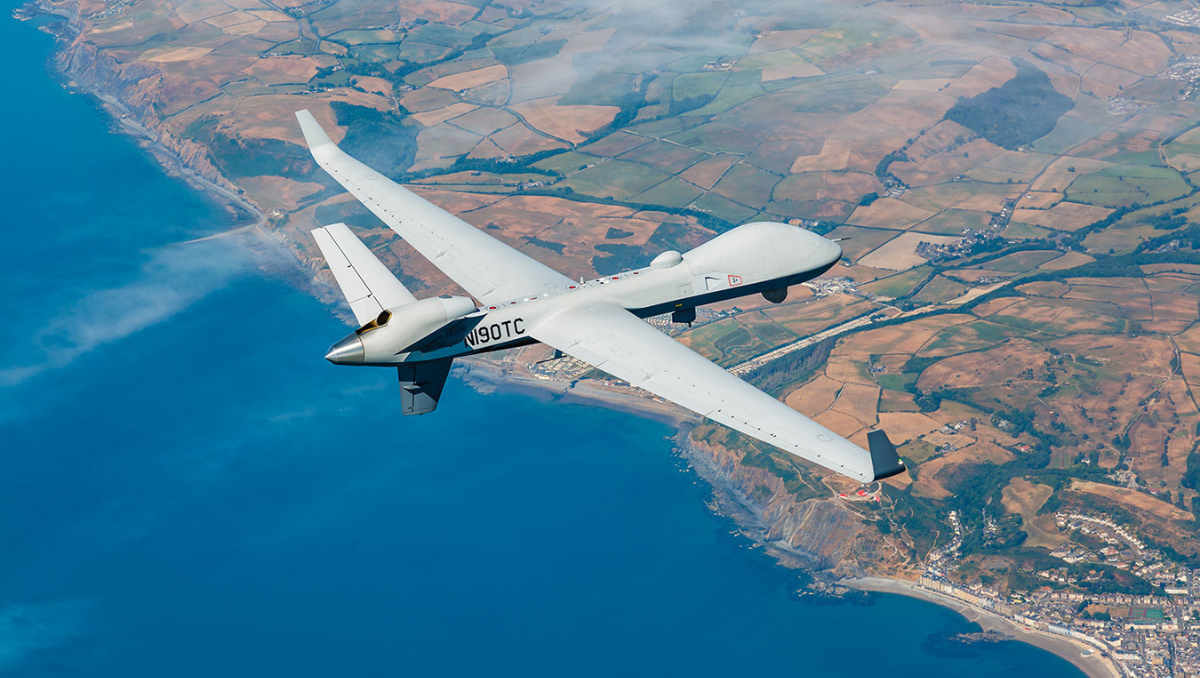
The term ‘RPAS’ stands for ‘Remotely Piloted Aerial Systems’. When it comes to understanding the Department of National Defence’s (DND) unmanned systems demands and desires, RPAS is the word to know.
For the RCAF, the term RPAS refers to a specific procurement project now underway. According to DND spokesperson Andrée-Anne Poulin in an email response to CDR’s questions, “The RPAS will provide the Canadian Armed Forces (CAF) with a large (the size of a fighter aircraft) and sophisticated remotely piloted aircraft that, unlike popular small drones, will be designed and certified to the rigid airworthiness standards applicable to crewed aircraft. This capability will provide the CAF with the ability to conduct long endurance surveillance missions over long distances, using a variety of sensors. This will help support airborne intelligence, surveillance, and reconnaissance, with near-real time information to inform senior leadership.”
Within Canada proper, the RCAF’s RPAS resource will be used to monitor Canada’s large territory and three-ocean coastline. It will also support security oversight at international events like the G8 summit and CAF operations that support civil authority, such as responses to forest fires and floods.
“In deployed operations, an RPAS will provide commanders an overview of operational situations with near real-time information.” Poulin said. “The system will be capable of detecting, recognizing, identifying, and tracking targets of interest in complex environments. On top of enhancing these capabilities, the system will reduce the risk to personnel involved in combat operations on the ground, as well as aircrew. There is no risk to aircrew life if a remotely piloted aircraft is lost or damaged because of an incident or enemy attack.”
As for the price tag? “The current project cost is expected to be between $1 billion and $4.99 billion,” said Poulin. “A more precise cost will be available once a contract is awarded.”
Initially there were two qualified bidders contending for the RPAS contract. One of these was Team SkyGuardian Canada (now composed of General Atomics Aeronautical Systems Inc./GS-ASI, CAE, L3Harris, and MDA). The other was Team Artemis (Airbus Defence and Space Canada, ATCO Frontec, Canadian UAVs, Israel Aerospace Industries, L3Harris, and Lockheed Martin CDL Systems). However, Team Artemis subsequently withdrew from the RPAS procurement, leaving Team SkyGuardian Canada as the only qualified bidder.
READ: GA-ASI and CAE Sign Long-Term Agreement MQ-9B SkyGuardian Mission Trainer
Team SkyGuardian’s UAV of choice for the RPAS procurement is the General Atomics’ MQ-9B SkyGuardian. Derived from the highly successful MQ-9 ‘Reaper’ UAV, the MQ-9B SkyGuardian “is the most mature and advanced multi-mission unmanned system in the world,” said Michel Lalumiere, GA-ASI’s International Strategic Development Director for Canada. “SkyGuardian can fly virtually any mission for far longer and farther than most manned platforms. It conducts surveillance and reconnaissance for military commanders for a wide range of applications, such as monitoring ocean sovereignty; providing assistance to other government departments’ operations, which includes fighting wildfires, surveying wildlife, and supporting search-and-rescue, as well as performing numerous military missions.”
READ: CAE Awarded Contract to Support MQ-9B SkyGuardian® Remotely Piloted Aircraft Systems
“GA-ASI has delivered more than 1,000 aircraft in its 30-plus year history,” Lalumiere added. “Its family of RPAS includes the Predator B/MQ-9A Reaper, Gray Eagle and Gray Eagle 25M, Predator C Avenger, and the new MQ-9B SkyGuardian and SeaGuardian.”
Canada isn’t the only target market for the MQ-9B SkyGuardian. GA-ASI is also providing a variant known as the Protector RG Mk1 to the United Kingdom’s Royal Air Force. “The first three Protectors are currently undergoing Integrated Test, Evaluation, and Acceptance trials,” said Lalumiere. “In addition, MQ-9Bs are being operated by the Japan Coast Guard (JCG) and Japan Maritime Self-Defence Force (JMSDF), as well as supporting various U.S. Navy exercises.”
The companies who belong to Team SkyGuardian aren’t the only ones hoping to take part in the RPAS and other DND unmanned systems procurements. “We are keenly interested in all Canadian government unmanned acquisitions, such as RCN ISTAR and the RCAF RPAS programs,” said Andrew Carryer, Director of Airborne Mission Systems — RPAS with General Dynamics Mission Systems — Canada (GDMS-C), which provides systems and subsystems for unmanned subsurface, surface, ground, and airborne systems. “Our recently opened RPAS Centre for Excellence in Sherbrooke is supporting the development and maturation of the LX300 [drone]. This Canadian-built, multi-mission and multi-role unmanned helicopter can perform missions over land and sea and is a testament to our capabilities. Our UYS-506 distributed sonobuoy processor is a key enabling technology for the MQ-9B Sea Guardian aircraft, which is currently in use in unmanned maritime patrol missions around the world. We also support the Communications Ground Station for NATO’s RQ-4D [drone].”
