


Why Joining Golden Dome is a Strategic Imperative
The GOLDEN Era of Continental Defence
BY RICHARD NGHIEM
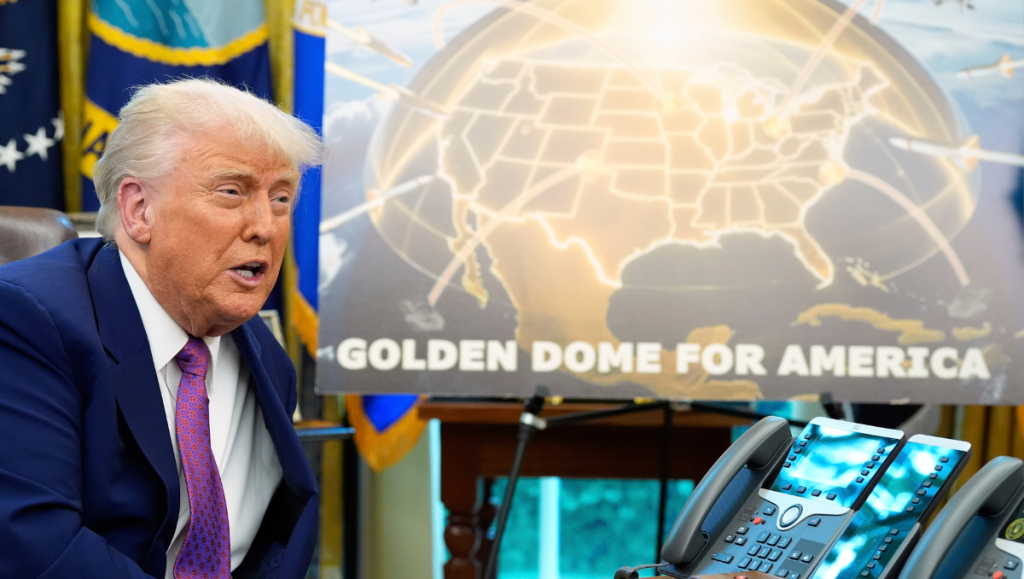
When U.S. President Donald Trump stood beside Canadian Prime Minister Mark Carney in the Oval Office in May 2025 to announce the Golden Dome initiative, the event marked far more than just another bilateral defence unveiling. It symbolized a defining moment for Canada — a test of whether the country is finally prepared to assume full responsibility for protecting its own skies, or whether it will continue to rely on American systems and American decision making for the defence of its territory. Golden Dome, described by U.S. officials as “the most significant defence system in modern military history,” envisions a sweeping continental missile shield spanning the entire United States, Alaska, Hawaii, and portions of Canadian territory. With an initial three-year budget of US$175 billion, it proposes a network of space-based sensors, ground interceptors, advanced directed-energy weapons, and next-generation command-and-control systems, all fused into a single North American missile-defence architecture capable of detecting, tracking, and destroying ballistic, cruise, and hypersonic threats before they strike.
While from America’s strategic perspective, the Golden Dome is an ambitious technological leap, for Canada, it is a moment of reckoning. The program revived a national debate that has lingered unresolved for two decades: whether Canada will continue its longstanding pattern of observing American missile-defence efforts from the sidelines or finally step forward as a full participant in the defence of the continent. The last time Ottawa confronted this question was in 2005, when it declined to join the U.S. Ground-Based Midcourse Defense (GMD) system. At the time, concerns about sovereignty, cost, and arms-control diplomacy prevailed. But twenty years later, the threat environment Canada faces has transformed beyond recognition, and the assumptions that shaped earlier decisions have evaporated.

A NEW THREAT ENVIRONMENT
FOR A NEW ERA
If the post-Cold War era lulled Canada into believing that distance and oceans would shield it from great-power conflict, the 21st century has shattered that illusion. Today’s strategic environment is defined by a class of weapons that compress space, time, and geography in unprecedented ways. Russia and China now deploy operational hypersonic glide vehicles capable of maneuvering unpredictably at speeds exceeding Mach 10, outrunning and outmaneuvering traditional radars. North Korea’s Hwasong-18 intercontinental ballistic missiles can already reach North America. Iran continues developing medium-range ballistic missiles while proliferating missile technology to proxies. And new weapons—drone swarms, loitering munitions, dual-use satellites, and space-based launch platforms—blur the boundary between conventional and strategic warfare.
Additionally, the Arctic, once a natural defensive buffer for Canada, is now a contested frontier as melting ice has opened navigable waters, drawing in Russian naval assets and Chinese research vessels outfitted with military-grade sensors. Russian strategic bombers and submarines consequently regularly probe Canada’s northern approaches, testing NORAD’s response times and exploiting gaps in its sensor network while Chinese surveillance balloons, drifting over North American airspace, have exposed glaring deficiencies in high-altitude domain awareness. The protective geography Canada has long relied on, in other words, has effectively disappeared.
The real question is whether Canada wants to help shape that defence—or remain a passive bystander as the United States constructs the shield that will determine the fate of the continent. Overall, Golden Dome offers an opportunity—arguably Canada’s last, for an entire generation—to help design the future architecture of North American defence rather than simply live beneath it.
CANADA’S STRATEGIC CONTEXT
That said, before considering the benefits of joining Golden Dome, Canada must confront a difficult truth: despite a dramatically evolving threat landscape, the Nation’s homeland-defence posture remains dangerously out of date. For decades, Canadian defence policy has rested on the assumption that warning alone is sufficient, that the country’s strategic assets need not be defended directly because any attack would be directed at the United States, and that the U.S. would handle active interception. This posture has created a stark asymmetry: Canada is deeply integrated into detection systems yet almost entirely absent from interception capability. It observes, but does not act. It participates symbolically, but not operationally.
The backbone of Canada’s northern surveillance architecture is still the North Warning System (NWS), a chain of radar sites in the Arctic designed in the 1980s to detect incoming Soviet bombers. But these radars were never built to identify low-flying cruise missiles, maneuvering hypersonic glide vehicles, or stealth platforms. Even Canada’s emerging Over-the-Horizon Radar (OTHR) system, while a critical step forward, is only an early-warning capability. It can detect a threat but cannot intercept it. Without missile interceptors, Canada possesses the equivalent of a sophisticated alarm system with no capacity to stop an intruder.
Institutionally, the situation is even more troubling. Through NORAD, Canada shares responsibility for aerospace warning and aerospace control, but it has no authority over active missile interception. When hostile missiles are detected, engagement authority rests exclusively with U.S. Northern Command (USNORTHCOM). Canadians assigned to NORAD command centres can observe the decision-making process, but they cannot influence it. As a former official once described, “When the launch button is pressed, Canadians leave the room.” The remark, though often repeated, captures the sovereignty dilemma at the heart of Canada’s defence posture: the country is a partner in principle, but a spectator in practice. This paradox undermines sovereignty rather than protecting it. By declining to participate in earlier U.S. missile-defence efforts, Canada preserved the symbol of autonomy but sacrificed influence. Today, that decision has left Canada technologically exposed, strategically dependent, and politically marginalized.

STRATEGIC VULNERABILITIES
Canada’s vulnerabilities span multiple dimensions—geographic, military, institutional, and economic. First and most fundamentally, the nation’s geography ensures that any ballistic or hypersonic attack on the United States would likely transit Canadian airspace. Canada is not a peripheral actor in North American defence; it is literally on the flight path of any attack. Even if the Nation sought to remain neutral in a great-power conflict, its radar sites, airbases, ports, and communication systems would be targeted to degrade NORAD’s situational awareness and reduce the United States’ response capacity.
Militarily, the gaps are even more severe. Canada currently has no operational Ground-Based Air Defence (GBAD) capability at all as the Canadian Army retired its last air-defence regiment in 2012 under the assumption of uncontested Western air superiority. The Royal Canadian Air Force can police the Nation’s skies, but it cannot intercept ballistic or advanced cruise missiles while the Royal Canadian Navy’s Halifax-class frigates carry short-range point-defence armaments but lack Aegis-level missile-interception systems. Canada’s national air-defence posture is thus a patchwork of partial capabilities with no integrated shield.
Institutionally, Canada depends on American priorities and infrastructure. Missile-defence algorithms are calibrated to protect U.S. cities and strategic assets first, resulting in Canadian cities such as Vancouver, Calgary, Toronto, Montreal, and Halifax being non-prioritized targets for U.S. interceptors. If a single missile threatened both a U.S. and a Canadian city, American systems would default to defending American territory. Canada’s citizens, in other words, are protected only incidentally, not intentionally.
Lastly, from an economic perspective, a successful missile strike on critical energy, transportation, or industrial infrastructure — even a single one — could cripple Canada’s economy, disrupt continental supply chains, paralyze exports, and damage public confidence in the government. And politically, the Nation would be drawn into the conflict regardless of its stated neutrality; its geography eliminates the possibility of remaining uninvolved. In short, Canada’s vulnerabilities reflect a dangerous blend of strategic complacency, technological obsolescence, and institutional dependence. Warning without defence is not security. It is a hope—one that grows riskier every year.
WHY CANADA MUST ACT NOW
As a result, Canada can no longer afford to confuse observation with protection. The world has entered an era in which warning without the ability to respond is meaningless. Each passing year that Canada delays building its own missile and air-defence architecture further entrenches dependence on systems that were never designed to prioritize Canadian lives or territory.
The Golden Dome initiative represents a rare moment in history when technological opportunity, political will, and continental necessity converge. Its architecture—space-based sensors, ground interceptors, and directed-energy systems—offers North America the first genuine chance in decades to re-establish strategic depth. For Canada, this is not merely a policy option; it is a strategic imperative. Refusing to participate would not keep the country neutral—it would leave it undefended.
Acting now serves three interlocking purposes. First, it would close the most glaring capability gap in Canadian defence: the absence of any deployable Ground-Based Air Defence (GBAD) system or missile-defence interceptors. While radar modernization is underway, detection alone cannot stop a missile from reaching its target. By taking part in the Golden Dome, Canada could, for the first time, protect its cities, bases, and northern infrastructure by actively destroying them.
Participation in this new military initiative would also restore sovereignty through shared command rather than eroded autonomy through abstention. Canada’s involvement must be formalized through a dual-key command structure within NORAD or a parallel binational arrangement, ensuring that any interceptor launched from Canadian soil requires Canadian authorization. Such a model preserves operational sovereignty while granting Canada full participation in the continental decision-making process. It also guarantees that Canadian cities are explicitly programmed as defended assets within continental algorithms—a critical shift from today’s reactive posture.
Lastly, joining the Golden Dome would undoubtedly reinforce deterrence and stability. A robust missile-defence network does not provoke aggression—it deters it. When adversaries know their missiles may be intercepted, their calculus for coercion or escalation becomes far more complex. For Canada, this not only strengthens homeland security but also underwrites its diplomatic credibility abroad. A nation that cannot defend itself cannot credibly advocate for peacekeeping or global stability. The argument for urgency is not speculative—it is practical. Modern warfare has shown that the speed of attack now outpaces political decision cycles. In Ukraine, Israel, and the Red Sea, the difference between readiness and reaction was measured in seconds. In North America, where intercept authority and command integration cross national lines, delay is not just dangerous—it could be fatal.
GOLDEN DOME: A CONTINENTAL SHIELD
Understanding the Golden Dome initiative requires viewing it not as an isolated American missile-defence project but as the foundation for a fully integrated continental security architecture that reshapes how North America manages modern threats. Where legacy systems were compartmentalized—treating space surveillance, atmospheric interception, and ground-based defence as distinct efforts—Golden Dome merges them into a seamless defensive continuum spanning from orbital space to ground-level drone defence. The project ultimately aims to restore the strategic depth that technological advances have eroded, pushing North America’s defensive perimeter outward to detect, track, and, if necessary, defeat incoming threats before they reach the continent’s airspace.
At its heart, Golden Dome envisions an integrated network of sensors, interceptors, and command-and-control systems capable of countering ballistic missiles, hypersonic glide vehicles, cruise missiles, and unmanned aerial systems across every phase of flight. Space-based tracking satellites would provide persistent surveillance and early interception opportunities, supported by exo-atmospheric kill vehicles designed to engage missiles during their midcourse phase. Below this cosmic layer, systems such as Aegis Ashore and naval platforms equipped with SM-3 and SM-6 interceptors would create a formidable midcourse and high-altitude interception shield, extending protective coverage across the Arctic and Pacific approaches. Their capacity to engage threats thousands of kilometres from North American territory effectively buys the continent precious minutes in which to react.
Further down the defensive ladder, THAAD batteries would provide a critical terminal-phase shield, engaging missiles as they descend toward targets. Their ability to intercept threats both inside and just above the atmosphere ensures a necessary layer of redundancy, creating overlapping zones of protection that reduce the risk of a single point of failure. At the regional and urban scale, proven systems such as Patriot PAC-3 MSE, NASAMS, and IRIS-T SLM would take on the responsibility of defending population centres, industrial regions, ports, and key military bases. Together, these systems form the dense and resilient fabric of a continental-scale defensive architecture.
That said, the Golden Dome’s innovativeness extends beyond kinetic interceptors. The program integrates directed-energy systems, such as the Epirus Leonidas high-power microwave weapon, to counter drone swarms and low-altitude threats that traditional missile systems cannot tackle cost-effectively. Leonidas provides an essential final layer of defence by disabling entire groups of unmanned aircraft at a fraction of the cost of missile-based intercepts. This technology not only fills a gap that adversaries increasingly exploit but also ensures that higher-end interceptors are preserved for more advanced threats.
Binding all of these layers together is a modernized C4ISR network—the digital nervous system of the Golden Dome. This system fuses sensor data from satellites, radars, naval vessels, airborne platforms, and ground installations into a unified battlespace picture. Artificial intelligence and advanced data-processing tools allow for rapid assessment of incoming threats and provide commanders with real-time options for interception. In many ways, this digital backbone is the true innovation of the Golden Dome: it restores the early-warning and decision-making advantage once provided by geographic distance, but now through speed, automation, and integration. In an era where seconds matter, the Golden Dome’s C4ISR architecture enables continental defence to function at the pace of modern warfare.
RESTORING STRATEGIC DEPTH
More importantly, though, participation in the Golden Dome, as stated above, offers Canada an unprecedented opportunity to rebuild the strategic depth it has steadily lost. For decades, the country has operated under the assumption that the vastness of the Arctic provided natural protection, yet the re-emergence of great-power competition has transformed that region into a strategic vulnerability. By integrating its newly modernized North Warning System and Over-the-Horizon Radar arrays into the Golden Dome’s continental sensor network, Canada could reverse this trend. Its northern frontier would no longer represent a vast, undefended expanse but instead function as a forward line of detection that strengthens the continent’s resilience against missile threats.
Equally important is the potential for Canada to deploy its own interceptors. Establishing systems such as NASAMS around key population centres, positioning Patriot and THAAD batteries along major air corridors, or even hosting Aegis Ashore facilities on coastal or Arctic territory would, for the first time, allow Canada to engage threats before they reached its skies. Such an approach would transform the geography of North America from an undefended void into a layered defensive zone. Overall, strategic depth in the 21st century is not measured in kilometres of space between rivals but in the number of detection layers, engagement opportunities, and decision cycles available when a threat emerges. Golden Dome restores that margin of safety.
Having said that, despite the promise and compelling nature of this defence initiative, many Canadian defence critics have called the project wildly ambitious and unfeasible. These doubts are far from unexpected as skepticism toward missile defence has persisted for decades, often rooted in Cold War-era assumptions that such systems are too expensive, too unreliable, or too easily overwhelmed. Yet the battlefields of the 2020s have delivered a different verdict. Real-world conflicts have demonstrated that layered missile defence systems are not theoretical constructs but indispensable instruments of national protection.
Overall, in an era increasingly defined by great-power competition and a renewed Cold War dynamic, Ottawa must prioritize building a robust, diverse, and interoperable air and missile defence network capable of meeting the full spectrum of modern threats.
BUILDING A CANADIAN LAYERED DEFENCE
Such a bold endeavour will require Canada to adopt a layered approach aligned with its geography, population distribution, and strategic vulnerabilities. A credible architecture would rely on a combination of long-range, regional, and city-level interceptors supported by flexible systems capable of defending dispersed infrastructure. Aegis Ashore sites would provide the strategic outer layer, anchoring Canada’s ability to intercept threats approaching from both the Pacific and Atlantic. One installation on the West Coast would give British Columbia and its vital port infrastructure a midcourse engagement capability, while another on the East Coast would extend the same protection to Halifax and surrounding population centres. Additional sites placed in the Arctic or central Canada could further strengthen the defence of northern radar networks, the Great Lakes corridor, and Alberta’s energy infrastructure, turning Canada’s vast geography into an asset rather than a liability.
Beneath this continental layer, THAAD batteries would form the backbone of regional protection by covering major population and industrial zones. The Lower Mainland could be shielded against high-altitude ballistic threats, while Alberta’s Calgary–Edmonton corridor and the oil sands would receive sustained coverage essential to national economic security. The Toronto–Hamilton–Niagara industrial region and the National Capital Region would likewise benefit from THAAD’s wide defensive reach, with Montréal–Québec or Halifax gaining additional resilience where required. These systems would create broad protective arcs that link strategic nodes across the country, ensuring that Canada’s most essential regions are no longer left exposed.
In terms of city-level defence, Patriot batteries would be positioned to protect Vancouver, the Alberta metropolitan centres, the Toronto–Hamilton corridor, Ottawa, Montréal, and potentially Halifax. Their narrower defensive footprint makes them ideal for shielding dense urban areas, strategic ports, and critical infrastructure vulnerable to cruise missiles or shorter-range ballistic systems. Supporting these fixed layers, NASAMS batteries would supply the distributed coverage required for Canada’s widely dispersed cities and infrastructure corridors. Their flexibility allows them to reinforce protection around Vancouver and Vancouver Island, the Toronto–Hamilton region, Ottawa and Montréal, Alberta’s industrial belt, and Halifax’s port, while also offering mobile defence for northern resource zones, Arctic transit routes, and remote infrastructure sites.
Close-in defence would be completed by Leonidas high-power microwave systems, which provide an essential counter-drone layer capable of neutralizing massed UAV attacks that traditional interceptors could not stop cost-effectively. Placed around airports, ports, command centres, airbases, and major cities, these systems fill the gap between wide-area missile defence and point protection. Together, these layers would give Canada a coherent defensive network in which each system assumes responsibility for a particular scale of threat—from continental intercepts to the last line of urban defence.
Lastly, but equally important, financing this architecture is achievable within Canada’s $71-billion commitment to the Golden Dome program, especially when integrated with U.S. procurement pipelines and NORAD’s command-and-control framework. Shared early-warning data, coordinated development, joint training, and synchronized acquisition reduce costs while accelerating deployment timelines. By prioritizing population centres, strategic infrastructure, and northern approaches, Canada can also phase in interceptors gradually while still establishing early capability where it is most urgently needed. Within this cooperative framework, Golden Dome provides a financially credible path toward a modern, multi-layered, and fully interoperable national air- and missile-defence posture.
INTEGRATION OR IRRELEVANCE
Ultimately, as Canada weighs these choices, it is clear that the pressures shaping today’s security environment demand more than incremental adjustments; they require a clear-eyed recognition of the stakes involved. As a result, Ottawa must come to terms with the fact that the world is far more dangerous and volatile than at any time since the Cold War. Long-range missile systems are proliferating, hypersonic weapons are reshaping strategic calculations, and geopolitical competition is intensifying across every domain. Canada can no longer assume that its proximity to the United States guarantees safety or that diplomacy alone can shield it from the harsh realities of modern conflict. Only military capability can truly guarantee the Nation’s security.
Luckily, the Golden Dome offers Canada a prime opportunity to reclaim agency over its own defence. By joining, Canada gains influence, restores true sovereignty through shared command, and ensures that its cities, infrastructure, and people are actively defended rather than incidentally protected. Refusing to participate would instead perpetuate dependence without authority and vulnerability without remedy. In the end, the choice is stark. Ottawa can either help shape the shield that protects North America—or stand beneath it, unconsulted and undefended. Given this geopolitical reality, it is clear that Canada has no choice but to embrace this American initiative. A truly sovereign nation does not outsource its defence; it invests in it. Joining the Golden Dome is not an act of submission but of strategic maturity—a recognition that sovereignty in the modern era is exercised not by standing apart from one’s allies, but by standing beside them, armed, prepared, and ready to defend the continent we share.
Richard Nghiem is a Regular CDR Contributor
