


Lieutenant-General MICHAEL WRIGHT – Commander of the Canadian Army
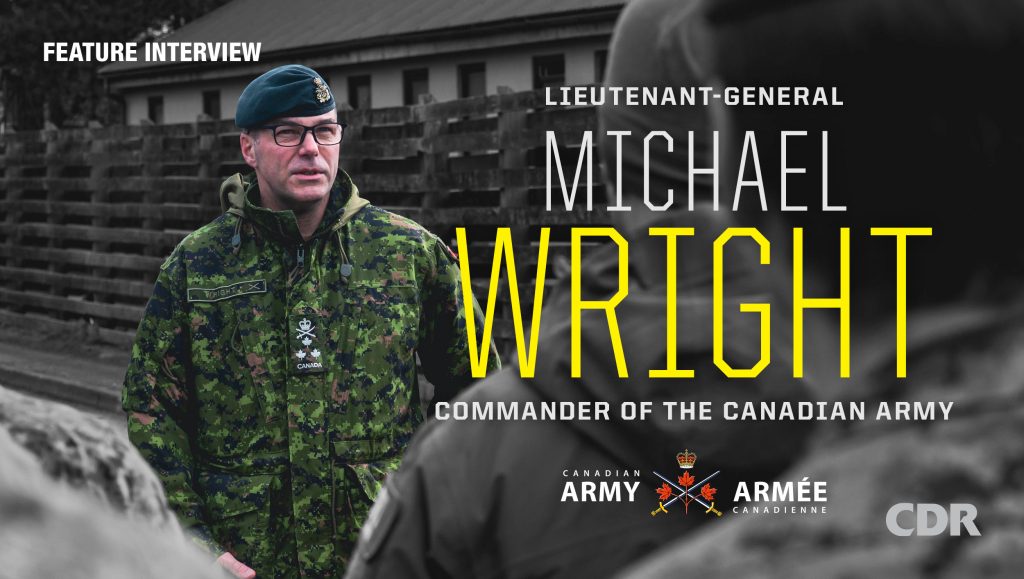
CDR’s Senior Staff Writer, Joetey Attariwala, recently spoke with Lieutenant-General Wright, Commander of the Canadian Army, for an in-depth one-on-one discussion about the Army and its plans for the future. Here is their discussion.
CDR: Lieutenant-General Wright, thank you for taking the time to speak with CDR. Let’s begin by talking about Army modernization. I know that is your priority, so what does Army modernization entail?
LGen Wright: It’s good to chat with you again, and great question. So you’re absolutely right, it is my top priority. I’m 16 months into the job right now, and I knew that going into the job that modernization was going to be my top priority. It took a lot of time over the first few months to look at the global situation, the threats to Canada that exist today and will amplify in the future, to look at the current state of the army in terms of people, equipment, training and sustainment, and so not a surprise, the deduction we came up with is that the army we have today is not the army that we need for the future. So modernization really encompasses the way that we need to equip, train, sustain, and to structure the army and make sure we’re the type of force that can be integrated across the joint force of the Canadian Armed Forces, across the Government of Canada, but also, importantly, with allies. A great example there is I just returned from another trip to Latvia where Canada is leading the multinational brigade. The importance of army modernization is making sure that we not only become a more modern, digitally transformed and enabled army, but an army that can offer agile and scalable options to the government of Canada for employment here in Canada or anywhere around the world.
CDR: My understanding is the modernization will include a revamp or restructure of the Army, and I believe that means new divisions or a reallocation of the existing divisions of the Army. I’ve also heard of an initiative called Inflection Point 2025, so are the two one in the same?
LGen Wright: Inflection Point 2025 is a document that we put out in September to explain to the members of the Canadian Army the need for change — the fact that we are at an inflection point with the global threat of where we are in terms of deficiencies in people, equipment, training and sustainment. You spoke about restructuring, so I’d say it’s a repurpose of our divisions. Right now, the way that our divisions are structured — we have four divisions: 3 Division which is located in the west from British Columbia and up to the northwestern part of Ontario; we have 4 Division that’s in Ontario; we have 2 Division that’s in Quebec; and we have 5 Division that’s in the Atlantic provinces. Right now, they are based on region, but they are not divisions in the way that our doctrine, or any of our allies’ doctrine expects. They don’t have the capabilities that we expect of a Division. They’re also asymmetric, but they’re asymmetric by divestment, not by design, and so the example that I use there is tanks and heavy engineer equipment are in just one of our divisions because of divestment of certain capabilities over the course of a number of years. We are reforming the structure of our divisions based on task and purpose. So whereas now we have those divisions that are based regionally, all of our divisions in the future will have a span of control that runs from coast to coast to coast.

REFORMING OF CANADIAN DIVISIONS
CDR: Could you share the plan for reforming those Divisions?
LGen Wright: Sure. We are forming a division focused on the defence of Canada. That’s a division that is going to be primarily consisting of our reserve units. I think you know that we have reserve units in over 120 communities across the country. There are no reserve units that are shutting down, but as we look at what we need to do to get up to our target of 24,000 members of the Army Reserve, and plan for a larger Army Reserve in the future, we’re going to need those 120 communities across the country, because the Defence of Canada Division is going to be responsible for domestic operations. As you’ve seen over the past decade, domestic operations have increasingly been weather-related emergencies. We saw this year again, a very heavy tempo for deployment of Canadian Armed Forces and Canadian Army soldiers to be part of Type 3 firefighting duties. It could include operations like we saw this year, where we had Canadian Army soldiers augmenting the security for the G7 summit in Kananaskis; and it’s also about ensuring that we have the capabilities, including the ability to be mobile and survivable in the Arctic. It’s also going to regroup our five Canadian Ranger Patrol Groups under a single division and under a formation headquarters. In the future it’s also going to include the Canadian Army’s contribution to the integrated air and missile defence of Canada, and that’s a project that we’re working hand-in-hand with the other services within the Canadian Armed Forces. An important factor of the Defence of Canada Division, and this goes back to why I said we are not going to shut down any reserve units, is that that gives us the footprint across Canada if Canada ever needs to get into a period of mobilization, because that way we would be able to attract, recruit and train Canadians across the country to be part of a larger Canadian Army and Canadian Armed Forces.
The Second Division is our Manoeuvre Division. I know you’re familiar with our current Canadian mechanized brigade group — 1 Brigade which is out west in Edmonton and Shilo, 2 Brigade which is located in Petawawa and Gagetown, and 5 Brigade that’s located in Valcartier. We also have our Combat Support Brigade which is 6th Brigade located in Kingston and Gagetown. All of those brigades will now fall under a single division. We’re also forming a Light Infantry Regiment, so the light battalion of each of our regiments will now be grouped under a light infantry regiment. We’re forming a fires brigade, in which one of the capabilities we’re going to be bringing in is a long range precision strike system, so there’ll be a unit of HIMARS. There will be our artillery regiments, which in the future, will transition from towed howitzers to self-propelled howitzers. We’re also planning for a first unit for uncrewed aerial systems. The importance of that division is they’re going to be our force generation base for our international operations, and as you know, our largest international operation currently is the multinational brigade in Latvia. It’s also going to be responsible for being able to respond to crises at scale, and that’s the importance of the light infantry regiment. They’re the ones who if there’s a non-combatant evacuation operation, if there’s a humanitarian or disaster assistance required somewhere around the world, or if there’s a requirement to surge forces quickly, it would be out of that light infantry regiment. It’s also about building the capabilities to operate at the division level because it’s no small feat. In fact, we have not exercised at the division level since 1992 and the Canadian Army has not fought at the division level since the Second World War. The important part there is, right now, we have a number of capabilities that we’re operating under brigades, but those capabilities and the capabilities that will be arriving, truly need to operate at the division level so that we can have effects on all parts of the battlefield — not only the close fight, but also the rear fight and the deep fight.
The 3rd Division is a Support Division, so those division support groups will more or less remain intact, but will now report to a centralized headquarters in Ontario. The importance there is maintaining a common standard of institutional support across Canada, but also being a tie into the national supply chain. We are also going to be maintaining our Canadian Army Doctrine and Training Command located in Kingston. Their importance is only going to grow for three reasons. First of all is for individual training, as we’re looking to grow the Canadian Army to the strength that we’re supposed to be at, and then go beyond that for growth over the next 10 years. Our focus is very much going to be on individual training — so on bringing soldiers in, getting them a basic qualification, and then getting them to a point where they can be employed in their units. We also are relooking at what we need to do to conduct collective training here in Canada. That’s been challenged over the last few years, both because of shortages in people, but also shortages in equipment. We are also looking at our professional military education to ensure that we’re providing the professional military education to our officers and senior non-commissioned officers to operate at the divisional level.
PERSONNEL & TRAINING
CDR: Speaking of personnel, what is the authorized strength and where is the Canadian Army at the moment?
LGen Wright: Right now we’re at about 22,000 in the regular force, which is a couple of thousand short of where we should be. In the reserve force we’re just over 21,000, and we have an authorized strength of 24,000. What’s concerning is that of those 21,000, there’s 7,000 who aren’t trained to what we call trained effective strength. For our Canadian Rangers, we’re at about 4,800 of our authorized 5,600. We’ve also got about 3,000 defence team civilians, so all-in, the One Army Team is about 51,000. There is a plan over the next 10 years to grow the regular force by approximately 10,000 people. What I want for the Reserve Force is to get up to the authorized strength and make sure we have a much larger percentage who are actually trained, but then also start planning for the Army Reserve that we need in the future, and that’s work that’s going to be starting later this fall. From the civilian perspective, you know, we’re aware of things that are happening across the government with public servants, but we’re also looking at all of our jobs across the army and trying to determine what jobs need to be performed by soldiers and what jobs could be performed by defence team civilians.
CDR: Do you think the potential of using more civilian instructors is a path that will help you with your training?
LGen Wright: We’re always going to have to look at where our soldiers in uniform are best employed, and if we don’t have sufficient people, what are the options we have to use defence team civilians. That’s frankly being done in some areas now. For example, the Canadian Forces Leadership Recruit School in Saint-Jean, which does not fall under the army, has already started using some defence team civilians in instructor roles.
LESSON LEARNED FROM THE WAR IN UKRAINE
CDR: There are many lessons being learned from the war in Ukraine, so how is the Canadian Army adapting and incorporating them into your concept of operations?
LGen Wright: In Inflection Point, we talk about the need for adaptive and innovative mindsets. As we look at the pace of change on the battlefield in Ukraine, there are a couple of areas that I’ll focus on. One is the use of uncrewed systems, and I deliberately say uncrewed systems, as opposed to uncrewed aerial systems, because we’re seeing rapid innovation and fielding of uncrewed systems in the air, on the ground and in the sea. The other area would be electronic warfare. So first of all, in terms of uncrewed systems, the technology is so rapidly evolving that what we’re doing within the Canadian Army is standing up an initiative called MINERVA. MINERVA is about bringing together industry, engineers and our soldiers to look at what is the technology that exists, what are the initiatives we currently have ongoing across the Army, and making sure that there’s an all informed net so as we move forward to determine what drones we need to help the Rangers with operations in the Arctic; what drones we would need, both kinetic and non-kinetic for a major combat operation and to look at what the possibilities are.
READ: Minister McGuinty Visits Roshel and highlights armoured vehicles donation to Ukraine
The second one is electronic warfare. Because of the pervasive nature of drones in Ukraine, electronic warfare is now down to the section level within both armies. One of the Canadian Army’s 49 major capital projects is Electronic Warfare modernization, so what does that mean for us. I also want to say another lesson from Ukraine is that you cannot end the conflict with uncrewed systems on their own. In fact, if anything, we’ve seen from the war in Ukraine that mass matters, mass in terms of being able to group soldiers together, bringing armour together or bringing indirect fire together. I think you have to remember that drones cannot hold, seize or retake terrain. Land forces can, armies can. So it’s determining what lessons to learn, but also what lessons in terms of the importance of armour, artillery, engineers, camouflage, concealment and deception that need to be incorporated into our training, our doctrine, and into our future capabilities.
ARCTIC OPERATIONS
CDR: Let’s talk about the Arctic, which is a huge focus in the defence policy. What are you envisioning with respect to the Canadian Army and defence of Canada. I know it involves Rangers, but I think we can both agree that they’re an enabling and sensing force, not a combat force.
LGen Wright: I’m glad you brought up the Rangers, and I will agree with you that they’re an enabling force, not a combat force, but they are right now one of two parts of the Department of National Defence that provides persistent presence in the Arctic — one is the Canadian Rangers, and the other is the Canadian Coast Guard. You’re right in that they are sensors, so we’re going through an initiative right now called Canadian Ranger Enhancement, where it’s one thing for us to say that they are our eyes and ears in the north, but what we’re ensuring is that what they’re seeing and hearing in their communities, they’re actually able to report up so that it influences the common operating picture that the Canadian Armed Forces has in our northern and Arctic regions, and also that that information is shared across the government of Canada security and intelligence community.
The second thing is making sure that our Rangers are adequately equipped and that they continue to be vectors of community resilience in their communities. So it’s about enhancing the effect of Rangers, but then in terms of forces to operate in the north, it’s about upping our game in terms of the way that we equip and we train our soldiers, whether that’s from our light infantry regiment to be able to respond to crises in the north, or from our Arctic Response Company Groups that exist in our reserve Canadian brigade groups across the country. It’s important for us to understand that the environment that exists in the Arctic now is evolving very rapidly because climate change is affecting a lot of things across Canada. It certainly affects the number of domestic operations the army has been called upon to support, but its effects are being felt more rapidly in the Arctic.
The equipment and infrastructure we need is going to be different 10 to 15 years from now than it is today so this is where we need to work with the other services and with the Canadian Joint Operations Command. You know that the Canadian Joint Operations Command has announced the location of the first three northern operational support hubs, because right now, our plan is to continue to project forces into the north out of those northern operational support hubs and on to exercises that we either do within the Army or to operations like Operation NANOOK. You’re aware that it’s going from periodic to persistent, so it’s going from four serials every year to seven serials. Not every serial will necessarily involve the army, but the army is going to be much more active in operating in the Arctic, and making sure that we have not only the equipment, but the skills to operate and fight in the Arctic.
ARCTIC RESPONSE FORCE
CDR: You mentioned these Arctic Response Companies that go up into the Arctic, but with Army reorganization and the establishment of the Defence of Canada Division, is there thought of a dedicated force that could potentially become an Arctic Response Force?
LGen Wright: We do have a company of the Loyal Edmonton Regiment that’s located in Yellowknife. I think you’re also tracking that the Navy is looking at establishing a Naval Reserve Division in the Yukon. You know, this is not a decision that the army is going to take on its own, or I’d say that the Canadian Armed Forces or Department of National Defence is going to take on its own, because anything that happens in the North needs to be by, with and through the federal government, and also the territorial governments. So, anything that we’re going to be doing in the north, particularly if we’re looking at options of anything from Northern operational support hubs to more persistent presence, has to be done fully understanding the supply chains, but also the impact to the communities. That’s another importance of our Canadian Rangers, because they provide us that link to the communities, because they are parts of and in fact, often leaders within those communities.

DAME & HIMARS
CDR: You have spoken about a number of procurements, including one called the Domestic Arctic Mobility Enhancement. What other kinds of capability specific to the Arctic region are important to you?
LGen Wright: I have four priority projects and then a project that needs to enable and link everything together. You mentioned the Domestic Arctic Mobility Enhancement which will replace our BV 206 that has been in service since the early 1980s, so we have a project to bring in the number of vehicles which will be able to be mobile and survivable in the Arctic. Those aren’t only for us, they’re also for the Special Forces and for the Royal Canadian Air Force. The second one with an Arctic nexus is our HIMARS system, so the long range precision strike. One of the reasons we advocated for the foreign military sales with the U.S. Government for the HIMARS system is not only is it the system that’s proven on the battlefield in Ukraine, but it’s the system that can go onto the back of Royal Canadian Air Force C-17 or Hercules aircraft and be transported anywhere in Canada. So for example, if there was a requirement to form a joint anti-access aerial denial bubble somewhere in the Arctic, that would be the Army’s contribution to that. I was talking about integrated air and missile defence, so both counter-UAS and ground based air defence will be part of the integrated air and missile defence of Canada.
CDR: I know Canada has operationalized the RBS 70 in Latvia, which is excellent, and I believe there’s been a reorganization for Ground Based Air Defence. Could you bring me up to speed on where the Army is with that?
LGen Wright: Yeah, you’re right. We launched a number of unforecasted operational requirements to enable the transition from the battle group to the multinational brigade level in Latvia. But what we’re trying to do now is to make sure that we’re not only procuring equipment for the army in Latvia, we’re procuring equipment for the Army writ large. So, we’ve now been able to blend the UOR for air defence in Latvia with a project for ground based air defence for the Canadian Army writ large. You’re right that the RBS 70 is already being fielded in Latvia. The next will be a SHORAD battery for Latvia, and then it’ll be bringing in VSHORAD and SHORAD for the Canadian Army, so this is where we’ve been able to blend the UOR in with the project to not only train in Canada, but also to field adequate systems in Canada or anywhere around the world.
CDR: You’re rotating a lot of land forces through Latvia so have you been thinking of permanent basing there to help ease pressure on the Army?
LGen Wright: That is really more a CJOC issue, but we have many different models for force generation. We have some people who are over there on 3 year postings, we have some people on a year long deployment, an 8 month deployment, or a 6 month deployment, and we’re constantly looking at what’s the best force generation cycle for the Canadian Army to allow us to make sure we’re sending soldiers over who are adequately prepared, but then also to regenerate and reconstitute the Canadian Army back in Canada.
CDR: Thank you, General.
Joetey Attariwala is CDR’s Senior Staff Writer
