


DEFENCE INFRASTRUCTURE: Building Readiness
Inside Canada’s Defence Infrastructure Surge
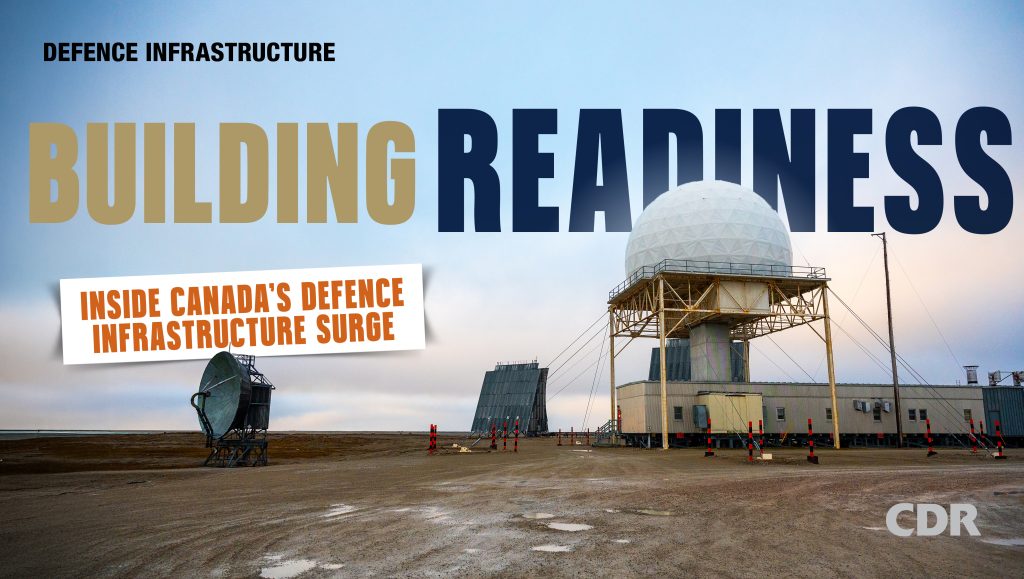
Multi-billion-dollar procurements such as the Canadian Patrol Submarine Project, River-class destroyers, and NORAD modernization tend to dominate public attention. Less visible—but equally critical—is the vast defence infrastructure portfolio that enables these capabilities to operate, train, and endure. CDR asked Ottawa Bureau Chief, James Careless, to speak with DND and major contractors to learn the latest about current and future defence infrastructure projects from coast-to-coast-to-coast. Here is our report.
The Department of National Defence (DND) manages the largest and most complex real property infrastructure portfolio in the federal government, directly supporting Canadian Armed Forces’ (CAF) readiness. The total replacement cost of DND’s portfolio is approximately $28 billion, and it is managed using an approximate annual budget of $3.1 billion.
“This portfolio includes varied real property assets including defence establishments such as Bases and Wings, enabling infrastructure like roadways, utilities, dining halls and accommodations, as well as mission-enabling infrastructure such as ranges and training areas, research and technical facilities, accommodations, ammunition and munitions infrastructure, hangars, warehouses, and the many systems required to keep them operational,” said Peter Hammerschmidt, DND’s Assistant Deputy Minister (Infrastructure and Environment). “Nearly every major equipment acquisition—from ships and aircraft to emerging technologies—requires corresponding upgrades or new construction to ensure those capabilities can be deployed, sustained, and operated effectively.”
CURRENT DEFENCE INFRASTRUCTURE PROJECTS
As the person in charge of DND’s property portfolio, Peter Hammerschmidt is the right person to provide a big picture view of Canada’s defence infrastructure sector and its major projects.
“We are at a pivotal moment where policy direction and government priorities are aligning, creating opportunities to renew infrastructure at the scale and pace required to meet the operational needs of the CAF,” he told CDR. “Through sustained, generational investments outlined in Budget 2025, DND is streamlining and accelerating infrastructure planning and delivery to enable the current and future CAF capabilities. These efforts advance defence priorities in Canada’s North, support NORAD modernization and Canada’s defence policy, Our North, Strong and Free, and strengthen the resilience and sustainability of the infrastructure portfolio.”
“I would like to highlight that a new directorate, NORAD Modernization Infrastructure Projects Delivery (DNMIPD), was established in 2023,” he added. “This directorate will support Northern operations, including Over-the-Horizon Radars, enhanced space-based surveillance and communications, Northern infrastructure upgrades, and investments in science and technology.”
Here’s a look at the largest defence infrastructure projects underway in Canada:
Significant progress was made in 2025 on the Arctic Over-the-Horizon Radar (A-OTHR)program, which is a key part of Canada’s $38.6 billion NORAD modernization plan. “This year, National Defence announced the first transmit and receive sites for the system,” said Hammerschmidt. “The permanent transmit site will be located on 163 hectares near Thistle Trail in the City of Kawartha Lakes, Ontario, while a preliminary receive site has been identified on 288 hectares of agricultural land in Clearview Township.” The A-OTHR system is expected to achieve Initial Operational Capability (IOC) by the end of 2029.
The Strategic Tanker Transport Capability (STTC) will replace the existing fleet of five CC-150 Polaris with nine CC-330 aircraft, significantly increasing the RCAF’s refuelling capability, while providing sufficient aircraft to support simultaneous operations for extended periods from different locations. This will enable Canada to meet current and future NORAD and NATO commitments, and will include air-to-air refueling, strategic airlift, aeromedical evacuations and strategic Government of Canada transport.
“The STTC fleet will operate—and therefore require dedicated infrastructure—at two Main Operating Bases: Main Operating Base East (MOB East) and Main Operating Base West (MOB West), as well as at a Forward Operating Location (FOL) in Northern Canada,” Hammerschmidt said. “Construction at CFB Trenton is already well underway, encompassing airfield modifications, a state-of-the-art hangar with apron and taxiway, fueling and defueling systems, training facilities, and cargo and passenger processing infrastructure. Edmonton International Airport is anticipated to serve as the Main Operating Base (MOB) for Western Canada, with lease negotiations currently underway and site studies scheduled to begin.
Work is also progressing on establishing the Northern Forward Operating Location for the CC-330 fleet at Inuvik’s Mike Zubko Airport. “Preparing the site will involve paving a new apron, building a taxiway and access road, and constructing a small storage building, with project scope refined as design work advances,” said Hammerschmidt. “Preliminary environmental studies are underway now, with full design work beginning in 2026 and construction expected to be completed by 2032.” A major runway expansion is underway, which will extend the existing 6,000 foot runway to 9,000 feet and modernize lighting, navigational systems, and the military aircraft arrestor system.
The AFEC Main Facility – 2 Wing Bagotville project will deliver a purpose-built facility to consolidate 2 Wing’s command, operations, and mission support elements, to enable the Royal Canadian Air Force’s expeditionary capability. Construction is ongoing and scheduled to achieve initial operational capability by 2026 and full operational capability by 2027.
“Work also moved forward in 2025 on the Land Based Test Facility (LBTF)at Hartlen Point in Halifax, a critical enabler for introducing Canada’s 15 new River-class Destroyers into service,” Hammerschmidt told CDR. “The $241 million LBTF will allow the Navy to test and integrate key electronic, communications, and radar systems on land before installation, helping ensure the new fleet is operationally ready from Day One.” Construction of the LBTF started in November 2025 and is expected to be completed in early 2028.
READ: Celebrating the keel laying for the first River-class destroyer
The new B-Jetty at CFB Esquimalt has achieved initial operating capability, marking a major milestone in the A/B Jetty Recapitalization Project. Designed to replace World War II-era infrastructure, the new jetty is larger, provides enhanced electrical capacity, and is built to modern seismic standards necessary for the Cascadia Subduction Zone. Efforts have now shifted to replacing A-Jetty, applying lessons learned from rebuilding B-Jetty with respect to innovative pile design and construction scheduling.
Meanwhile, the ongoing Joint Task Force 2 Infrastructure Project (JTF 2) will both construct new facilities consisting of up to 23 buildings, and recapitalize existing facilities at the Dwyer Hill Training Centre (DHTC, near Ottawa). “Several buildings have already been completed and turned over to DND for use, with the next major block of buildings expected to be completed and handed over to DND in 2028,” said Hammerschmidt.
Finally, planning is underway for the new National Defence Secure Campus (NDSC) to be constructed at National Defence Headquarters (Carling) in Ottawa. The NDSC will deliver a modern operational facility with a view to co-locate and integrate command, control, communications, coordination, intelligence, and targeting capabilities of multiple commands, along with essential operational support resources. It is expected that the contract will be awarded in the Spring of 2026 with occupancy in 2034/2035.
“The next three years present an important opportunity to make sustained, strategic investments in defence infrastructure that directly enable CAF readiness, sovereignty and operational resilience,” Hammerschmidt concluded. “Investing now allows Defence to meet the near-term operational demands while laying the foundations for the long-term capability growth and reconstitution as we rebuild, rearm and reinvest in the CAF.”
The multi-billion dollar value of DND’s defence infrastructure and associated products have attracted many of Canada’s major contractors to serve this sector. Here’s a look at some of them.
ATKINSRÉALIS
AtkinsRéalis is a global engineering services and nuclear company active in key defence markets including Australia, Canada, the UK, and the U.S. Its completed CAF projects include transportation infrastructure at CFB Bagotville, training facilities at 5 CDSB Gagetown, health centres at Garrison Saint-Jean, CSOR facilities at Petawawa, and maintenance hangars at CFB Trenton. This company is active in the Future Fighter Capability Project, Canadian Multi-Mission Aircraft Training Facility, transition centres at Gagetown and Shilo, RPAS ground control and hangars, and the Sherbrooke Armouries.
“AtkinsRéalis is currently supporting the CAF from coast to coast,” said Antonella Tomaro, the company’s VP of Defence, Canada. “We are providing engineering and design services across various types of facilities, including hangars/aircraft maintenance facilities, vehicle maintenance facilities, physical security, ammunition storage facilities, short- and medium-term accommodations, warehouse and workshop facilities, office facilities, training facilities, range and training area infrastructure, kitchen and mess facilities, and gym and recreational complexes.”
Looking ahead, “AtkinsRéalis is prioritizing program-level opportunities in NORAD modernization and Northern Base Infrastructure, where integrated facilities and resilient systems will be critical to Arctic sovereignty,” Tomaro told CDR. “We are also positioning for multiple new vessel programs for the Royal Canadian Navy.”
Asked about the new Defence Investment Agency, she replied that, “its creation is a positive step toward streamlining defence procurement. By centralizing oversight and reducing hand-offs between departments, the DIA has the potential to shorten decision cycles and create clearer accountability for both requirements and delivery.”
ATCO FRONTEC
ATCO Frontec provides in-service support, facilities management, operations, maintenance, construction, remote camps, and disaster response in support of Canadian, U.S. military, and NATO operations. The company also manages bulk fuel, maintains airfields, provides fire inspection and maintenance services, and radar operations.
ATCO Frontec’s past DND projects include the North Warning System, NFTC Moose Jaw, and the Ontario Facilities Management Contract. The company currently has DND contracts for the Polar Over-the-Horizon Radar project (design, build, and installation of a test site in the Northwest Territories), DCC Alberta for 15 DND sites across the province (ongoing maintenance, repair, refits and renovations for defence infrastructure), and Real Property North (maintenance, repair, aircraft hangar renovations, upgrades and refits at the CAF Forward Operating Locations and Whitehorse cadet camp; recently extended for two years).
“ATCO Frontec brings years of proven expertise in Arctic operations, including the operation of the North Warning System; initially as ATCO, and currently through our Nasittuq partnership,” said company President Jim Landon. “We’ve built strong relationships with Indigenous and Inuit communities across Canada, aligning with the Federal Government’s commitment to Indigenous procurement. Our collaborations with Canadian companies enable us to deliver radar systems and other made-in-Canada solutions for government and defence projects. As a Prime Contractor for U.S. forces under the WEXMAC 2.1 contract vehicle, and with a history of supporting NATO missions in Europe and Afghanistan, we have a solid track record of operating in remote, challenging, and unfamiliar environments.”
ELLISDON
EllisDon is a national Canadian company with 5,000 employees across 17 offices. “We have delivered over $9 billion in defence infrastructure with the Canadian Armed Forces and Department of National Defence since 2010,” said Chris Lane, EllisDon’s Senior Vice President and Edmonton Area Manager.
EllisDon is currently working with the CAF and DND on projects such as the Future Fighter Capability Project, the Future Aircrew Training Program, and the National Shipbuilding Strategy. “On the West Coast, our teams are designing the Junior Non-Commissioned Members Training Accommodation Facility at CFB Esquimalt, as well as the Multi-Mission Aircraft Hangar at CFB Comox,” Lane told CDR. “In the Prairies, we are designing and constructing the training, maintenance, storage, and support infrastructure for the Future Fighter Capability Project (FFCP) at CFB Cold Lake as well as the Future Aircrew Training Program at CFB Moose Jaw, CFB Winnipeg, and the Southport Aerospace Centre. Our teams are also actively supporting the design of the new Chemical and Biological Laboratory at CFB Suffield.” As well, EllisDon is building the new Eastern Ontario Campus and FFCP infrastructure at CFB Bagotville, designing the Combatant Training and Integration Centre at CFB Halifax, and supporting infrastructure improvements for the National Shipbuilding Strategy at the Halifax Shipyards.
“We will continue to pursue major opportunities in the defence sector across Canada, fostering strong partnerships and delivering innovative solutions that support the Canadian Armed Forces now and into the future,” said Lane.
HATCH
Hatch is a Canadian multinational engineering and project delivery company. With experience in over 150 countries, Hatch has $75 billion of projects under management globally.
“Hatch’s experience supporting the Department of National Defence (DND) extends back to the environmental clean-up of the Distant Early Warning system,” said Harvie Buitelaar, an Associate with Hatch Defense. “Additionally, an example of key infrastructure that provides outstanding support to the Canadian Armed Forces is the Halifax Shipyard, which is currently building ships for the Royal Canadian Navy (RCN). Hatch provided design, engineering and construction management for Irving to expand and modernize their facilities in support of the National Shipbuilding Strategy.”
Today, Hatch is providing engineering services to the CAF/DND at numerous locations nationwide through existing Source Lists, including the Canada-wide airfield engineering design program. “We also maintain Architectural and Engineering Multidisciplinary Source Lists for key CAF bases, such as CFB Gagetown, reflecting our ongoing role as a trusted delivery partner,” Buitelaar told CDR.
Hatch is motivated to support the CAF/DND’s northern Canadian infrastructure initiatives. “We are ready to contribute our deep and broad expertise for CAF/DND projects with exceptional multi-disciplinary experience from coast-to-coast-to-coast, with particular interest and experience in the proposed locations for Forward Operating Locations and Northern Operational Support Hubs,” said Buitelaar. “Hatch has been involved with a vast majority of the infrastructure developments in Canada’s far north over the last 20 years, including multi-billion-dollar infrastructure and facilities that have supported mining operations across the region.”
PCL CONSTRUCTION
PCL is Canada’s – and one of North America’s – largest construction companies. (Source: On-Site Magazine’s “Top 40 Contractors 2025”.) PCL’s many past CAF/DND projects include the Syncrolift Upgrade and Submarine Shed project in CFB Halifax, the Canadian Special Operations Regiment new regimental campus at CFB Petawawa, and the Tactical Armoured Patrol Vehicle facility at CFB Gagetown.
Today, PCL is working on projects at more than 10 Canadian Forces Bases. They include the Land Based Test Facility (LBTF) in Halifax, NS in support of Canada’s River Class Destroyer program, the Ground Based Air Defence (GBAD) facilities in CFB Gagetown, the Strategic Tanker Transport Capability (STTC) Main Operating Base (East) at 8 Wing Trenton, and the Multi-Purpose Building in Yellowknife, the new headquarters for the 1st Canadian Rangers Patrol Group and elements of Joint Task Force North.
As well, “PCL and Hanwha Ocean of South Korea have signed a Memorandum of Understanding for cooperation on infrastructure development for the Canadian Patrol Submarine Project,” said David Hudock, PCL’s National Director of Defence and Federal Government Relations. “PCL is the ideal choice because we have the largest national presence of any general contractor in Canada, working in the buildings, civil and industrial sectors, all of which will be required in this national undertaking. The company has strong long-term relationships with the design community and with the trades, ensuring competitive pricing, ready availability and the big-room collaboration required to successfully meet the military’s needs, including enhanced security requirements.”
POMERLEAU
Pomerleau is an integrated Canadian construction company with a coast-to-coast presence. It builds highly secure critical infrastructure for the CAF and private defence companies.
According to the company, Pomerleau has delivered more than 50 projects since 1991, worth nearly $10 billion in total. Key achievements include the A&B Jetty recapitalization projects at CFB Esquimalt, the Hangar 14 renovation project in Ottawa, the Sedley S. Blanchard Training Center at CFB Trenton, the Signals Squadron building at CFB Petawawa, and technical and accommodation complexes at CFBs Valcartier and Bagotville.
Today, Pomerleau is continuing its work on the A&B Jetty recapitalization projects and the Hangar 14 renovation. It is also building a Remotely Piloted Aircraft System (RPAS) Infrastructure Air Maintenance Facility and Canadian Multi-Mission Aircraft Flight Training Facility at 14 Wing Greenwood, Annapolis Valley, Nova Scotia, and doing preconstruction work on an Armoured Combat Support Vehicles Facility at CFB Valcartier, among others.
“The ramp-up in DND investments has resulted in a structural pipeline of several billion dollars in major projects over 10 years (excluding additional programs such as submarines, etc.), and an acceleration of needs in the Atlantic, Pacific, Ontario, West, North, and Quebec,” said David Boudreau, Pomerleau’s Director of Business Development. “This momentum is fueling portfolios in hangars, jetties, training centers, health, housing, utilities, and communications. For Pomerleau, it is materializing in the form of growth in assignments and an increase in teams authorized to work in sensitive environments from coast to coast and in our seven offices.”
SERCO
When it comes to infrastructure management, Serco is a key DND partner. But it is not a typical facilities management company. Instead, “We are an operational services integrator with deep experience delivering end-to-end base operations, aviation services, and infrastructure sustainment under long-term, performance-based contracts,” said Mike Peckham, Director Facilities Management at Serco Canada. A case in point: As prime contractor at 5 Wing Goose Bay since 1998, Serco supports a portfolio exceeding 275,000 square metres of floor space, comprising 264 permanent and temporary facilities, three runways totaling more than 6,300 metres, 45 kilometres of roadways, and extensive utility systems. The company also provides 24/7 air traffic control (ATC), IFR terminal services, air information services, ground electronic services, weather observations, 24/7 emergency services, and operation of the Wing Operations Centre supporting NORAD activities.
As well, Serco provides site support and facilities management services for the NATO Flying Training in Canada (NFTC) program at 15 Wing Moose Jaw, and is a key subcontractor on the Future Aircrew Training (FAcT) Program.
Looking ahead, “Serco is focused on upcoming infrastructure, site operations, and sustainment opportunities, including NORAD modernization, particularly at bases and training locations that underpin Canada’s contribution to air defence, and national security objectives,” Peckham told CDR. Summing up his company’s 25-plus years managing 5 Wing Goose Bay, he added, “facilities management and site support are often invisible when delivered well, but they are critical enablers of CAF readiness, training capacity, and operational success.”
STANTEC
Stantec is a global professional services firm specialized in sustainable engineering, architecture, and environmental consulting. “We have a long and successful track record working with the CAF, DND, and DCC [Defence Construction Canada],” said Robert Dumaresq, Stantec’s Account Manager for the Department of National Defence. With respect to DND’s enhanced focus on northern defence, “Stantec has gained extensive experience over four decades of working with Indigenous communities by delivering programs that have provided positive and mutually beneficial outcomes.”
Currently, Stantec is working on several CAF/DND/DCC projects. They include five maintenance and operations hangars for highly advanced manned and unmanned aircraft (Cold Lake, Bagotville, Trenton, and two in Greenwood), and a vehicle maintenance/storage facility with administrative components (Petawawa). Stantec is also designing a four-building training campus for the CAF (Trenton), a multipurpose facility (Yellowknife), and a neurobehavioral research facility (CFB Suffield).
“We are also involved in the RCAF’s Future Aircrew Training program (multiple locations), a testing facility for the Royal Canadian Navy (Halifax), and the recapitalization and remediation project to replace old marine jetties (Esquimalt and Halifax),” Dumaresq told CDR.
Looking ahead, Stantec wants to take part in the design of major DND infrastructure projects associated with the Canadian Patrol Submarine Program (CPSP), the Armoured Combat Support Vehicle (ACSV) Program, and NORAD Northern Basing Infrastructure (NNBI).
READ: Canada chooses TKMS as preferred bidder for CPSP submarine fleet
“Alongside our commitment to indigenous partnerships, particularly our partnership in the North—Nunami Stantec—we are proud to be the only engineering firm with offices and staff located in each territory,” said Dumaesq.
WSP
WSP is a global design, engineering and environmental services firm that has supported DND for decades. Its national team of industry experts includes nearly 13,000 professionals located in 140 offices across Canada. They cover Property and Buildings, Earth and Environment, Transportation and Infrastructure, and Energy, Resources and Industry.
Today, WSP is executing numerous DND contracts in support of NORAD Modernization and infrastructure improvements. Some of these contracts are complex collaborative projects, including modified design-build, as well as traditional design-build projects related to marine infrastructure, hangars, Quick Response Area infrastructure, Army Training and Integration Centre, accommodation and barracks facilities, and munitions handling facilities.
“Our teams are involved across the full life cycle of DND’s projects,” said Erik von Krogh, Defence Client Account Manager for WSP in Canada. “Long term involvement at CAF bases by our specialists contributes to strong working relationships and familiarity with the site conditions and constraints.”
Today, WSP is targeting all CAF/DND projects that complement the expertise of its Canadian workforce. In doing so, the company’s many experts are committed to serving as trusted partners to the CAF, delivering high-quality, future-ready infrastructure solutions to Canada in an increasingly dangerous world.
“Security isn’t just a requirement; it’s integral to everything we do in defence infrastructure,” said Francois Lemay, Executive Vice-President of Property and Buildings for WSP in Canada. “Our commitment to excellence, supported by up-to-date clearances and unparalleled expertise, ensures that WSP is the right choice for the most sensitive and mission-critical projects.”
James Careless is CDR’s Ottawa Bureau Chief
