


DAVID MCGUINTY – MINISTER of NATIONAL DEFENCE
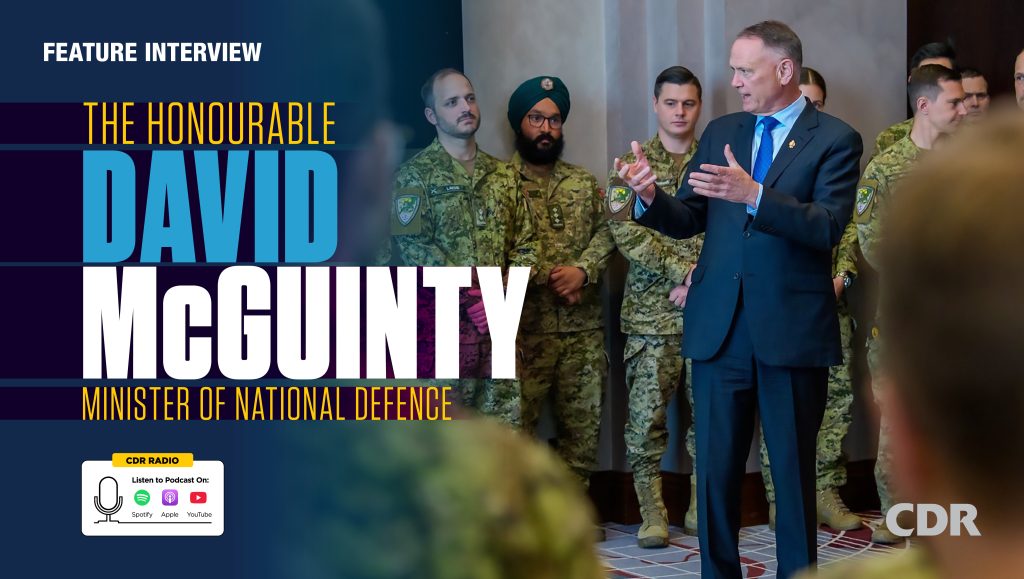
CDR asked its Ottawa Bureau Chief, James Careless, to sit down with Canada’s Minister of National Defence, the Honourable David McGuinty, for an exclusive interview. Addressing Canada’s complicated defence procurement relationship with the United States, DND’s partnership with the Canadian defence industry, and the revitalization of Canada’s defence infrastructure: These were some of the many concerns addressed by Minister McGuinty during CDR’s annual interview.
Listen to the full breadth and depth of Minister McGuinty’s comprehensive comments on the CDR Radio Podcast, available at www.CanadianDefenceReview.com/Podcast, with an abridged version of the interview available here.
CDR: Minister McGuinty, thanks for joining us.
Minister McGuinty: Thank you for having me, James. It’s a great pleasure.
CDR: This is our first opportunity to speak with you since you assumed the role of Minister of National Defence. How is your new role going so far? And what are some of the notable milestones during your first seven months on the job?
Minister McGuinty: I would say that I’ve been very fortunate to build on my previous eight years as the chair of the National Security and Intelligence Committee of Parliamentarians here for Canada, as well as a short stint as the Minister of Public Safety. So national security has been pretty profoundly involved in my political career serving as an MP, and I’ve carried that into my role as the Minister of National Defence.
Three foundational things have really stuck with me since taking on the role. The first is, I have a lot to learn. This is a very complicated department. The CAF has got many moving parts. So, I’ve got lots to learn and I keep learning every day.
The second thing I would say is I can’t believe how extraordinary the women and men of the Canadian Armed Forces are. I meet with them, I learn about their backgrounds, I see what tasks they accomplish, how well-trained they are, and it’s really quite extraordinary. I’ve had a chance to meet and work with a lot of people over my career, but these folks are really standing out as something else.
The third thing that struck me is that we need to introduce the members of the Canadian Armed Forces to the Canadian people. The population doesn’t really know who CAF members are, what they do, how well-trained they are, and how they equip themselves. So I think it’s important for me and incumbent on all of us to make sure that Canadian people get a better idea of what all these extraordinary women and men are doing.
CANADA-U.S. RELATIONS
CDR: Canada’s defence procurement is deeply intertwined with the United States, from the F-35 to NORAD modernization. How do you ensure that close integration with the U.S. strengthens Canada’s security without limiting our freedom of choice or locking Canada into American timelines, priorities, and suppliers?
Minister McGuinty: It’s no secret that we’ve been buying the preponderance of the defence equipment and technology from the United States for many decades now. We buy and obtain the best equipment based on specifications and operational requirements put forward by the CAF.
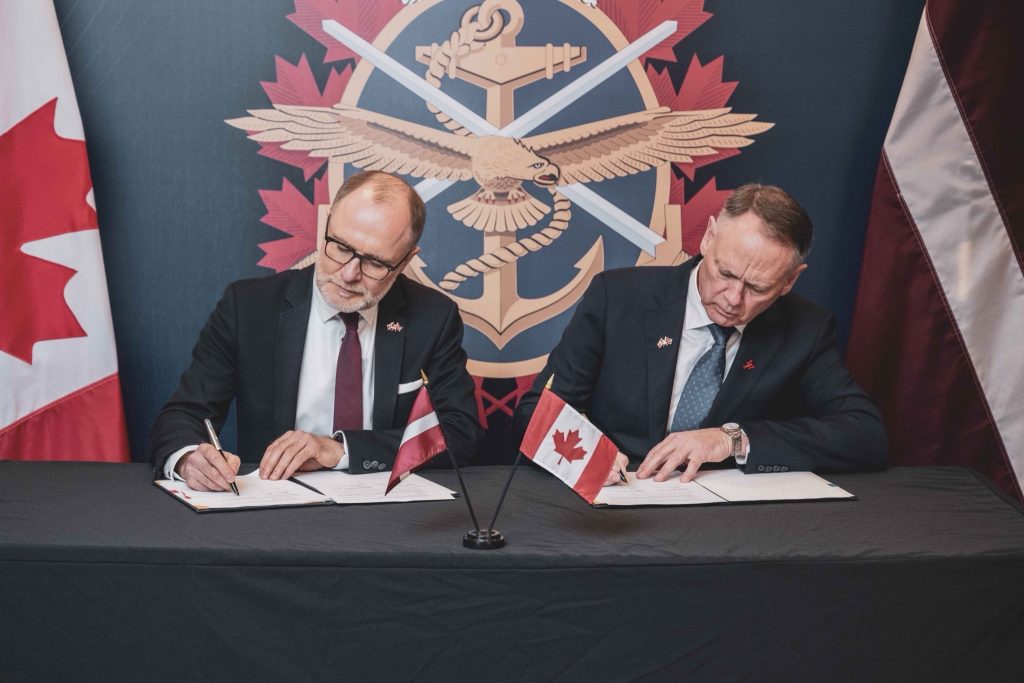
We have always maintained our sovereign authority in terms of our procurement choices. That will not change. Our partnership with the U.S. is decades long. It’s beyond just buying things. It’s also integration. It’s joint training, it’s operations at home and abroad. We have hundreds of personnel in the United States. We cooperate around the world.
I’ve had the chance to see a lot of this firsthand. I’ve been in Washington many times to discuss our national security priorities with our U.S. counterparts. I’ve also, in my first seven-eight months, had the chance to get to all four of our NORAD locations, two in the United States—Colorado Springs and Anchorage, Alaska—and two in Canada, Winnipeg and North Bay. I met with General Guillot, the commander of NORAD, in the United States. It was clear to me how our discussions underscored just how deeply integrated our forces are in defending this continent.
While there, I met with Canadian Armed Forces members serving in NORAD. The work that they’re doing exemplifies the strength and the professionalism of our binational command, which is really quite unique and a part of what I consider to be a winning combination that we should continue to build on.
I’ve also had the chance to meet with Secretary of War Pete Hegseth on several occasions in the United States at the Pentagon and in Brussels. We were talking and continuing to work together on our bilateral defence relationship, making progress on a number of fronts.
I want to be clear on this: Our approach to continental defence modernization, it’s deliberate, it’s a choice, it’s responsible, it’s fully aligned with our Strong, Secure, Engaged policy document. It builds on our NORAD modernization investments. It builds on our commitments to NATO and our broader network of allies.
So, we are making progress. It’s an incremental approach, but it’s very systematic and we are driving it forward.
CANADA’S DEFENCE INDUSTRY
CDR: You’ve described the Canadian defence industry as a strategic partner. What does that mean in practice? Earlier engagement, longer contracts or greater tolerance for risk sharing? What does this all come down to?
Minister McGuinty: Well, it means all three of those things, to be honest with you. It means that we have a clear mandate to grow Canada’s economy and to build Canada strong. We are committed to renewing our partnership with industry and supporting a revitalized mutually beneficial defence sector. We have about 600 Canadian companies in this space now, about 82,000 full-time employees, 200,000 or so part-time employees, but it really means bearing down to build a stronger domestic defence industry that creates good jobs, that gives rise to regional economies, that gives rise to new research, new development, and it helps us with our sovereign needs. That’s why we have been working, for example, with our top 15 research universities, looking to see where their interests and their capabilities lie. That’s why we’ve been looking at building these new defence hubs, these DISH hubs, as they’re called, for top secret research facilities.
We can meet the needs of the CAF and work with private sector partners, foreign direct investors, commercial partners, including, for example, working with the Communications Security Establishment in key areas like artificial intelligence or in cryptography. These are areas where we have obviously strong capabilities and frankly, global prowess in these areas.
We want to build on those successes. We’re going to continue to rebuild, re-arm and reinvest in the Canadian Armed Forces. That means making some key investments in our defence industry, working with our partners, and building more foundations.
I’ve been meeting with companies. In fact, I’ve just met with 13 or 14 of the country’s top venture capitalists. I’ll be meeting with the top 15 banks in Canada within a couple of weeks of this recording. And we’ve put into action, obviously, initial investments to support our industrial sector, our base: For example, about $4.6 billion on a cash basis now under the forthcoming Defence Industrial Strategy.
We’ll have more to say about that in due course, but this is intended to try to do three things. It’s going to help us identify what we need for our Canadian Armed Forces, for our sovereignty, for our security. What can we build or devise. What can we drive in terms of research. And what can we share and sell globally in the marketplace.
We’re going to be making those decisions and identifying clearly the sovereign capabilities that Canada has under the Defence Industrial Strategy when it’s released. This will help bring coherence to rising defence investments. It’ll help deepen our government industry collaboration, our scientific research, our AI, our universities, pulling together an industrial ecosystem that we have in place now that can be built on so we can leverage more domestic and international partnerships. We’re convinced this is going to have a very significant effect on helping to create one of the top three industrial sectors for Canada going forward.
This is about jobs. This is about research. This is about engineering. Canada’s got everything we need to do this. We have the engineers, we have the universities, we have the risk-taking, we have the capital. The Prime Minister is working hard, around the world to bring in more of that capital. And I think the word is getting around the world that Canada is going to be bearing down on this defence industrial sector and giving fuller effect to it.
We’re very hopeful for the future and we’re convinced we can do it.
DEFENCE INFRASTRUCTURE
CDR: Canada’s defence infrastructure—from northern airstrips and ports to bases, housing and training facilities—is widely described as aging, overstretched, and increasingly vulnerable to climate change. What is your government’s concrete plan to modernize defence infrastructure at the pace required by today’s threat environment and where will infrastructure investment rank against new equipment and personnel in your priorities?
Minister McGuinty: Investing in infrastructure ranks on an equal footing with the procurement of new equipment, just as investing in our personnel through a pay raise is also on an equal footing. We have a plan, we have timelines, and we have the resourcing allocated to be able to make those improvements.
When I tour a base, I don’t simply say, “Hey, I’d like to meet the mess manager or the kitchen manager or the food manager.” I want to walk into the walk-in freezers. I want to meet the dishwashers. I want to see what the state of the equipment is. I want to tour your water and wastewater facilities. I need to see the barracks. I need to understand what is the status of electrification right across the country, base by base, because we are rapidly exceeding the capacity of a lot of electrification on our bases.
Investing in our bases is foundational. How we treat the women and men of the Canadian Armed Forces is integral to their ability to do their jobs. You can’t ask good people to go to work and work with defunct equipment or equipment that is duct taped back into action. We need to get this right.
I’ll give you an example. Just a few months ago, I approved hundreds of millions of dollars to replace entirely the generator systems in the Canadian Armed Forces. Why? Because in Afghanistan, when we wanted to stand up either a temporary medical clinic or a kitchen in the field, we didn’t have generators that were interoperable. That’s not right. We will now as we move forward to replace those.
DEFENCE SPENDING TARGET
CDR: The Carney government committed in June 2025 to meet the current target of 2% of GDP spending by the end of this fiscal year. That is an ambitious and laudable goal that will require the rapid expenditure of an additional $9 billion before the end of March 2026. Will this goal be achieved?
Minister McGuinty: That is entirely our plan. For the first time in a long time, the Canadian Armed Forces and National Defence are being properly funded. This is long overdue.
So we are investing in operational readiness. We’re investing in new military capabilities, emerging capabilities, a stronger defence industrial space through the Defence Industrial Strategy, and better and more significant partnerships.
We’re signing agreements all over the world. I was in the Philippines and Korea where we’re talking now to a number of other countries, to expand our defence relationships. We’re bringing more people into Operation NANOOK in the Canadian Arctic. We’ve reformed the procurement system. We have a new procurement agency, which is going to be more fleet-footed, more independent, more efficient, and more cost-effective. Working with our ADM policy, our ADM infrastructure, we are now operationalizing a plan, not just simply devising. We are well, well beyond devising.
We’re operationalizing this change. And we’ve drawn on not just a perspective from the top of the crow’s nest, but what have we seen on the ground? What are the frontline women and men telling us? What are the senior leaders telling us?
So yes, we have a much clearer picture of the investments we’re making. We’re moving quickly to deliver them.
You’re right in pointing out that nearly $82 billion in defence spending over the coming years was in our first federal budget, a $9 billion book for this year alone. But let me just give you a snapshot of some of the things we’ve done in 2025 alone. $2 billion more, at least, for military pay increases. Almost $900 million in renewed support for Ukraine, major procurements and infrastructure upgrades that are well underway.
We’re buying apartment buildings now, something that’s never happened previously. The officials here came to me and said, well, there are a number of apartment buildings available for us to purchase that are close to Esquimalt. And I’m like, “okay, tell me more. Where are we bidding on these? Well, we’ve never done that. Is there anything that legally precludes us? No, there’s not. Great. So go bid.”
From the day we bid until the day we closed and purchased the property under the asking price was exactly five weeks. I think we picked up another 37 apartments.
When I came into this portfolio, I was unaware of the scale of DND and the CAF’s responsibilities. We effectively run a provincial-level government. This outfit looks after healthcare and dental care and pay systems and travel systems and childcare and housing and corrections systems and education—policing, justice, lawyers, and so much more.
So those expenditures that we’re making in those fields continue. And the way we’re doing this to achieve this 2% target—which we will achieve by March 31st— we’ve broken the work down into bite-sized pieces. We built a very disciplined system. We follow up to keep those things moving forward.
As I like to say, when I come to work in the morning here with all staff, legislative, political, official, defence, there are no home runs. We’re hitting singles. Every day we hit singles.
We’re moving the ball down the field with 50 plays running at once. That’s how you can modernize a military with discipline, with unrelenting momentum, with energy, with relentless follow through, and we’re not slowing down. In fact, I can tell you that when the Treasury Board was asked to provide the increased pay package, their original reaction was, “Well, sir, that would take 18 to 24 months.” And we said, “Okay, tell us more.” And they said, “Well, it’s complicated and it’s across the government and we’ve got to make sure this is balanced.” And I said, “That’s great. You have 100 days. You have 100 days to get this done because the women and men of the Canadian Armed Forces need a pay raise. They haven’t had one since 1996-1997.”
And it was done in 101 days.
While other jurisdictions like the United States are still talking about pay increases, we were able to get it done in less than four months between the time we announced the pay raises and the time money was showing up in our CAF members’ bank accounts retroactive to April 1st of 2025.
So we are definitely moving forward on the 2% and we’re laying track for the next series of investments to hit the 3.5 and the 5%. The Prime Minister and I were very deliberate in those negotiations. And so, we are now ordering aircraft and of course submarines. We have large procurements, what I call front page procurements, and then they’re behind all of that, the meat-and-potato procurements; thousands of homes being built and retrofitted, apartment buildings.
All of this is in play in a package of measures. And because there’s so much to get done, we’ve taken a very disciplined approach and we’re confident we’re going to get there.
CDR: One final question. We are living–as you know much more than I do because you know what’s going on—in such complicated, challenging and unsettling times. I have to wonder, how do you cope with that? How do you keep going and not let the stress get to you when you’re charged with such a major responsibility?
Minister McGuinty: Thank you for asking. It is a very, very big job. It’s a great privilege and honour.
I like to bring a very disciplined approach. I think it’s very important to keep things calm and deliberate and focused.
I am very heavily influenced by the professionals inside the CAF and frankly, the defence family. They bring a very, very focused style and an ability to execute. I think it has a lot to do with their training. That is an approach we bring here, to be able to move those balls down the field at once and show progress on a daily basis. We do that and we keep ourselves focused without being distracted.
Of course, we have to pay attention to global goings on—things that are happening geopolitically, things that are happening in the United States, things that are happening with our NORAD partner, things that are happening in the Arctic.
We do that. We track them, but we never lose sight of the fact that we have to keep making progress on the practical things that will make a difference for the women and men of the Canadian Armed Forces. Well-prepared, well-supported, well-paid, well-housed, well-health-cared, and well-child-cared members of the Canadian Armed Forces will just continue to thrive. They’ll continue to show expertise, they’ll really help Canada drive up its security and its sovereignty.
As well, we’ve managed to build a high performing team that has been waiting for support, to be able to sprinkle a bit of magical catalytic dust and make things happen more quickly than not. I think that’s what we’re doing. And it’s just a great honor for me to be able to work with such extraordinary people.
CDR: Well, thank you, Minister, for joining me today.
Minister McGuinty: Thank you very much for having me. I want to send a shout out as well to all the women and men of the forces. Thank you for your continuing service.
James Careless is CDR’s Ottawa Bureau Chief
