


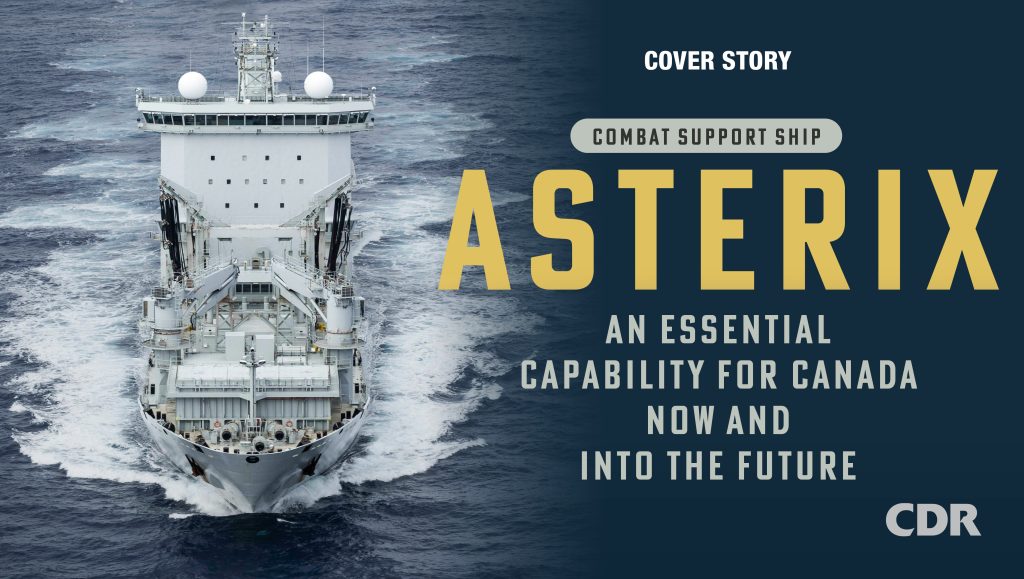
Combat Support Ship ASTERIX
An Essential Capability for Canada Now and Into the Future
BY JOETEY ATTARIWALA
The Combat Support Ship (CSS) Asterix stands today as one of the most consequential and quietly transformative maritime capability decisions undertaken by Canada in the National Shipbuilding Strategy era. After almost a decade of valuable service to Canada, the Asterix is ready to serve for the next decade.
Conceived during a period of acute operational vulnerability for the Royal Canadian Navy (RCN), the ship emerged not from a conventional defence procurement program, but from an innovative solution, presented to the RCN via an unsolicited proposal that was privately funded, cost effective with the risk totally managed by the supplier; all wrapped in a turn-key solution that was rapidly implemented. Owned, operated and maintained by Federal Fleet Services (FFS), crewed by highly qualified Canadian Merchant Mariners, the ship is leased to the RCN for a full 10-year period. Working in full collaboration with Mission Specialists from the Canadian Armed Forces (CAF) Asterix has, since entering service in 2018, restored Canada’s naval supply ship capability in order to sustain naval forces at sea, meet alliance obligations, and respond to crises across the globe.
As the current lease agreement needs to be continued, CDR’s Senior Staff Writer, Joetey Attariwala, reflects on how this service came to be as well as the ship’s impressive operational record, strategic relevance, and cost-effectiveness.
The conversion of MV Asterix into CSS Asterix was carried out at Chantier Davie in Québec and stands as a landmark achievement in Canadian maritime innovation. The project demonstrated what could be accomplished when commercial marine expertise, Canadian industrial capacity, the CAF and Canada’s procurement personnel are aligned around a clearly defined objective. The goal of the conversion was to provide a service that could meet or exceed the re-supply capability of the legacy HMCS Preserver and HMCS Protecteur, while being operated by Canadian Merchant Mariners, in an integrated manner with the RCN.
READ: RCN May Need More Than Two JSS: Case for Retaining CSS Asterix
CSS ASTERIX SPECIFICATIONS
As a combat support ship, Asterix delivers a comprehensive and highly flexible logistics capability. It can carry more than 10,000 cubic metres of diesel fuel (F76) and 1,332 cubic metres of aviation fuel (F44), enabling it to refuel multiple warships and embarked air assets during a single deployment. Measuring 182.5 metres in length and displacing approximately 26,000 tonnes, Asterix is a large and modern platform designed for sustained global operations. From the outset, the vessel was built to operate far from home port, with a focus on endurance, redundancy, and interoperability with allied navies.
The ship produces up to 400 tonnes of fresh water per day, an essential capability for sustained operations and humanitarian missions alike. Extensive dry cargo storage, including containerized supplies housed within a protected internal bay, allows the ship to carry spare parts, ammunition, food, and mission-specific equipment. The tween deck provides additional flexibility for large or specialized payloads and allows for cargo to be moved under cover and transferred to or from the helicopter pad.

Credit: Master Corporal William Gosse, Canadian Armed Forces.
CSS Asterix has conducted over 550 replenishment operations involving liquid and solid cargo transfers and has delivered more than one million gallons of fuel to Canadian and allied warships. Remarkably, the ship has never failed a tasked mission. This record of absolute reliability is not accidental; it is the result of deliberate design decisions, a qualified and experienced crew, and a commercial operating philosophy that prioritizes availability, accountability, and proactive maintenance. With four refueling stations, the ship can re-fuel 2 ships simultaneously and maintain critical system redundancy, as required by NATO standards.
Andrew Powell, Master of the Asterix, emphasized this point, noting that, “Redundancy is built into Asterix from the ground up. We can continue transferring fuel or cargo even if one system is down. That’s one of the reasons the ship has never missed a tasking.”
ASTERIX CREWING MODEL
The ship’s crewing model is central to its success and remains one of its most distinctive features. CSS Asterix is operated by 72 Canadian merchant mariners (36 per hitch) who are employed by Federal Fleet Services, and are deployed with up to 114 Royal Canadian Navy personnel who are embarked for mission-specific roles such as Replenishment-At-Sea operations, communications, aviation support, and command functions. This civilian-crewed, military-integrated model is unique within the Royal Canadian Navy and has proven not only viable but highly effective. Merchant Mariners bring deep technical expertise, continuity, and a culture of self-sufficiency, while naval personnel gain operational experience aboard a modern, NATO-interoperable platform. Over time, the integration between civilian and military crews has become seamless, fostering mutual respect and a shared sense of purpose.
Crew comfort and training value were explicit priorities during the conversion of Asterix. Unlike legacy naval auxiliaries, the Asterix offers modern accommodations, including individual cabins with internet connectivity, contemporary recreation spaces, and high standards of habitability. These features directly contribute to morale, retention, and operational effectiveness. They also enhance the ship’s value as a training platform. According to Federal Fleet Services President John Schmidt, “Asterix can become a key enabler for training and certification. Sailors gain hands-on experience conducting replenishment operations, managing complex systems, and operating alongside allied navies. That training value does not disappear even if other supply ships bring added capacity; it becomes even more important.”
Beyond logistics and training, CSS Asterix offers substantial humanitarian and contingency response capabilities. The ship is equipped with a modern medical complex that includes a hospital ward and fully outfitted dental facilities. In emergency situations, Asterix can accommodate up to 350 evacuees, providing food, shelter, medical care, and logistical support. These capabilities have been demonstrated in real-world operations. During the civil war in Sudan, Asterix supported evacuation efforts in the Red Sea region, underscoring its value as a Humanitarian Assistance and Disaster Relief (HADR) platform. Its ability to deploy rapidly, operate independently, and sustain itself in austere environments makes it a critical national asset during crises.
OPERATIONAL PORTFOLIO
Operationally, CSS Asterix has become a global workhorse for Canada. Over eight years of service, the ship has sailed the equivalent of ten times around the globe, supporting more than 35 missions and major exercises across the Atlantic, Indo-Pacific, European, and Arctic theatres. Its operational portfolio includes sustained support to Operation REASSURANCE in Europe, Operation PROJECTION and Operation HORIZON in the Indo-Pacific, Operation LATITUDE in northern waters, and Operation NEON in support of international sanctions enforcement. The ship has also participated in high-end multinational exercises such as RIMPAC, Formidable Shield, and Cutlass Fury, demonstrating interoperability with NATO and allied navies at the highest levels.
The tempo of operations in 2025 alone illustrates the ship’s enduring relevance. In that year, Asterix spent 134 days at sea, travelled 31,812 nautical miles, and visited five countries. It supported two named operations — Operation REASSURANCE and Operation LATITUDE — and participated in two major exercises: Exercise Formidable Shield and Exercise Cutlass Fury. These deployments required sustained logistical output, precise coordination with allied forces, and consistently high availability. Asterix delivered on all counts, reinforcing its reputation as a reliable and indispensable asset to our allies. The Asterix crew and RCN Mission Specialists work seamlessly together without issues around command and control of the vessel, with each operation conducted with efficiency and effectiveness. The motto onboard has become, “One Ship, One Team, One Mission” and over the life of the service these missions have been met with dedication and total collaboration. This is also applicable to working in high-risk zones such as the South China Sea, where the Asterix has been asked to serve without hesitation.

Photo: MCpl Manuela Berger, Canadian Armed Forces Photo
The professionalism and impact of Asterix’s crew was formally recognized on January 16, 2025, when officers and crew were awarded the Special Service Medal – EXPEDITION for their exceptional contributions to Operation PROJECTION in the spring of 2023. The medals were presented by Rear Admiral Josée Kurtz, Commander of Maritime Forces Atlantic and Joint Task Force Atlantic, during a ceremony held aboard the ship. The recognition underscored not only the ship’s operational significance, but also validates the vital role that FFS civilian merchant mariners play in Canada’s defence. As John Schmidt observed, “This award validates our model. It demonstrates that a contractor-owned, contractor-operated ship that is crewed by Canadian mariners can deliver at the highest operational standards alongside the Navy and NATO allies.”
From a strategic perspective, CSS Asterix delivers exceptional value to Canada’s defence posture. In the Arctic and northern regions, the ship is able to provide a mobile logistics hub capable of sustaining naval and coast guard operations over vast distances in areas with limited infrastructure. Asterix directly supports Canadian sovereignty and situational awareness in a region of growing geopolitical competition. Its ability to refuel and resupply vessels or communities in remote northern waters addresses one of the most persistent challenges in Arctic operations: the tyranny of distance.
SUPPORTING CANADIAN ALLIES
Within NATO, Asterix significantly enhances Canada’s credibility and leadership as an operational partner. By refueling and provisioning allied warships, the ship reduces logistical burdens and extends the endurance of multinational task groups. Canada’s ability to contribute a deployable fleet oiler to alliance operations strengthens collective defence and demonstrates tangible commitment to shared security. Asterix could also be offered more formally as a NATO logistics asset during exercises or contingency operations, further embedding Canada within alliance sustainment frameworks. “We believe that Canada can be a leader in combat support ship technology and capability by offering Asterix as a common service platform that can be used by any of our allies,” Schmidt told CDR. “Asterix is interoperable with NATO vessels and would represent a significant, positive contribution by Canada to our national defence commitments. I know that our team of great Canadian Mariners would be proud to continue their service on Asterix deploying with the RCN or any of our allies in support of Canadian values. As our Prime Minister recently said, what makes Canada great is Canadians, and that is what makes Asterix great as well.”
The ship’s relevance extends into the Indo-Pacific region, where Canada has articulated a clear strategic interest in maintaining a persistent naval presence as part of its Indo-Pacific Strategy. Asterix has supported Canadian and allied vessels during deployments in the Indo-Pacific, including participation in RIMPAC and operations in the Western Pacific and South China Sea regions. By enabling sustained operations far from home ports, Asterix underpins Canada’s Indo-Pacific strategy and provides concrete support to allied maritime security efforts. In this context, logistics is not merely a support function; it is a strategic enabler. Schmidt further added, “There is a lack of replenishment ships amongst other allied navies, with many not having a single ship. This makes Asterix a highly desirable asset to our allies and that means appreciation from NATO and allies when this ship is engaged in support of international task groups, and that the ship and the operating model has created great interest from allied navies — whom FFS is in dialogue with — who are seeking to gain advice on how they could also adopt this solution.”
Crucially, the value of CSS Asterix does not diminish with the arrival of future supply ship capability. Instead, its capabilities will be complementary in addressing the supply ships shortage as capacity is a capability of its own. Additional support ships will require extended maintenance and refit periods that can last many months. During those periods, the Asterix would provide essential capability, ensuring that the Royal Canadian Navy or our allies do not once again face a logistics gap. Powell emphasized this point, stating that “there will always be times when a vessel is unavailable due to maintenance. Supply Ships are rare and valuable assets and are needed to ensure the Navy remains operationally relevant. Without them we no longer have a blue-water capability.”
Commercial acumen extends throughout Federal Fleet Services’ approach to operations and administration. The company emphasizes innovation, schedule discipline, and proactive risk management. FFS utilizes a reliability centered maintenance philosophy using condition monitoring tools to minimize machinery downtime while optimizing replacement cycles, allowing equipment to be replaced before failure rather than after. This approach significantly reduces costs, shortens dry dock periods, and enhances availability. Federal Fleet Services is also advancing cyber security initiatives with companies like Neptune Cyber and Calian, to ensure communications onboard Asterix are secure at all times. “We continue to innovate where we can,” says Schmidt. “Three years ago we installed a greenhouse onboard and grow our own spices and vegetables. It may seem like a small thing, but having fresh vegetables of your own when at sea is unique to Government ships and the crew enjoy the results.”
REDUCED COST OF OPERATION
On reduced cost of operation, Schmidt said, “We are able to provide cost effective services because we build relationships and create strategic partnerships with our key suppliers as well as our customer, the RCN and PSPC. Relational contracting rather than transactional contracting will bring you lower costs, faster delivery and quality service. A key example is our steward and hotel services contractor, Compass Group. We have been working together since the beginning and support each other to ensure that the provision of high-quality food and services is available to our sailors anywhere in the world. We buy things at costs that are at or lower than that of the public sector. As for maintenance costs, these are kept much lower than Government ships because our Engineers are trained to perform first, second and third level maintenance on board the ship, as opposed to having to rely on a third-party maintenance provider or in-service support contractor. We are also incentivized to reduce overall budgeted operational costs and split any savings that we achieve with the Government. This is extremely innovative and no other Government contract that I am aware of drives this level of efficiency and cost effectiveness.”
Schmidt believes that Canada can build on this service as an example of how the private sector can deliver other defence needs in a more cost effective and expeditious manner. “When we compare the cost of our service to that of the public sector building a similar type vessel, the cost of the Asterix is less than a quarter of that of the public sector traditional shipbuilding model,” Schmidt explained. “We believe that our service agreement with Canada is an excellent model for other defence capabilities. Utilizing funding from the private sector is one way that Canada can expedite defence procurement under the Defence Investment Agency and help deliver needed materiel and close our current wide gap in defence spending.”
Security and sustainability investments further underscore Asterix’s adaptability. FFS have invested in a Counter-UAS system in a proactive effort to address the growing threat posed by unmanned systems in contemporary operating environments. “We’re the only Canadian commercial vessel with our own anti-drone capability where we can detect any aerial threats or water-borne threats,” Schmidt told CDR.
TRAINING
Federal Fleet Services is actively exploring ways to expand Asterix’s utility. At the 2025 Imagine Marine Conference, John Schmidt outlined a proposal to utilize Asterix as a national training vessel for Canada’s maritime workforce – Canada’s Training Ship. The initiative envisions embarking up to 12 cadets and a dedicated training officer at a time, providing hands-on experience aboard a fully operational ship while completing Transport Canada and Standards of Training, Certification and Watchkeeping for Seafarers (STCW) certification requirements. Classroom instruction could be conducted onboard, followed by real-time watchkeeping during deployments. “This is a practical solution to a growing problem,” said Schmidt. “By 2032, nearly 43 percent of Canada’s maritime workforce is expected to retire. We need to act now, and Asterix gives us a ready-made platform to help address that problem. We have great plans to re-build and expand the Canadian federal fleet, yet if we don’t train the sailors we won’t be able to operate these needed assets”.
This training initiative would increase the ship’s utilization while addressing a national skills shortage. It would also reinforce Asterix’s role as a bridge between commercial and military maritime communities, strengthening Canada’s broader maritime ecosystem. As Schmidt has stated, “At Federal Fleet, we believe that a rising tide lifts all boats. That philosophy guides our operations and our long-term vision for the industry.”
Financially, CSS Asterix delivers tangible benefits across Canada. The ship is supported by a robust Canadian supply chain that sustains employment in shipbuilding, maintenance, logistics, and maritime services from coast to coast. Many of the original all-Canadian crew members remain with Federal Fleet Services, a testament to the company’s professional culture and the pride its mariners take in supporting the Navy and Canada. This continuity enhances institutional knowledge, reduces training costs, and contributes directly to operational reliability and efficiency.
After nearly 10 years of continuous service, CSS Asterix has proven itself to be a fully mission-capable, cost-effective, and indispensable asset to the Royal Canadian Navy and the Government of Canada. It supports Arctic sovereignty, NATO collective defence, Indo-Pacific engagement, humanitarian response, and naval training. It does so at a fraction of the cost of traditional government-owned auxiliaries while delivering unmatched reliability and cost effectiveness. As Schmidt emphasized, “In a world of uncertainty, you can never have enough logistics support capability. Asterix is proof that this alternative service delivery model works — and works exceptionally well.”
MAINTENANCE
By all respects the CSS Asterix is in excellent technical and structural condition with FFS having found little or no degradation to the hull as a result of recent inspections during its latest drydocking. Asterix is therefore well positioned to remain in service for a further 25 – 30 years. FFS extend their maintenance philosophy to ensure structural integrity with routine condition monitoring of the hull in an integrated maintenance framework aligned with annual Class surveys, and ISO and ISM audits, ensuring continuous compliance with international safety, quality, and environmental standards. The adoption of these advanced maintenance planning practices, including predictive techniques to identify potential equipment degradation ahead of failure, has reduced lifecycle costs, minimized dry dock durations, and maximized operational availability. Collectively, these practices demonstrate a mature, well-governed operating model that supports long-term asset integrity and underpins confidence in CSS Asterix’s extended operational lifespan.
Maintaining the service of CSS Asterix beyond 2028 is not a matter of convenience, but of strategic necessity. In an era defined by geopolitical volatility, alliance commitments, and the centrality of logistics to operational success, Canada cannot afford to relinquish a proven capability, particularly with a demonstrated track record for operational excellence. The Asterix complements all future Government ship capabilities, either directly through its combat ship capability or as Canada’s Training Ship.
“You don’t have to look too far back to remember that we deployed convoys in World War II with merchant mariners. Our current model is a perfect example of seamless cooperation between the commercial and military sectors, while freeing up sailors for combatant ships,” said Schmidt. “There is no doubt the Asterix can continue to serve Canada and our allies for another 25 – 30 years.”
The CSS Asterix is a Canadian success story: innovative, reliable, and cost effective. It has restored a critical naval capability, strengthened alliances, supported humanitarian missions, trained sailors and mariners, and delivered exceptional value for money. The current missions and deployments planned by the RCN in Indo-China and elsewhere would not be possible without the Asterix. The evidence is overwhelming, the logic is soundly afloat, and the conclusion is clear: Maintain the Asterix, an essential Canadian capability.
Joetey Attariwala is CDR’s Senior Staff Writer
