


CANADA’S SPACE INFLECTION POINT
SPACE & COMMUNICATIONS

The 2025 Space & Communications Report prepared by CDR’s Ottawa Bureau Chief, James Careless, reveals a single, defining trend: Canada is entering a sovereign space capability inflection point driven by defence modernization, commercial innovation, and the rise of 3 Canadian Space Division as a strategic leader. These and other trends are outlined below, based on input from the Canadian Armed Forces, space-related agencies, and industry. Here is our report.
3 Canadian Space Division (3 CSD) is a dual-role organization within the Canadian Armed Forces (CAF). Reporting to the Royal Canadian Air Force (RCAF), it is responsible for delivering operationally ready personnel and effects in the Space Domain. 3 CSD also serves as the Joint Force Space Component (JFSC) supporting the Canadian Joint Operations Command (CJOC) and Canadian Special Forces Command (CANSOFCOM), for global CAF operations.
Brigadier General Christopher Horner is Commander of 3 CSD and JFSC. “3 Canadian Space Division is tasked with delivering space power effects that enable the CAF to operate with precision, resilience, and strategic advantage.” he told CDR.
3 CSD has three core tasks: enable and protect the Joint Force, protect and defend critical infrastructure, and control the Space Domain. “As Space professionals, our moral obligation is to enable the CAF’s long-range kill chains, deliver them decisional advantage, and ensure their operational surprise, all while denying the adversary the same,” BGen Horner told CDR.
To fulfill its tasks, 3 CSD conducts operations in four core mission areas. These are Space Domain Awareness (monitoring and understanding orbital activities), Satellite Communications and Navigation (providing secure comms and position/timing services), Space-Based Intelligence, Surveillance, and Reconnaissance (delivering timely, actionable data), and Space Control (assuring access and freedom of action in space through offensive and defensive measures).
3 CSD does this work in collaboration with NATO and Canada’s other allies.
“Deterrence through Space Superiority cannot be accomplished alone, by any nation,” BGen Horner said. “This unity of effort is essential to maintaining strategic advantage.”
At present, BGen Horner and 3 CSD are concerned with four major and escalating threats in the space domain. These are orbital congestion (the exponential growth of satellites and debris, increasing the risk of collisions and signal interference), electronic or spectrum warfare from adversarial states (i.e. Russia and China) that use jamming and signal interference, indiscriminate use of kinetic anti-satellite weapons (that create large amounts of space debris), and cyber vulnerabilities (attacks on satellite digital systems). “These threats are not theoretical, they are real, active, and evolving,” said BGen Horner.
To counter these threats, 3 CSD is executing a phased Campaign Plan to achieve Full Operational Capability (FOC). Phase 1 (now to 2028) is focused on building and preparing the force and capabilities. Phase 2 (2028 to 2035) is focused on shaping the future.
3 CSD’s Campaign Plan has Four Main Lines of Effort (LOE): • Prepare and professionalize the force; • Seamlessly integrate Space Effects into joint plans and operations; • Strengthen interoperability with allies and partners; • Optimize and expand key space mission areas: Shaping future capabilities through disruptive innovation.
“The commercial and private sector is a critical enabler of our mission,” BGen Horner told CDR. “We will continue to and likely expand our reliance on commercial partners for: • Satellite communications, remote sensing, and data analytics that support real-time decision-making; • Launch services, ground station infrastructure, and space situational awareness tools that enhance our ability to operate and respond; • Emerging technologies that support mission assurance, resiliency, and tactical advantage.”
Space Canada is the industry association for the Canadian space sector with more than 100 members. “Canada is operating in a global security environment that is rapidly changing. Protecting our sovereign interests — and meaningfully supporting our allies — now demands far greater attention to space-based capabilities,” said Brian Gallant, CEO of Space Canada. “The federal government has recognized this moment. With a renewed commitment to national defence, including a planned multibillion-dollar investment that will finally bring Canada to NATO’s 2% of GDP defence-spending target, we are taking steps to strengthen our ability to monitor, protect, and act — especially in the space domain.”
However, money isn’t enough. “To effectively defend Canada through space and communications capabilities, the federal government needs to modernize the way it plans, procures, and partners,” Gallant told CDR. “If Canada is serious about strengthening national and continental security, defence spending must also be directed in ways that grow and sustain our domestic space industrial base.” As well, Ottawa needs to deliver on establishing the National Space Council, which it committed to in Budget 2024.
The Aerospace Industries Association of Canada (AIAC) wants Ottawa to create an aerospace industrial strategy that recognizes space as a core, mission-critical domain for Canada’s national security and economic prosperity.
“Space and communications are central to NORAD modernization and to Canada’s broader continental defence,” said AIAC President and CEO Mike Mueller. “That is why AIAC continues to advocate for a coherent industrial strategy, aligned with the National Security Strategy and forthcoming Defence Industrial Strategy, to guide Canada’s new Defence Investment Agency. Together, these tools must align priorities, accelerate procurement and ensure Canada’s industrial capacity grows in step with its allied commitments.”
READ: MIKE MUELLER – AIAC – CDR ONE-ON-ONE
Mueller wants Ottawa to treat space as a core mission domain equal to air, land, sea, and cyber. “Space is now a critical domain for both defence and national security,” he told CDR. “Modern deterrence, intelligence, and emergency response all depend on access to space-based assets.”
When it comes to defence, the Canadian Space Agency (CSA) plays a key role in fostering ‘dual–use technologies’. “Many space technologies have the ability to serve both civilian and defence needs,” said a response provided by the CSA. “These technologies are providing the Canadian space sector with new opportunities to diversify its markets, contribute to Canada’s economy, and develop critical national capabilities.”
A major opportunity for Canadian dual-use space sales was realized in November 2025,
when CSA President Lisa Campbell announced that Canada will invest €407.71 million (about $664.6 million) in European Space Agency (ESA) programs. They include Satellite Communications, Earth Observation, Space Exploration, Space Safety, and Navigation and Technology Development, all of which have dual-use potential. “Money invested in the ESA flows directly back to Canadian businesses,” the CSA said. As well, the CSA recently invested over $13 million in new space technology development projects, most of which have dual-use applications.
READ: MDA Space Awarded $44.7 million Contract by CSA for RCM Replenishment Satellite
Based in Ottawa, ADGA Group provides a range of communications-related services to the CAF and other clients. These services include Tactical Communications and Radio Systems support, Systems/Software/Communications Engineering and Integration for satellite and RF communications, C4ISR and Networked Communications (including Cyber ISR and space-enabled communications), and Security/Resilience of Communications Infrastructure.
With respect to the CAF, “ADGA is serving as an embedded engineering and software-lifecycle partner to the Canadian Army’s Land Command Support System (LCSS) and the wider Land C4ISR (Command, Control, Communications, Computers, Intelligence, Surveillance and Reconnaissance) framework,” said Dan A. Doran, ADGA Group’s Vice President of Business Development and Marketing.
READ: Women in Defence – Jana Lee Murray, ADGA Group
“In this role, ADGA supports the Army’s transition to a fully integrated tactical network,” Doran continued. “This comprises sensors, communications hardware, firmware and software that enable commanders to plan and direct operations, manage information, achieve situational awareness, and exchange data in real time both domestically and on expeditionary deployments.”
Doran is upbeat about increased defence spending and Canada’s investment in a global satellite communications capability. “For ADGA, whose expertise spans C4ISR systems, systems engineering, and secure communications, this initiative aligns directly with our core capabilities,” he noted. “More broadly, the investment (if done smartly, with a focus on growing sovereign industries) will stimulate growth and collaboration across Canada’s defence and aerospace sectors, strengthening domestic innovation, enhancing sovereign communications capabilities, and expanding export potential for Canadian-developed technologies and expertise.”
Calian Group builds RF systems and antennas used in space missions and operates multiple 24/7 global teleports, including sites in Hawaii, Guam, and Canada. The company has delivered more than 160 ground stations on all seven continents in every climate and offers a full line of SATCOM products.
“We are working closely with Telesat on the Lightspeed LEO network, providing key ground segment systems that will support secure, resilient connectivity across Canada, including the Arctic,” said Chris Pogue, President of Calian Defence and Space. “We also recently signed a major contract with a Middle Eastern customer to support two next-generation geostationary satellites that will provide secure government communications across three continents. As well, approximately 40 Calian specialists support the Canadian Space Agency’s Multi-Mission Control Centre, providing flight dynamics, mission planning, command and control, and anomaly response across multiple CSA missions.”
READ: Calian Announces $100 Million to Accelerate Canada’s C5ISRT Defence Capabilities
In 2025, the company launched Calian VENTURES, a Canadian initiative designed to help small and medium-sized defence companies scale and bring innovative products into operational use with the Canadian Armed Forces and allied markets.
“Our first partnership, signed with TACTIQL Inc., supports next-generation intelligence, surveillance and reconnaissance (ISR) software development,” Pogue explained. “Our early focus areas include command-and-control decision support systems, autonomous systems, and space resource orchestration. Together, these programs underscore Calian’s role in delivering mission-critical space and communications solutions.”
CATALYST
PCI Geomatics (doing business as CATALYST) has been providing satellite imagery processing for the past 40 years. “We provide powerful, automated image geometric correction capability which is critical for precise image analysis and data integration with other forms of intelligence,” said PCI Geomatics’ Chief Product Officer Kevin Jones. “We’ve supported the CAF over the years including the Canadian Forces Joint Imagery Centre (CFJIC), Defence Research and Development Canada (DRDC), as well as the Mapping and Charting Establishment (MCE). We also support domestic operations through the large-scale on-premises and cloud-based image processing systems in use at the Emergency Geomatics Services (EGS) within the Canada Centre for Mapping and Earth Observation (CCMEO).”
PCI Geomatics has recently launched CATALYST INSIGHTS Horizon. It provides historical and near-real-time imagery derived intelligence for maritime domain awareness, feature extraction, anomaly detection, and land border monitoring.
Although its CATALYST capabilities have been used for the CAF for years, “we believe there is much more that can be done to leverage our technology in forward deployments to drastically decrease the TCPED (Tasking, Collection, Processing, Exploitation, and Dissemination) cycle,” Jones told CDR. “We have developed advanced AI-based analytics that can support the needed infrastructure to deploy deep learning for object and feature detection.”
GSTS
Global Spatial Technology Solutions (GSTS) is a Canadian artificial intelligence analytics company headquartered in Montreal, Quebec. Its primary product is OCIANA (Operational Cognitive Intelligence Analytics), a sovereign Canadian AI platform that delivers real-time maritime domain awareness using data from space, terrestrial, and maritime sources.
“GSTS is advancing the integration of OCIANA with satellite constellations that provide earth observation, synthetic aperture radar, satellite-AIS, and other space-based data,” said Penny Switzer, the company’s Director of Defence and Security. “We are developing AI models that identify and predict vessel behaviour patterns by combining multiple sensor types and meta-data inputs. The company is also strengthening interoperability between space-based data and maritime or terrestrial networks to enable faster decision cycles. These activities support both Defence and civil missions and align with GSTS’s new Canadian initiative of MAICIE, the Maritime AI Centre of Intelligence Excellence.”
To date, GSTS has participated in DND’s Innovation for Defence Excellence and Security (IDEaS) initiatives, including projects focused on advanced maritime domain awareness. “We have collaborated with the Royal Canadian Navy and the Canadian Coast Guard on multi-agency maritime security applications, particularly in the Arctic and Atlantic regions,” Switzer explained. “GSTS is pursuing alignment with NORAD modernization goals and is engaging in research for the CBSA and RCMP on AI-enabled interoperability through OCIANA’s newly developed tracking features.”
As the legendary creator of the Canadarm (Space Shuttle) and Canadarm2 (International Space Station) robotic arms, MDA Space is synonymous with Canada’s space industry. The company also provides space-based assets to the Canadian government, including MDA Space’s RADARSAT-2 satellite, RADARSAT Constellation Mission, Sapphire, Polar Epsilon 2, SCISAT, and NEOSSat.
“We take our role as a national industrial champion and trusted mission partner to the Canadian government and Department of National Defence seriously,” said Mike Greenley, CEO of MDA Space. “Our Satellite Systems team, based in Montreal, is supporting commercial satellite operators and government mission partners globally as a prime contractor and provider of constellations, satellite systems and subsystems for communications networks in low Earth orbit (LEO), medium Earth orbit (MEO), and geostationary orbit (GEO). Once operational, it will be the world’s largest high-volume manufacturing facility in its satellite class, with capacity to produce up to two software-defined MDA AURORA digital satellites per day. We are under contract for some of the most advanced commercial space systems in the world, including Telesat Lightspeed and Globalstar’s constellation for Apple.”
In addition, MDA Space is building MDA CHORUS, a fourth-generation commercial synthetic aperture radar (SAR) satellite constellation based on RADARSAT heritage. It is also building Canadarm3 for NASA’s Moon-orbiting Gateway space station and the chassis, wheels, locomotion system, and navigation cameras for Europe’s Rosalind Franklin rover that will launch to Mars in 2028.
As of November 20, 2025, Maritime Launch Services (MLS) has achieved two successful suborbital launches from Spaceport Nova Scotia, the company’s launch site near Canso, Nova Scotia. The second flight used a Barracuda single-stage, solid-fuel suborbital vehicle, which is capable of carrying payloads of up to 40 kilograms to altitudes of approximately 120 kilometres.
“We recently announced funding from Export Development Canada (EDC) and a new partnership with MDA Space to advance the build-out and readiness of Spaceport Nova Scotia for orbital launch operations,” said Stephen Matier, President and CEO of Maritime Launch Services. Both partners provided $10 million each in funding. “Together, these commitments accelerate the readiness of Spaceport Nova Scotia for orbital operations and strengthen Canada’s foundation for sovereign launch capability,” he told CDR. “As we prepare for orbital operations, we are collaborating with allied launchers and our Canadian launch vehicle partner, Reaction Dynamics, to ensure that Spaceport Nova Scotia supports the full range of domestic and allied launch requirements.”
At present, Maritime Launch Services does not have any contracts with the CAF or DND, but the company is hoping to garner them in the future. “Our focus is on enabling Canadian and allied missions that serve defence, security, and space-domain awareness needs by providing a sovereign domestic launch option,” said Matier.
Network Innovations Canada is a specialized systems integrator that designs and delivers secure, reliable, and resilient converged private networks by leveraging satellite, cellular, and terrestrial technologies.
“We provide mission-critical satellite and secure communication solutions that support Canadian defence operations across land, sea, air, and the Arctic,” said Frank Czulo, President of Network Innovations Canada. “Our capabilities include multi-orbit SATCOM (LEO, MEO, GEO), Beyond-Line-of-Sight communications for mobile, maritime, airborne, and Arctic missions, and deployable and expeditionary SATCOM systems. Our focus is simple: ensure the CAF has reliable, resilient connectivity — anywhere, under any conditions.”
Beyond these capabilities, Network Innovations is working on zero-trust overlays that protect CAF traffic across commercial and military constellations, plus engineering and managed services support to prime contractors on key DND programs. “We support or are positioned for programs central to NORAD modernization and Arctic sovereignty,” Czulo told CDR. These programs include Arctic and Polar SATCOM modernization, NORAD communications upgrades, Canadian Surface Combatant SATCOM, 3 Canadian Space Division space-support initiatives, and Canadian Special Operations Forces deployable SATCOM. “We provide the secure connectivity that enables Canada to sense, understand, and act, at home and abroad.”
As for the future, Frank Czulo expects that NORAD’s $38.6 billion modernization budget will invest heavily into space-based systems. “NORAD modernization cannot succeed without robust, survivable, redundant communications, particularly in the Arctic,” he concluded.
NordSpace Corp. is an end-to-end space missions company. Its capabilities include the development of Canadian orbital-class medium-lift launch vehicles and 3D-printed rocket engines, dual-use small satellites, a dedicated spaceport (under construction in Newfoundland and Labrador), and hypersonic technologies.
“Space is the ultimate high ground and is critical for pan-domain awareness of the threat landscape, just like the land, sea, and air,” said Rahul Goel, CEO and Founder of NordSpace Corp. “Without space-based capabilities that are not built for Canada’s needs, particularly in northern regions of the country, we lack the communication, navigation, observability, and sovereign access to space to detect and respond to national security threats.”
NordSpace is keenly interested in providing space services to the CAF. “The most recent federal budget outlines an investment of $182.6 million for sovereign space launch development,” Goel explained. “NordSpace is best positioned to deliver a true sovereign space launch capability as we are not only developing a dedicated spaceport and satellite systems, but designing and manufacturing our own launch vehicles entirely in Canada. Crucially, NordSpace is the only Canadian entity developing medium-lift (5,000 kg+ to LEO) capabilities. Payloads of significant value and strategic importance are typically about 1,000 kg+ and are placed at minimum in low Earth sun synchronous orbits—ideally higher energy orbits.”
SpaceBridge Inc. delivers advanced SATCOM solutions, such as VSAT (Very Small Aperture Terminals) platforms, to its clients. “Our latest, next generation multi-purpose platform, Estella, was recently introduced to the market,” said David Gelerman, SpaceBridge President and CEO. “Estella is a software-defined, high-capacity satellite ground infrastructure platform designed to seamlessly operate across multi orbits, providing persistent, resilient, and secure connectivity for defence, government, and commercial missions. We complement Estella with a full portfolio of VSAT terminals, multiple waveforms, network automation tools, and managed services.”
According to Gelerman, SpaceBridge technologies have supported Canadian government users for decades, and Estella is positioned for upcoming requirements aligned with CAF modernization priorities. “We are targeting programs related to global SATCOM capability expansion, including multi-orbit integration; NORAD modernization, especially resilient ground-segment infrastructure; Arctic and Northern communications initiatives; and deployable and mobile command-and-control systems,” he told CDR. “Our objective is to provide sovereign, secure, Canadian-developed SATCOM solutions that enhance communications assurance for the CAF. As global threats evolve, particularly in the Arctic and across contested domains, space is no longer a supporting asset. It is the backbone of command-and-control, intelligence sharing, and real-time operational awareness.”
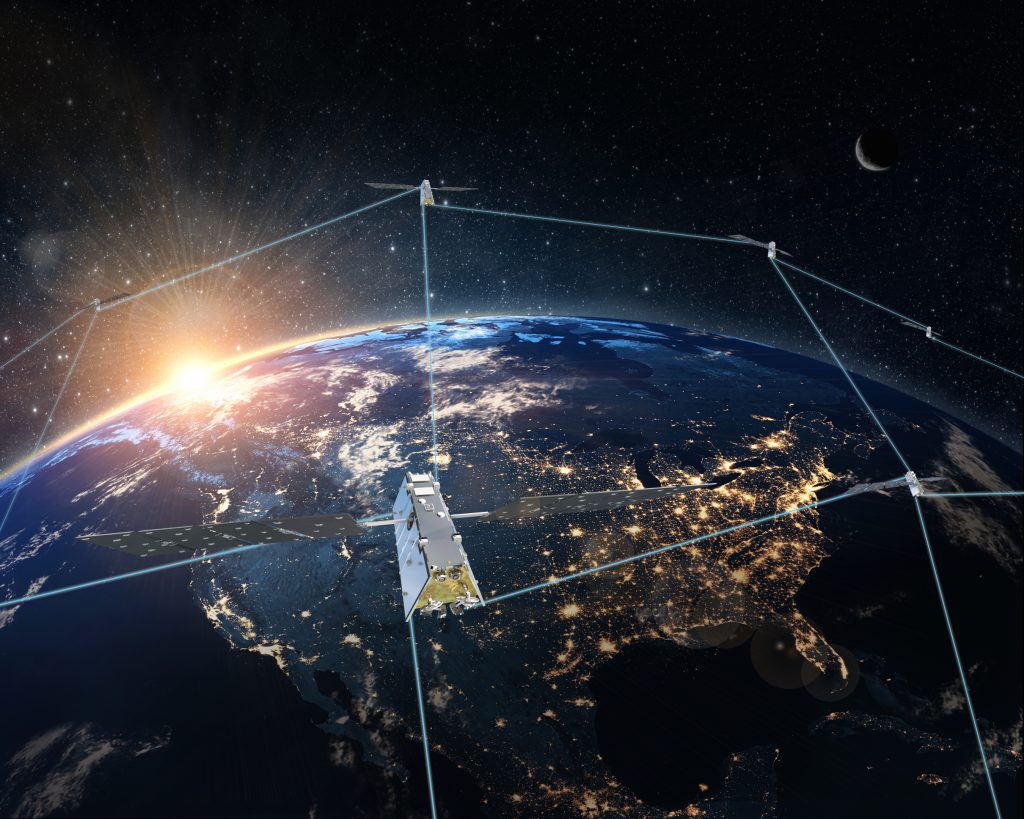
Headquartered in Ottawa, Telesat is one of the largest global satellite operators, providing secure SATCOM solutions for defence and enterprise clients. Telesat Lightspeed, the company’s advanced LEO satellite network, is the biggest space program in Canadian history, all designed, built, and operated in Canada.
“A top priority of Telesat Lightspeed is addressing the DND’s Arctic connectivity for NORAD modernization and protecting Canada’s sovereignty,” said BGen (Ret’d) G. Michael Adamson, Telesat’s Director of Defence Strategy and Business Development. “The closest thing to bespoke military satellite infrastructure available, Telesat Lightspeed is uniquely positioned to deliver the reliable, resilient, secure connectivity DND/CAF need.”
Supporting the CAF is nothing new for Telesat. “For several decades, our satellites have been connecting the North Warning System radar sites for all the northern approaches across North America,” BGen (Ret’d) Adamson told CDR. “We also provide connectivity services to Navy and Coast Guard ships for operations in Canadian and Arctic waters, as well as internationally.”
As for the CAF’s future plans for space? BGen (Ret’d) Adamson is confident that Telesat can play a key role in making them happen. “We believe there can be a role for Telesat Lightspeed to serve the mission-critical connectivity requirements for the DND and our allies,” he said. “Building on our 56-year heritage and experience, we designed Telesat Lightspeed to serve modern defence requirements like cybersecurity, resilience, low latency and full global coverage, all critical to supporting the DND’s significant communications requirements.”
Taken together, these organizations illustrate a national space sector undergoing rapid transformation. With 3 CSD driving operational requirements, industry scaling sovereign capabilities, and government agencies investing in dual-use technologies, Canada is entering a strategic inflection point in space. The decisions made now will define the nation’s ability to monitor, defend, and act across the Northern approaches for decades to come.
James Careless is CDR’s Ottawa Bureau Chief

