


MISSILE DEFENCE: Attack on Iran Highlights Need for Canada to Increase its Firepower
BY RICHARD NGHIEM
The US State Department has approved a potential $2.19 billion foreign military sale of 175 Tomahawk Land Attack Missiles (in various variants) to the Netherlands, according to a US DSCA’s (Defence Security Cooperation Agency) announcement made on April 25, 2025. The proposed deal includes the sale of up to 163 Tomahawk Block V All-Up-Round (AUR) missiles, 12 Tomahawk Block IV AURs, 10 Tactical Tomahawk weapons control systems, and two Block IV telemetry missiles. In addition to the munitions, the package covers critical support infrastructure such as satellite data link terminals, secure communication systems, missile containers, training, software, and maintenance services.
The Netherlands is expected to integrate the Tomahawks into its military ‘with ease’, enhancing its long-range strike capabilities against evolving threats. With these cruise missiles, known for their precision and extended range, the Dutch Navy will be fully capable of launching conventional surface-to-surface missile strikes at stand-off distances and destroying strategic targets, deep inland, at will. Such aim points include enemy command and control nodes, early warning radars, air bases, integrated air defence systems, and munitions storage facilities.
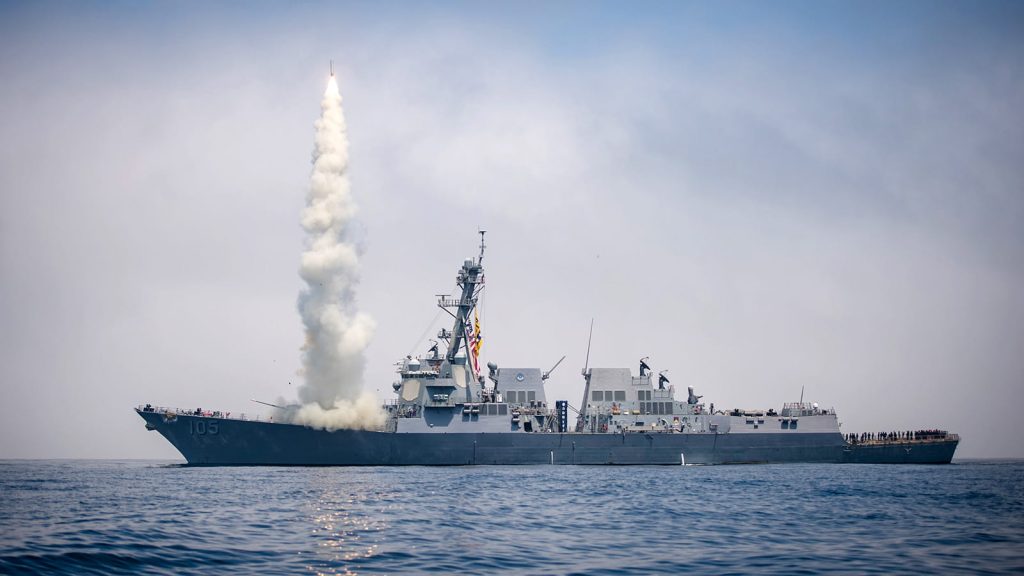
Officials emphasized that the sale will not alter the basic military balance in the region, but will help ensure interoperability among NATO forces in an increasingly complex European security environment and strengthen the Netherland’s role in collective defence. The decision to procure Tomahawk missiles was publicly made in April 2023 by the Dutch State Secretary for Defence as part of a “maritime strike” capability for the RNLN. In terms of fielding, these long-range weapons will be installed across the navy’s four De Zeven Provincien-class frigates via the ships’ existing Lockheed Martin strike-length Mk 41 vertical launching systems (VLSs), with potential future deployment on its soon-to-be-acquired Orka-class submarines and its current fleet of Walrus-class attack boats.
THE TOMAHAWK MISSILE
Developed by RTX Corporation in Tucson, Arizona, the Tomahawk has revolutionized modern naval warfare, offering pinpoint precision and long-range strike capability. The Block V variant, in particular, represents the cutting edge of cruise missile technology as it is an all-weather long-range, precision-guided subsonic cruise missile that can be launched from surface warships and submarines for land attack warfare and can strike targets precisely from more than 2,400 km away, even in heavily defended airspace. This unique capability of hitting strategic aim points deep within enemy territory with an accuracy of about 4 meters is due to the munition’s advanced navigation systems, including GPS, inertial guidance, and terrain contour matching that allow it to follow complex flight paths while flying at extremely low altitudes to evade radar detection and hostile air defences. The weapon’s guidance systems are also designed to be resistant to jamming, making them effective even in challenging electronic warfare environments.
More impressively, this missile, equipped with a 1,000-pound high-explosive warhead, can be reprogrammed mid-air via two-way satellite communications to attack alternate sites at any of 15 pre-programmed locations or be redirected to different GPS target coordinates where it can loiter over an area for hours, providing flexibility in striking targets of opportunity and the ability to coordinate a full-scale aerial bombardment on dozens of enemy facilities and installations, as part of a ‘shock and awe’ operation. Once these aim points have been hit, any remaining Tomahawks can hover over the scene and provide battle-damage assessment for Joint Force commanders through an onboard camera.
COMBAT HISTORY
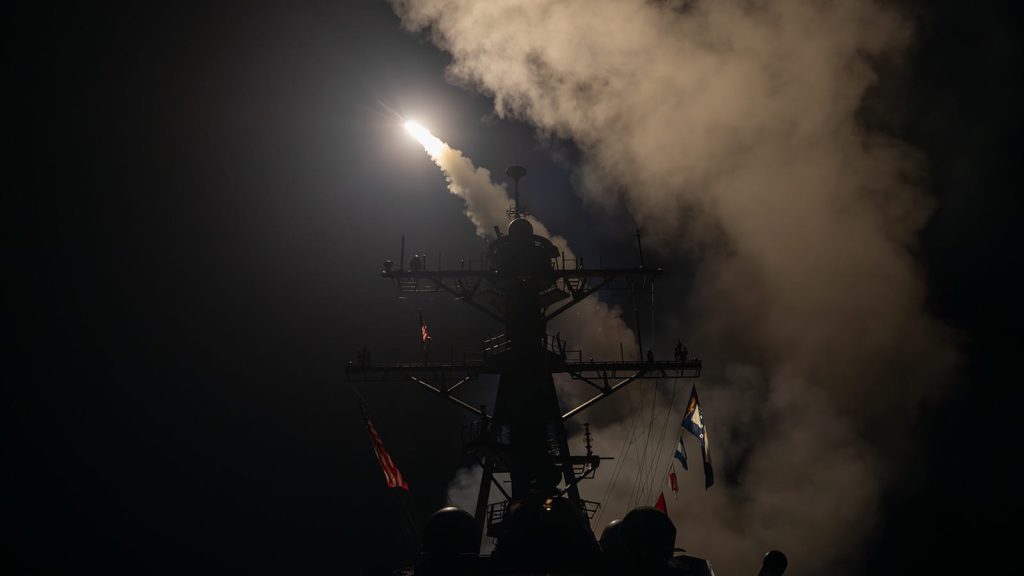
This long-range precision-guided munition, consequently, has become the weapon of choice for the US and several other allied militaries with it having been used in combat more than 2,350 times since its debut during the 1991 Gulf War. Recent examples of its employment include America’s military intervention against President Bashar al-Assad from 2017 to 2018, during which US Navy destroyers, cruisers, and attack submarines launched 66 Tomahawk missiles at Syrian chemical weapon facilities in retaliation for the Douma chlorine gas attack and another 59 missiles against Shayrat Airbase near Homs, in response to the Syrian regime’s Khan Shaykhun sarin attack, striking “research and development centres, chemical weapons bunkers, attack aircraft, hardened aircraft shelters, petroleum storage sites, ammunition supply bunkers, air defence systems, and radars.” In terms of damage inflicted, approximately 20 planes were destroyed, and 124 out of the 125 cruise missiles launched had “severely degraded or destroyed” their intended target. These kinetic strikes in conjunction with diplomatic pressure and economic sanctions ultimately forced President Bashar al-Assad to halt all chemical attacks and dismantle his chemical weapons program.
Additionally, during the US’ recent sustained air campaign in Yemen, codenamed Operation Rough Rider, hundreds of Tomahawk strikes were conducted against Houthi rebel assets including command-and-control nodes, communications infrastructure, coastal surveillance radars, munitions depots, mobile missile launchers, drone production facilities, and air defence systems. This offensive was Washington’s response to constant Houthi attacks on civilian cargo ships transiting the Red Sea and the failure of Houthi leadership and commanders to abide by repeated warnings from American officials to cease such hostilities. After 7 weeks of continuous aerial bombardment, the terrorist group eventually sought an exit strategy and agreed to a ceasefire, restoring freedom of navigation once again in the Red Sea.
BLOCK V UPGRADES
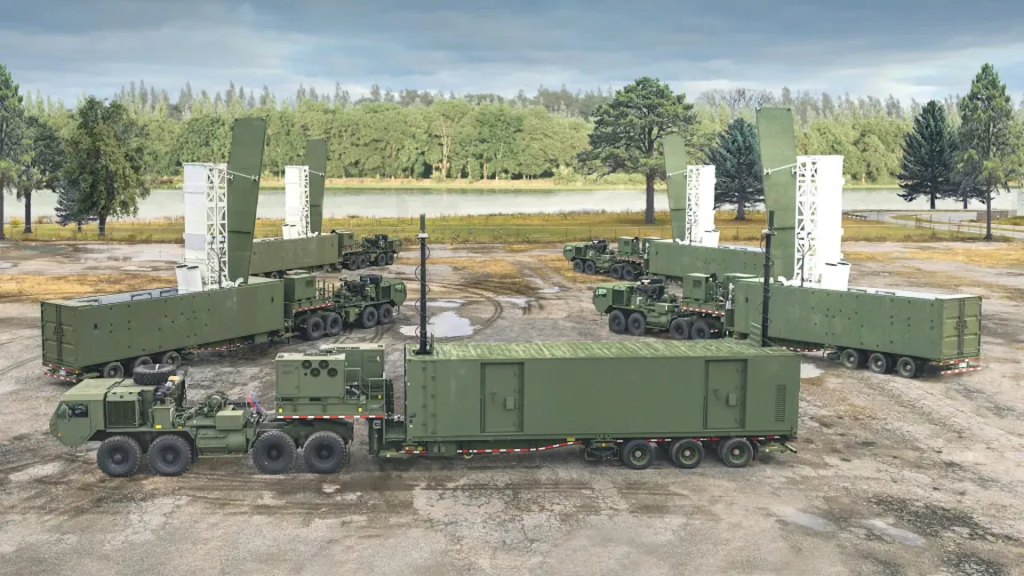
As a result, given this extensive history of highly successful combat operations, it is no surprise that Raytheon is currently taking all measures to re-certify and modernize the Tomahawk, extending its service life by 15 years, and resulting in the new Block V series. What sets this variant apart is its increased tactical versatility, longer range, and upgraded navigation, communication, and in-flight targeting. Introduced in 2021, the missile has two versions: the maritime strike Block Va and the land-attack Block Vb. The Block Va features a new seeker to strike moving vessels at sea, while the Block Vb is equipped with a joint multi-effects warhead to take out more diverse land targets. These weapons can also be fired from a variety of platforms including submarines, warships, and the new ground-based Typhon missile launcher.
Having said that, despite all of these new formidable capabilities, the UK Royal Navy is so far the only user of the Tomahawk outside of the US. This has historically been the case due to strict export controls. However, with Washington’s recent shift towards offshore balancing as its new grand strategy, there has been a relaxation of restrictions on these munitions, enabling Australia, Japan, and the Netherlands to procure Tomahawk cruise missiles. Other potential customers include the German Navy and the Royal Canadian Navy which is highly interested in arming its future River-class destroyers with Raytheon’s iconic long-range precision weapon.
TOMAHAWK MISSILES FOR CANADA
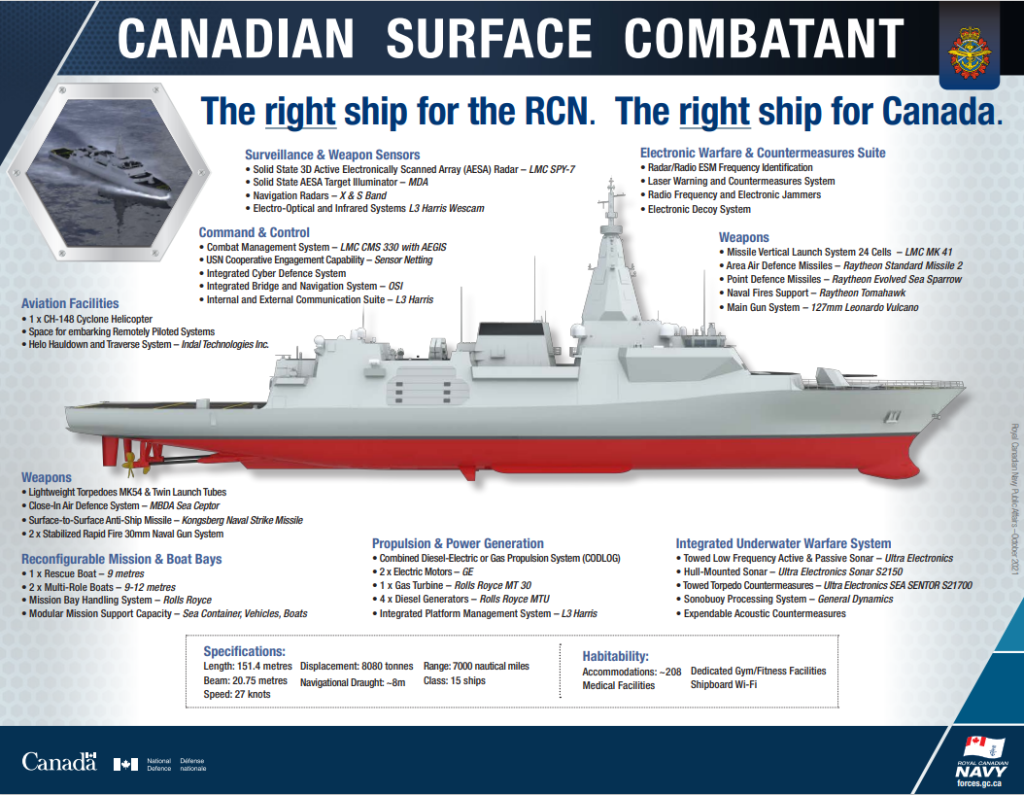
According to an official DND/Raytheon/Lockheed Martin infographic, the Canadian Surface Combatants’ arsenal will most likely include the Tomahawk for “naval fires support,” a term that typically refers to stand-off strikes against targets on land. Such a new maritime capability, if acquired, would give Canada a significantly greater role in future operations, especially together with allies and partners, such as other members of NATO. More importantly, it would fulfill DND’s priority of providing the Nation’s fleet with the striking power and long-range sea-launched missiles it needs to effectively deter threats and, if necessary, accurately “strike targets with greater effect at ranges longer than our adversaries,” as stated in the Defence Policy Update. The operational implications of this potential procurement are profound as the RCN’s future River-Class Destroyers are already projected to be formidable platforms, equipped with advanced SPY-7 radar systems and Naval Strike Missiles. Integrating Tomahawks will further transform these ships into strategic assets capable of striking targets deep inland or at sea, enabling them to contribute more to offensive military interventions like America’s recent sustained naval campaign in the Red Sea against the Houthis and other similar coalition missions throughout the Middle East.
Additional potential combat scenarios include supporting NATO operations in Eastern Europe as the missiles’ long range will allow Canada’s destroyers to engage threats or hold Russian assets at risk, from Kaliningrad to the Kola Peninsula, enhancing the alliance’s deterrence posture without exposing themselves to Russian A2/AD defences, a critical advantage in a contested environment. More importantly, from a strategic perspective, the RCN’s acquisition of Block V missiles would be a significant addition to NATO’s arsenal as apart from the American Navy, the Royal Navy is the only maritime force that currently operates Tomahawks in Europe. This move aligns with the alliance’s broader push for burden-sharing, especially as European allies face pressure to reduce reliance on US military support amid uncertainties in transatlantic relations.
Furthermore, on the home front, with regards to Canada’s own national sovereignty, River-Class Destroyers armed with these weapons could certainly give Ottawa a new organic ability to project naval power, fulfill its NORAD obligations, and provide an anti-access/area-denial deterrent for responding to challenges to the country’s most vital national security interests, especially its territorial claims in the increasingly strategic Arctic region.
As a result, a future acquisition deal for new Block V missiles, facilitated by the US Foreign Military Sales system, which enables rapid procurement for the RCN, is absolutely essential to send a clear geopolitical message to Russia that its growing naval presence in the Far North, including submarines and surface ships, will no longer be tolerated. At the same time, it also raises questions about Ottawa’s heavy reliance on American technology. This strategic dependency in addition to increasingly strained relations between the current US administration and NATO have consequently caused Canada along with its EU allies to explore their own defence initiatives and pay more attention to domestic alternatives to American weapon systems.
COMPARISON TO RUSSIAN
& CHINESE MISSILES
Having said that, these concerns, while valid, do not justify Ottawa abandoning its plans to procure the Tomahawk. This is due to the fact that among all of Canada’s European and Asian allies, no country can currently offer a viable missile system that is even remotely as capable as the Block V. To appreciate the significance of this acquisition, it is worth comparing the Tomahawk to its global counterparts in terms of combat effectiveness. For example, Russia’s Kalibr cruise missile, frequently deployed in Syria and Ukraine, shares a similar range and low-altitude profile but lacks the Block V’s maritime strike capability and advanced retargeting features. China’s YJ-18, another competitor, offers high-speed terminal sprints but is less proven in operational contexts and cannot match the Tomahawk’s battle-tested reliability, with over 2,350 combat launches since its debut in the 1991 Gulf War. Over that time, the latter has been employed in numerous conflicts in countries all over the world, including the former Yugoslavia, Kosovo, Afghanistan, Iraq, Libya, Syria, Somalia, Sudan, and Yemen.
That said, if Ottawa still wants an alternative non-US precision weapon, the closest allied counterpart to the Block V would be the French Scalp Naval, otherwise known as Missile de Croisière Naval (MdCN). However, its availability for export remains an open question. There is no public data of any Scalp Naval exports so far and reports suggest that only the French Navy has ordered around 200 units in total. More importantly, this missile cannot be fired from the RCN’s future River-Class Destroyers’ Mk41 VLS. One can also question its reliability and effectiveness as the MdCN was first used during the April 2018 missile strikes against Syrian chemical weapons production sites, with the FREMM frigates Aquitaine, Provence, and Languedoc launching three of the missiles, of which two immediately malfunctioned and failed to fire and another which suffered considerable technical difficulties before hitting its target.
FOLLOWING THE NETHERLANDS’ LEAD
Overall, the Netherlands’ acquisition of Tomahawk missiles is a microcosm of NATO’s evolution. It reflects a small nation’s determination to adapt to a world where threats are no longer distant. The technological prowess of Block V, combined with the strategic foresight of Dutch planners, will soon position the Netherlands as a key player in NATO’s northern flank and the Arctic. As a result, it is imperative that the RCN follow the Royal Netherlands Navy’s lead and continue on with its planned procurement of Tomahawk cruise missiles despite current economic and political tensions between Ottawa and Washington.
This course of action will enable Canada to not only effectively enforce an A2/AD zone in the Far North and assert its sovereignty in the region, but also bolster its contribution to international maritime security missions and other NATO operations. Ultimately, while Ottawa’s purchase of new River-Class Destroyers had already looked set to usher in a new era for the Royal Canadian Navy, the potential arrival of the Tomahawk would mark an entirely different monumental advancement, completely transforming the service branch. Armed with these cruise missiles, together with the various other weapons they will be able to employ, the fleet now looks ready to not only defend Canada’s national sovereignty, but also, more importantly, project a new form of maritime power anywhere around the world in support of the Nation’s foreign policy.
Richard Nghiem is a Regular CDR Contributor
