


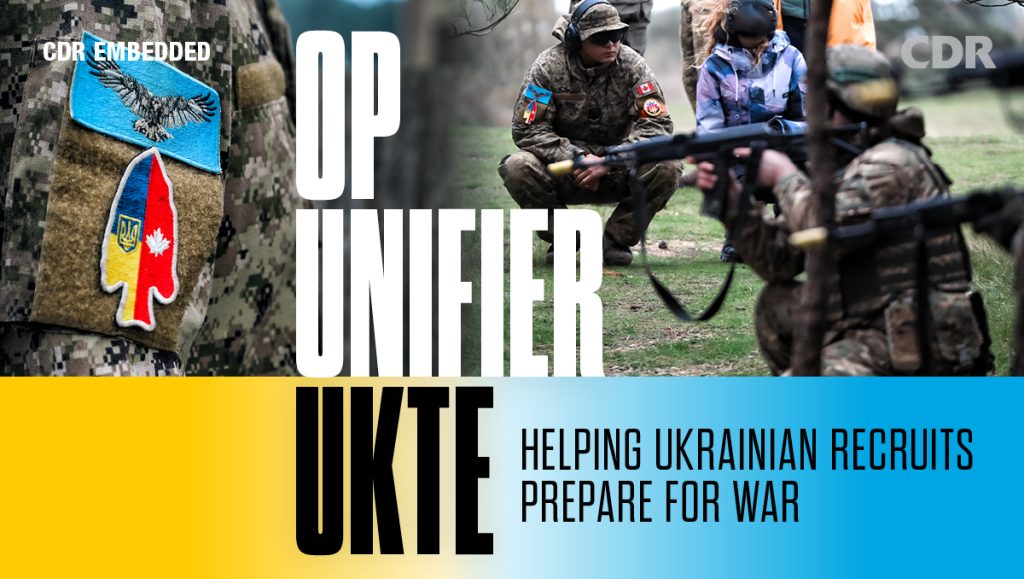
CDR had the honor and privilege of entering the gates to Op UNIFIER’s UK Training Element (UKTE) in Southern England. We asked UK Correspondent, Joe Campion, to report on Canada’s contribution to the training of Ukrainian Armed Forces recruits in the UK. CDR was even granted a rare opportunity to speak directly with Ukrainian recruits to get their perspective on the challenges and fears of preparing for war. Here is our exclusive report.
Helping Ukrainian Recruits Prepare for War – Op UNIFIER
Operation (Op) UNIFIER is the Canadian Armed Forces’ (CAF) military training, professionalization, and capacity building mission in support of Ukraine. Launched in 2015 at the request of the Ukrainian government following the illegal annexation of Crimea, it was expanded in early 2022 during the Russian pre-invasion military buildup, and currently extends by Government of Canada mandate through to 2026 – and potentially beyond. Headquartered in Poland, Op UNIFIER supported by just under 400 CAF personnel currently provides training in multiple military elements to new Ukrainian recruits such as, Recruit Training in the UK, Engineer training in Poland, Combat Medic training also in Poland and Junior Officer Leadership Training in Latvia, all in harmony with various other nations. Seven years later, after Vladimir Putin’s illegal invasion of Ukraine on February 24, 2022, Operation UNIFIER was expanded, and training elements were withdrawn from Ukraine and placed around Europe.
In August 2022, The CAF’s recruit training, now known as the UK Training Element (UKTE) of Op UNIFIER was located to Southern England. In Collaboration with trainers from the UK, New Zealand, Lithuania and Estonia, the UKTE is producing freshly trained Ukrainian soldiers roughly every 35 days (five weeks) at the Southern England site. This was a three-week course, and apparently is soon to be changed to a seven-week course to integrate more opportunity for practice. During those five-week UK designed courses, a few hundred Ukrainian trainees are segmented in to platoons of 50 and trained by roughly 10-12 CAF instructors per class/platoon.
The UKTE encompasses approximately 160 CAF personnel, most of whom are instructors who train Ukrainians under the British led Operation INTERFLEX. Canada is the largest deployment of personnel after the UK for Op INTERFLEX alongside 12 other nations. The CAF members are on a six-month deployment with accommodation located offsite. Deployed CAF members are tasked to train a rotation on the 35-day course, then have roughly four days before the next rotation arrives. CDR was told this break between rotations can sometimes be as small as one or two days depending on circumstances. During our visit, CDR had the opportunity to speak with Lieutenant Colonel Petersen, Task Force Commander of Op UNIFIER. “Our soldiers are obviously dedicated to this mission, and for the time they are here, they put it all on the table, and they will train, train, train,” he told CDR. “We tell them, you know that you’re here on a mission; we need to reinforce the armed forces of Ukraine by providing support and training, and we’re going to do it.”
Now over 1,000 days since the full-scale invasion of 2022, Petersen mentioned “since 2015, the number of Ukrainian troops trained across the UNIFIER training elements is around 43,000. Two years after the full scale invasion, we are at roughly 9,800 troops trained and we’re going to hit 10,000 within the next month or two and have done 6,000 of those in just the past year.”

LCol Petersen, who is based in Poland, is responsible for the over watch of CAF personnel across all European sites of Op UNIFIER. He took over the Task Force in August of this year on a six-month rotation and will hand the Task Force over in February 2025. Worth noting: This is the LCol’s fourth deployment as a CAF member, with Petersen having previously served in Afghanistan, Iraq, Bosnia and Herzegovina.
CDR asked LCol Petersen about how this deployment feels on a personal and professional level. “We’ve seen territory annexed in Europe for the first time since the second world war, you look at the news and you see a maternity hospital get hit, cities are struck by strikes, villages are occupied or whole towns are flattened, so the fact that we’re able to contribute to enabling them to resist that makes you feel like you’re doing the most relevant thing you can do in uniform right now.”
As for what he believes the UKTE is providing Ukraine, LCol Petersen said, “We are training students to shoot, move, communicate and medicate, right now. Soldiers will come here and will learn skilled arms with a rifle, they will learn urban and rural field craft – so operating in a trench – and medical training, a lot of first aid. We really want to do two things: make them more lethal and more survivable, because that is our best way to contribute to Ukraine’s success. Russia has four times the amount of manpower, it’s a bigger country and it’s got a larger defence industrial base however, we can give them the qualitative edge in equipment and in trained personnel.”
WHAT KIND OF TRAINING DOES THE CAF PROVIDE AS PART OF Op UNIFIER – UKTE?
Once Ukrainian recruits arrive in the UK, which is arranged under Op INTERFLEX, there are multiple Training Delivery Units (TDUs). The CAF are part of TDU2 alongside New Zealand, Estonia and Lithuania. The other TDUs are located elsewhere in the UK and are contributed to by the eight other coalition nations.
Ukrainian recruits are sent to the site of UKTE, split into platoons of roughly 50 individuals and put through a Handling And Processing (HAP) unit. There, they will be fitted and equipped with the various individual soldier equipment they need, such as uniforms, body armour and training weapons, all of which is provided by the British.
They are then handed over to the Canadian instructors and undergo the five-week course. CDR spoke with Major Colton Morris, Commanding Officer of the UKTE and Sergeant Rafuse, 2IC [second in command] of Training Team 19 of Trident Company. Both explained “We equip them with the baseline capabilities that an infantry soldier would require to operate. Op INTERFLEX tries to focus on increasing the lethality, survivability, and offensive spirit. We equip them with that warrior mindset so when they go back to Ukraine, they’re ready to participate in the war.”

3 MODULES INCLUDED IN Op UNIFIER UKTE TRAINING
According to Maj Morris, the course is broken down into three modules. First is the fundamentals, where the recruits will learn how to use a weapon and how to take up different firing positions. “We harp on massively about weapon safety, we then teach them how to actually fire the weapon, how to load it, how to load a round into the chamber and then we’ll move into stoppage drills, so if they have an issue with the weapon the know how to remedy it, and get them firing again ASAP,” said Sgt Refuse.
They will also be taught basic tactical combat casualty care (TCCC). “It is a scaled down version of the TCCC program due to time contraints, they learn combat medicine, how to deal with injuries that are sustained on the front line, common ones being gunshot wounds or other penetrating trauma, as well as injury type medical care that we as just general service members learn,” Maj Morris told CDR.
When it comes to counter explosive ordinance, troops are taught skills such as ground line awareness, spotting, identifying and avoiding explosive hazards in urban and rural environments. The troops also get introduced to counter-UAS operations and are given time on an anti-armour weapon simulator that is located on site which teaches them how to fire a rocket and/or missile to destroy a tank, aircraft or drone. Also, part of the fundamentals is heading out on a two to three-day field exercise teaching basic field crafts, operating in the woods, camouflage concealment, how to sleep on the ground and the security posture of living outside the wire in a threat environment, “which all contributes to the survivability aspect” Sgt Refuse added.
The second module is the transition to the tactical portion of the course, segmented into urban and rural environments. “What we’re mainly focused on here is how to break in and fight through trenches,” Maj Morris told CDR. “We teach them trench clearing tactics and the skills and drills to get them from wherever they are to that trench which has more of a patrolling focus, we will teach the different formations required to get safely to that trench, break into the trench and clear through, and that’s kind of the main focus of the rural environment ops.”
The urban environment is a similar focus but instead of trenches, it is buildings. Recruits will be taught how to move through the urban environment, how to break into buildings safely and effectively, how to clear rooms, and how to consolidate and hold ground in that environment.
After the tactical portion, the third module focusing on live fire commences. “We take them through the basics and fundamentals of marksmanship: how to shoot accurately; how to shoot consistently; how to shoot somewhat rapidly; and then progress into a level where they’re able to shoot, move, and communicate with each other in two to four man groups,” said Maj Morris. “We take all they’ve learned from module one and two and layer them on top, add more complexity and then put the recruits in that scenario. We call this battle inoculation.”
CDR was able to witness first-hand Maj Morris’ third platoon of subunit alpha carry out the battle inoculation, part of the final module of the site’s mock urban facility. “This one specifically is in the urban environment, they will go from patrolling a rural area in a wooded location, moving through some explosive threats, they’ll hit a security outpost that’s outside the urban area, they’ll break into the urban area, they’ll link in with friendly forces, they’ll use drones to gain situational awareness of the area and then they will assault a building,” said Maj Morris. “Throughout that, we throw in some injects to add confusion such as actors playing civilians in the urban area, and the recruits have to deal with getting them out of the hostile environment safely, we will have CAF personnel playing opposing forces as well firing blanks at the recruits. The recruits will be firing blanks also to make it as real as possible.”
CDR SITS DOWN WITH UKRAINIAN RECRUITS
CDR had the humbling honor of sitting down with four Ukrainian recruits who are going through the UKTE. Andriy, Danylo, Oleksander and Dmytro were all just over a week into their training at the time of writing and were all conscripted to serve their nation.
Andriy, who is 38, a previous carpenter who has a wife and two children back home, said “I have a wish, that everyone that has come to our land with their weapons systems, they need to be held accountable and I have many friends in the Armed Forces of Ukraine, some who are unfortunately now dead including my cousin, so I would like to give it a try.” When asked about the training he replied, “The training is wonderful, but I am a civilian and it’s a bit hard for me.” When asked about life before the invasion, Andriy replied “My life was honestly wonderful” and when asked the question about life after the 2022 invasion and what his family thinks of him serving he replied, “I was scared and it is not great fun, but I will do anything to make their lives a little bit more full of joy, I am fighting for Ukraine.” CDR asked him if he was scared going to war, he replied “Everyone is scared of war and everyone wants to live in peace, but as far as the weapons systems, I used to go hunting and I do not know yet how it will feel.” Andriy thinks the war will end with negotiations but hopes for victory and plans to head to the seaside with his children when the war ends. CDR asked him what he would say to the Russian’s who illegally invaded Ukraine, he replied with “Get off Ukrainian Land”.
Danylo is a 31-year-old waiter and chef from Kyiv who had his own sushi bar before the war broke out and subsequently became a chef in a hospital during the first few months of the conflict. We asked Danylo some of the same questions posed to Andriy. “Some of my friends have been fighting since 2014, the training is very cool, well for a civilian it is a lot, it’s the first time I have put on a uniform and ever handled a weapon. I have many new skills in over a week.” His family were worried about him serving, “but I have reassured them, it’s necessary, all men are needed now.” When asked about being afraid to go and fight he replied “As psychologists would say, is a fool the one who is not afraid? Yes, and it’s normal to be afraid.” Danylo’s birthday was a day before the invasion, the next day on the 24th he saw himself in the long line for the commissariat to sign up and two years later he got the phone call to serve.
“I am very grateful to the CAF. They do a lot for us, teach us a lot. This is difficult knowledge that is hard for many of my guys to grasp, my brothers in arms. And the Canadian instructors work very hard to help us to absorb this.” Regarding how the war will end in his opinion, Danylo thinks negotiations but added “You never know what course of action the war will take. So maybe the war will be frozen as before. Maybe some military actions will be taken. But we hope for victory.” He had no answer when asked what he would say to a Russian who illegally invaded Ukraine but said “It’s a Very hard question. I just hate them. Feel hatred, anger. I feel like I’m going to explode from the inside.”
Next to the table was the 34-year-old Oleksander, a previous sales manager who says “we must defend and help the guys since 2014”. When asked about the 2022 invasion he replied, “I was woken up by the air alarm sirens, I understood the war had started, I got upset and I had no thoughts except that our neighbors are idiots, I was more angry than scared.” Oleksander mentioned from all the skills he has learned “the tactics, medicine and TCCC is the most important thing on the battlefield, I would be extremely scared if I didn’t have this training and it is essential, the more prepared you are the more chance of survival.” A significant point mentioned by Oleksander was the location of the training, “I think it is very important that we are abroad and it is a safe place, so we can focus 100% on training only and not interrupted by rocket attacks in the Ukrainian training center.” He said he would tell the Russians that illegally invaded “Hands Up!” and that the war will most likely conclude with negotiations but interestingly added “our mission is to end the war in a better position.” When asked who he was fighting for “He said my mother, my friends and my dear Kyiv.”
The final recruit was Dmytro, a 34-year-old previous sales manager with a wife, two children and pets. “The ten days training so far has been hard for me, the workload is intense, all day in uniform, running, jumping with equipment and body armor, I thought it would be like this but not as hard for me. In Ukraine there is a proverb, hard training, easy battle.” When asked if it is physically or mentally harder to be going through the training, Dmytro replied “Both, I don’t see my wife, I miss my kids, but I try and just deal with it, they are extremely worried about me but I am fighting for them and I don’t want my kids to grow up in a country at war.” When asked about putting on a uniform, he replied “frankly speaking, it is weird because I never imagined myself in this role, but I am trying so hard to get used to it, I am afraid to go to war but I am more afraid for my family, because who will take care of them if I die.” Like the rest of the recruits, he thinks the war will end with negotiations, but hopes to win, and the big thing for him is “What conditions will we be after these negotiations.” Like the others, he would say to the Russians who illegally invaded Ukraine “Why and what do you want, and not being so polite he would say, stupid Russian, go home!”
Joe Campion is CDR’s UK Correspondent

