


TRAINING & SIMULATION REPORT
As part of CDR’s special Training & Simulation (T&S) edition, we asked Senior Staff Writer, Joetey Attariwala, to examine the T&S priorities for the Canadian Armed Forces (CAF); and speak with some of the companies delivering T&S support to the CAF. Here is our Training & Simulation Report.
The CAF have long recognized the importance of realistic, scalable, and cost-effective training to maintain their operational readiness. As each branch of the military has its unique training needs, all have adopted advanced methodologies and technologies to prepare personnel for increasingly complex modern warfare. A key aspect of this transformation is the widespread adoption of Live, Virtual, and Constructive (LVC) training, which integrates realworld exercises with virtual and simulated environments. Additionally, the use of Virtual Reality (VR), Augmented Reality (AR), and Mixed Reality (MR) technologies is enhancing the effectiveness and versatility of military training across the CAF — these technologies enable more immersive, handson training without the need for expensive live exercises. From an industry perspective, these technologies are increasingly being paired with machine learning and artificial intelligence algorithms to further optimize training efficiency and throughput.
LVC has become a huge enabler for training — this training blends live exercises (real people using real systems), virtual training (real people using simulated systems), and constructive training (simulated entities in a simulated environment). This multilayered approach allows the CAF to conduct comprehensive and immersive training exercises that replicate the complexities of real-world operations. Whether it’s air combat, naval operations, or ground maneuvers, LVC ensures personnel are better prepared for the range of situations they may encounter in a conflict scenario.
For example, aircrew trainees might participate in virtual air combat against simulated opponents, while simultaneously integrating with live aircraft in real-world exercises. Meanwhile, Army personnel can practice large-scale maneuvers using constructive environments that simulate entire battlefields, reducing the costs and logistical challenges of deploying entire units for live training.
The CAF, like all modern militaries, are faced with the challenge of platforms and weapon systems that are extremely complex, and therefore require sophisticated training solutions. For example, training to the F-35’s full potential is typically reserved for full mission simulators connected to a secure Joint Simulation Environment which simulates a complex system of sensors and platforms within a virtual battlespace. This training is reinforced by live training in advanced instrumented ranges like the Nellis Test and Training Range in Nevada, or the likes of the Cold Lake Air Weapons Range in Alberta, which is slated for Operational Training Infrastructure modernization.
EMBEDDED TRAINING CAPABILITIES
The CAF is increasingly integrating embedded training capabilities directly into platforms, like the Canadian Army LAV 6.0, a capability that enables personnel to train on the actual systems they will operate in the field. These embedded training systems can emulate combat conditions, and provide real-time feedback which allow users to practice responses without the cost and risk associated with live exercises.
This approach is particularly crucial for high-end weaponry such as missiles, where cost can become prohibitive for training. The Saab RBS 70 NG short-range air defence system, which was selected by Canada earlier this year, is a perfect example of a weapon system which has an embedded training mode within it. This enables operators to reduce the need for live fire exercises while still ensuring personnel are highly proficient in their use, and are able to train with ‘sets and reps’ which instills confidence in the ability to proficiently operate said systems.
In addition to adopting cutting-edge training technologies, the Canadian Army is ramping up its live training efforts in Europe as it focuses on supporting NATO’s Eastern flank. The shift to large-scale European deployments reflects Canada’s commitment to deterring aggression and maintaining readiness in a volatile security environment. To this end, the Canadian Army has increased its participation in large maneuver exercises alongside allied forces — like Exercise Silver Arrow (which you can read about in this issue) — and the forthcoming Exercise Resolute Warrior which will take place in November. These exercises are crucial for interoperability where Canadian troops work seamlessly with international partners in high-intensity combat scenarios.
CANADIAN ARMY TRAINING & SIMULATION
To get to high-end training takes a crawlwalk- run approach, and for the Canadian Army, this means a graduated approach fcrom individual training to collective training.
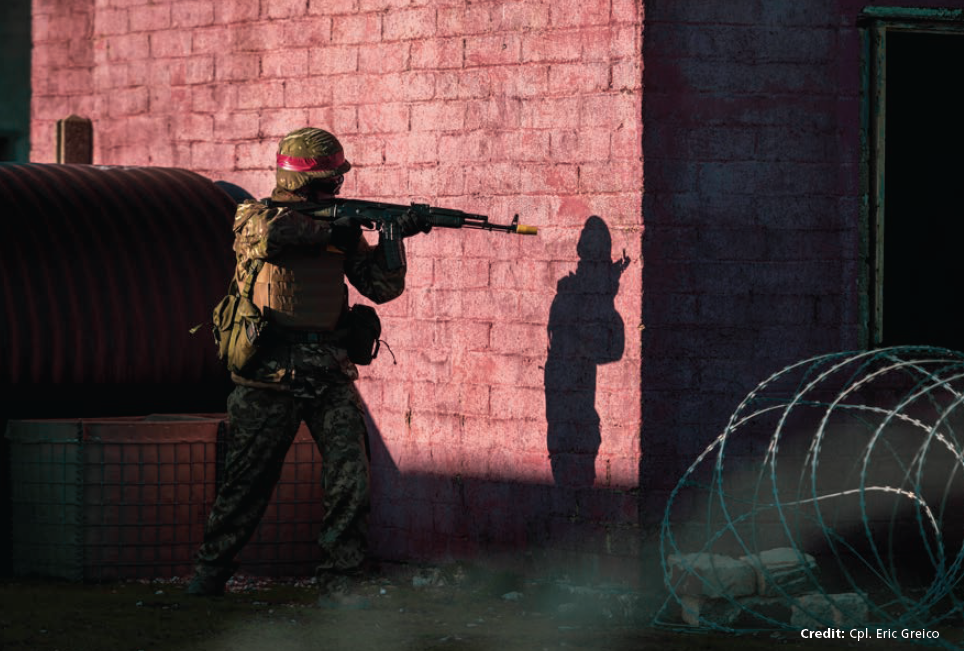
“We have seven levels of training that we denote for all our training and simulation efforts in the Canadian Army,” said Lieutenant-Colonel Mark Leach, G5 Simulation, Canadian Army Doctrine and Training Centre. “The three different domains: Live, Virtual or constructive are integrated and utilized to all levels of training — levels one to seven. We use different tools and technologies at various levels to enhance the training of the soldier, and the safest application of delivering the best, most realistic combat type scenarios is using simulation and technologies to enable that training. Our Weapons Effects Simulation [WES] would be one of the tools that is part of live simulation technology. That’s where you have real soldiers using a real technology that they put on, in this case a harness, which we can mount on soldiers or on vehicles, and with that we can immerse them in combat, like a type of simulated laser tag in real scenarios to develop their training.”
Canada’s WES technology has been provided by Cubic Defense since 2003, and the project is currently in a sustainment mode until the Weapons Effects Simulation Modernization project takes effect. That competitive project will augment instrumentation and simulation equipment to increase the realism of joint collective training exercises, and will take advantage of technological advances to increase the effectiveness and efficiency of training and the After Action Review process.
Potential project requirements and deliverables could include: improvements to soldier and vehicle WES equipment, integration of air assets, improved exercise control software and communications networks, expansion of communications coverage zones, integration with constructive and/or virtual simulations, and instrumentation at urban training sites. As it stands today, the WES Modernization project will start Options Analysis in 2027/28.
According to sources, the challenge with WES Modernization is the ability to scale for the Canadian Army and also for allies who will engage in collective and combined training — as occurs with the Canadian-led NATO Multinational Brigade in Latvia. The principal challenge is that each fighting force has its own types of equipment, like small arms and fighting vehicles, and therefore kits have to be able to mate to countless different types of equipment for the host and for allies. That challenge is further exacerbated by who will fund said kits for all participants.
“We have a document called the Future Integrated Training Environment, and essentially it’s asking procurement staffs and project management offices that source the types of technology that the Canadian Army needs to train on to do so under the umbrella of having it be compliant and ready to be network compatible,” LCol Leach told CDR. “This will link into NATO, and it will link into the Canadian Army’s priority number one for training and simulation which is the Virtual Training and Experimentation Network (VTEN) — a closed source network internal to DND that enables distributed training.”
“This will allow us to construct exercises in a synthetic training environment, with people in distributed and dispersed locations. This means we can have simulators at home stations which are connected across the country through VTEN. This would allow us to train more efficiently while also using defence dollars in a responsible way,” said LCol Leach. “This is what NATO is trying to do in the Baltic states — they want to have distributed synthetic type environment training where the technologies are compliant and ready.”
INDUSTRY PERSPECTIVES
CAE is seeing exciting developments in both available technologies and in the willingness of clients to consider new approaches. The rapidly maturing AI and Large Language Models space offers new promise to ease syllabus development, provide for artificial learning assistants, and enable the creation of instructor upskilling and assessment support tools. At the same time, the next generation of courseware development products and integrated learning platform technologies are beginning to arrive, driven in part by large programs, such as the Future Aircrew Training Program in Canada (FAcT).
“FAcT has the mandate to align and collapse multiple legacy training systems into a single tightly architected, data-rich training suite with embedded assessment analytics,” said France Hébert, Vice President and General Manager, CAE Defense & Security, Canada. “When such capabilities are considered in the context of dropping compute costs and new display, AR/VR, haptic devices, and part-task training tools, it is clear that the industry is poised for a generational leap forward in the art of the possible – just at the point the user demand signal is about to increase exponentially.” Against this very positive backdrop, CAE is aggressively exploring how best to align and integrate the foundational elements of a modern, flexible training ecosystem within a wider simulation environment.
CAE’s next generation mission training capability being developed as part of the Remotely Piloted Aircraft System (RPAS) program exemplifies how Canada is leveraging platform procurement to advance innovative training and simulation solutions. Such efforts align well with ongoing work to better manage platform obsolescence and bring new training and simulation technologies into existing training centers, as the Department of National Defence (DND) and Public Services and Procurement Canada (PSPC) work with industry to evolve the continuous capability sustainment concept.
Such efforts are revealing new and, in some cases, unexpected adjacencies between training functions, mission planning, rehearsal, and experimentation needs, and even operational execution and readiness assessment. These findings are also a critical reminder that training and simulation are activities that exist on a spectrum, with a goal that goes beyond merely attaining individual platform proficiency. In the current geopolitical context, and given the rapid progression of Western military doctrine to encompass new levels of digitalization, CAE recognizes that the next generation of training tools and systems must deliver objectively better outcomes at less or equivalent cost, provide options for the delivery of advanced training capabilities in a platform-agnostic fashion, and must furnish and support collective and ultimately joint operational capability.
FUTURE AIRCREW TRAINING
SkyAlyne is the FAcT program provider for the Royal Canadian Air Force (RCAF). The company was formed in 2018 as a partnership between CAE and KF Aerospace, two longstanding Canadian aviation, training, and defence leaders.
“We have assembled a team of defence, training, simulation, and aviation industry experts from all across Canada. A number of them trace their roots through the current training programs run by our parent companies, CAE and KF Aerospace, while others bring experience from the RCAF, RAF, and other military backgrounds. Still others have backgrounds in the civilian world, including aviation and ight instruction,” says Kevin Lemke, SkyAlyne’s Senior Executive. “Together the team is able to bring the diverse perspectives needed to understand and unpack the complexity and demands of building a bespoke and world-leading training program for the RCAF, utilizing the latest proven technologies.”
Building on successful programs with the latest proven technologies and methods is how SkyAlyne expects to succeed.
“In Canada, we have tremendous aircrew training expertise, and a proud history of aircrew Training,” Lemke told CDR. “Our job at SkyAlyne — and with our extended Team SkyAlyne, a collection of nearly a dozen major subcontractors — is to build a modern, collaborative, innovative, and flexible system that is able to adapt to a changing world over the next 25 years. The RCAF needs aircrew that can operate in a wide range of situations and theatres, including situations a decade or more from now that we cannot possibly predict. Utilizing new — and proven — simulation and learning methodologies is how we can build-in that adaptability.”
To facilitate the necessary adaptability, the program is not a static design. Over time, it will continue to innovate and improve in two ways. First, as new technologies are matured, SkyAlyne will use these where a positive enhancement to training delivery can be realized. Second, SkyAlyne will use cutting edge data analytics to gather information on the effectiveness of training in multiple areas, and use this information to inform improvements to the training ecosystem.
In delivering the FAcT program, SkyAlyne will be building on competency-based adult learning techniques, which allows students to progress at varying speeds — and receive varying levels of support — as they progress through their training. These techniques have been proven in other fields to improve learning outcomes and reduce the amount of time required by students to progress, and reduce failure rates.
Additionally, SkyAlyne will be deploying a greater number and variety of simulation-based training platforms. These platforms have levels of fidelity, sensitivity, resolution, and accuracy far beyond those in the current training system. As such they bring an entirely new perspective to the way that effective crew, emergency and mission training can be conducted. The ability to reduce the demand for live-flying, while allowing students to experience a much wider range of situations, leads to reduced lifetime training costs and reduced environmental impact, while simultaneously increasing student knowledge, skills and experience. The simulators will include a mixture of full-motion, fixed base devices, cockpit procedures trainers, in addition to VR devices, ejection seat and egress trainers and a full-fuselage mission training device for Air Combat Systems Operation (ACSO) and Airborne Electronic Sensor Operator (AES Op) training.
Cubic Defense is a recognized industry leader in T&S. The company has evolved its WES capabilities significantly over the course of the last two decades through the introduction of new wireless, geo-pairing and urban operations capabilities, resulting in signifcant improvements to the overall live simulation training experience for soldiers.
AIR COMBAT TRAINING SYSTEMS
Cubic Defense is also a global leader in providing air combat training systems.
“We provide Advanced Training Solutions [ATS] engineered to ensure warfighters are equipped with the tools they need to succeed in any environment,” said Paul K. Averna, VP and GM, Advanced Training Solutions, Cubic Defense. “Our proven capabilities highlight Cubic’s commitment to provide operational readiness in the age of ubiquitous growing threats. We proudly support the Royal Canadian Air Force and allied air forces with tools that improve combat effectiveness.”
Recently, the ATS team successfully delivered Secure Live Virtual and Constructive Advanced Training Environment (SLATE) and Simplifed-Planning-Execution-Analysis- Reconstruction (SPEAR) hardware and software systems to Guam in support of the Valiant Shield 2024 (VS24). The VS24 exercise is a multinational, joint field training exercise focused on integration between U.S. and allied forces in the Indo-Pacific region — Canada participated in VS24 and was able to use these training tools.
According to Cubic, SLATE closes the pacing adversary training gap with Synthetic Inject to Live – Live, Virtual and Constructive (SITL-LVC) training, contributing a revolutionary approach to training and simulation. Integrating computer-generated (synthetic) elements, or scenarios, into live training exercises, SITL-LVC augments the training environment’s realism and complexity and enhances the training experience’s efficiency and effectiveness. SLATE uses proven and flight-tested open standards tested 5th Generation Advanced Training Waveform (5G-ATW), a U.S. Government-owned LVC data link, ported in software defined radio configurations for pod and internal mount airborne subsystems. SLATE pods flew in 34 sorties, totaling 76.2 total hours with an impressive 97% sortie completion rate.
Cubic’s SPEAR software platform is an advanced, multi-domain, multi-environment Common Data Model (CDM) that is the world’s premier analysis and archiving tool for training. The data model is used for real-time integration of platforms, weapons, sensors, and effects that are real or modeled in live, virtual, and blended environments to optimize training. It is also an indispensable debrief asset for the multi-domain warfighter, demonstrating real savings in real time for aircrew, and revolutionizing the quality of debriefs through advanced analytics.
Throughout the VS24 exercise, SPEAR was the featured reconstruction solution used during planning, execution, analysis, and reconstruction. SPEAR demonstrated new CDM functionality incorporating tactical chat into reconstruction and the display of operational Universal Command and Control Interface (UCI) messages. These updates, along with SPEAR’s refined displays, supported the joint and combined forces mission by delivering an integrated multi-perspective representation of the overarching exercise mission. SPEAR integrated LVC data and mission operations from diverse sources to support Guam’s Advanced Training Environment.
SPEAR has become an invaluable analysis and training tool. The RCAF is using SPEAR in Canada, and has also used it at Exercise Cobra Warrior, which is hosted by the Royal Air Force in the United Kingdom.
AUTOMATED PILOT ASSESSMENT
One of the most significant recent developments underway at the International Test Pilots School (ITPS) Advanced Aircraft Simulation Centre (AASC) is the creation of the Automated Pilot Assessment System (APAS). This cutting-edge system is designed to address current and future pilot training needs, focusing on maximizing efficiency in both live fly and simulator training environments.
The APAS system revolutionizes pilot training by integrating data from flight simulators, live aircraft, and human performance monitoring tools. This datadriven approach enables instructors to assess and analyze a student’s performance during missions more efficiently. The system’s core functionality is its ability to gather biometric data, flight performance metrics, and cockpit interactions in real-time. By automating numerous aspects of the analysis process, APAS provides instructors with real-time feedback and insights, streamlining post- fight debriefing sessions and improving training outcomes.
Of particular interest to military flight training organizations, such as the RCAF, is APAS’s alignment with modern pilot training demands. In support of initiatives like the Future Fighter Lead-In Training (FFLIT), APAS enhances pilot readiness by allowing for detailed performance assessments in complex air combat scenarios. The system’s Advanced Mission Debriefing System (AMDS) will ensure that mission data from both live aircraft and simulators is thoroughly analyzed. This module is being developed to leverage insights from biometric indicators such as eye-tracking and heart rate variability to assess pilot situational awareness and cognitive load, critical factors in high-stress combat training.
“By employing APAS, ITPS will be setting new standards for ight training that not only meet the current needs, but anticipate the evolving needs of modern air forces,” says Brendan ‘Darcee’ Pierce, Vice President Tactical Training at ITPS Canada. “The system’s integration of live and simulated flight data, combined with human performance analytics, ensures that we can train the next generation of pilots more effectively and efficiently.”
3D TRAINING
Celebrating 13 years in business, Modest Tree has developed 3D training programs and virtual task trainers for globally recognized aerospace and defence firms.
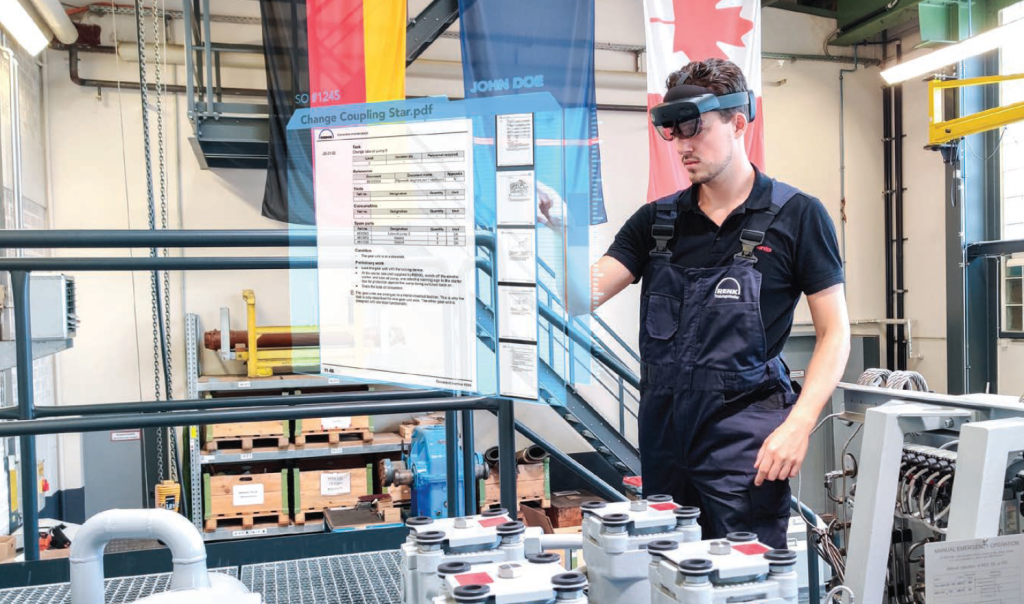
Modest Tree’s Tech Companion brings together digitalized work instructions, 3D visualizations of procedures and remote support. The company’s Xplorer software enables immersive training to be rapidly created and deployed across locations and devices (PC, VR, AR, Tablet, mobile, or iOS) for self-paced, instructor-led and multiplayer training.
Xplorer, a flagship product of Modest Tree, is a software platform that leverages digitalization to enhance the visualization of equipment maintenance and operations. In the defence space, where timely and accurate maintenance is critical to operational readiness, Xplorer’s ability to visualize complex machinery and systems in real-time enables military personnel to better understand and maintain sophisticated equipment. Xplorer provides interactive digital models of land vehicles, aircraft, and other complex assets, allowing technicians to visualize each component and its function within the broader system. By providing a detailed, stepby- step breakdown of maintenance processes, Xplorer helps military personnel conduct repairs more efficiently and avoid costly errors.
“Our immersive capabilities enable defence organizations to visualize and practice complex maintenance procedures with accuracy and realism,” says Emily Smits, CEO of Modest Tree. “This ensures that personnel are better prepared for the challenges they will face in real-world equipment operations.”
While Modest Tree’s roots are in Canada, their solutions are increasingly being adopted by NATO allies and other international defence organizations. “We focus on data-driven solutions with modular, scalable design that ensures solutions can be adapted to meet the unique needs of various defence programs around the world,” said Smits. “As military organizations face the growing challenge of training personnel on sophisticated equipment, Modest Tree’s immersive solutions provide a way to meet these demands efficiently and effectively.”
One can see that as modern warfare evolves, so too does the training required to ensure the CAF remains a capable and agile force. By embracing LVC training methodologies and integrating VR, AR, MR, and embedded training technologies, the CAF is preparing its personnel for the complexities of contemporary and future conflicts. Major training projects like FAcT and LVCTS highlight the Canadian military’s forward-thinking approach, ensuring that training remains adaptable, immersive, and effective for the challenges ahead.
Joetey Attariwala is CDR’s Senior Staff Writer

