


RCAF Cobra Warrior
CDR EMBEDDED: Reassuring Quality in Europe
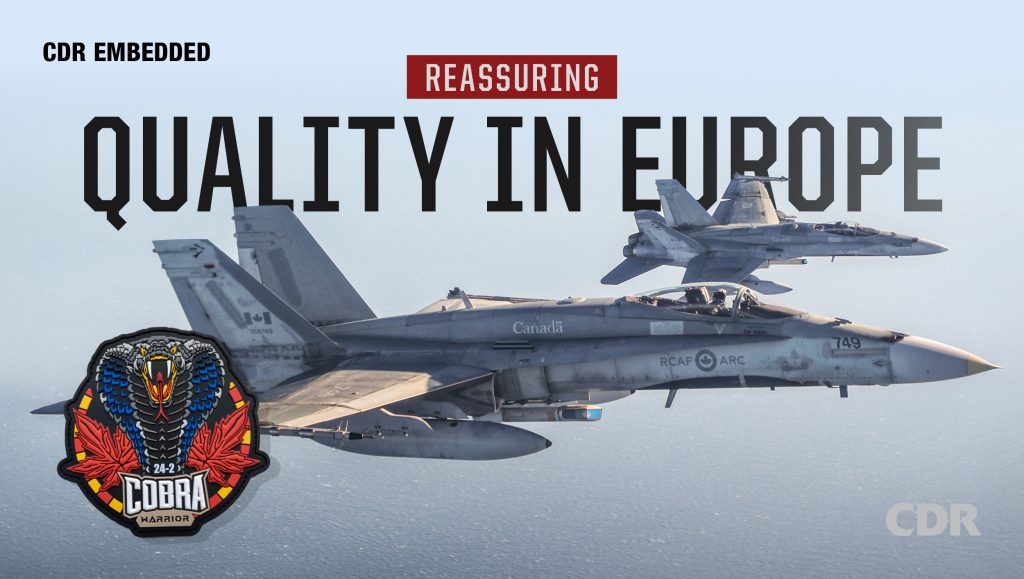
A Royal Canadian Air Force (RCAF) detachment spent more than six weeks in Europe participating in Exercise COBRA WARRIOR in the United Kingdom and TARASSIS in Estonia, both conducted under Canada’s Operation REASSURANCE. CDR tasked its UK Correspondent, Joe Campion, to visit and speak with RCAF personnel to gain deeper insight into the skills being developed. Here is our report.
In early September, eight CF-188s from 3 Wing departed CFB Bagotville heading East across the Atlantic to the UK. The Hornets left in three waves, two waves supported by 437 Squadron CC-150 Polaris tankers and the final two jets were escorted across the Atlantic by a 435 Squadron CC-130HT, also destined for the European detachment ahead.
WATCH NOW: Cobra Warrior 2025
429 Squadron used a CC-177 Globemaster III to transport equipment and spare parts for the movement. The RCAF Tactical Aviation Detachment at Prestwick, Scotland, also supported the movements. Alongside the aircraft, over 160 personnel headed for Europe, including aircrew and ground crew.
FIRST STOP – COBRA WARRIOR
After arriving in the UK, specifically RAF Waddington, the RCAF detachment took part in RAF led multinational Exercise COBRA WARRIOR (CW) 25-2. During CW, the aircrew performed a wide variety of mission disciplines such as, escort, sweep, Suppression of Enemy Air Defences (SEAD), dynamic targeting missions, electronic warfare support, interdiction, and Close Air Support (CAS) coordination with Joint Terminal Attack Controllers (JTACs). They also played as Red Air: simulating adversary tactics and threats.
CDR spoke with Major Sébastien Tremblay-Verreault, Deputy Commander, Air Task Force COBRA WARRIOR 25-2. “In the lead-up to Cobra Warrior 25-2, we saw a deliberate increase in operational tempo at 3 Wing,” he told CDR. “The month prior to deployment, our training focus shifted toward multi-asset mission sets — particularly escort, Offensive Counter-Air (OCA), and Defensive Counter-Air (DCA). This was essential to prepare our CF-188 crews for the complexity of coalition operations, especially in a large-force environment where integration with 4th and 5th generation platforms is critical. We emphasized on planning, dynamic targeting, and interoperability drills to ensure our crews were tactically ready.”
CW is an exercise created to push those involved to the tactical edge by taking part in composite air operations (COMAO) with dissimilar 4th and 5th generation platforms. The RCAF was training with Eurofighter Typhoons from the UK, Italy and Spain, as well as F-35s from the UK and the USAF. It is a perfect opportunity for Canadian crews to display their skills and, more importantly, gain knowledge via integrating with other nations. “Our TTPs focused on joint Defensive Counter-Air (DCA), Offensive Counter-Air (OCA), interdiction, Close Air Support (CAS), and large force employment (LFE) in a simulated combat environment,” Tremblay-Verreault added. The Exercise emphasized dynamic targeting, electronic warfare, and multi-domain coordination, all within a contested and degraded battlespace.
During CW 25-2, three CF-188 pilots gained the Mission Commander qualification, giving them the tactical expertise to lead large forces into battle, augmenting the tactical leadership readiness of the RCAF.

HEP-2 JETS
All eightCF-188s deployed were the most modern variant the RCAF has in its arsenal, upgraded under the Hornet Extension Project Phase 2 (HEP-2).
“Particularly, the new advanced radar paired with more advanced weapons is putting back the CF-188s into the melee of the battle, no longer needing to be protected by other more modern fighters,” Tremblay-Verreault stated. “CW was a great venue to showcase those new capabilities, and other nations quickly realized that the 40+ year old jets still have some tricks.” He continued, “the impressive serviceability rate of the HEP-2 jets is also not to be underestimated, with only two sorties lost on a total of over 200.”
“The HEP-2 upgrade allowed our Hornets to operate in more advanced mission stacks, closer to the tactical edge,” Maj. Tremblay-Verreault told CDR. “They were able to integrate with Typhoons, F-35s, and F-15s, contributing to targeting and situational awareness in ways not previously possible. The improved radar and data link capabilities meant our pilots could support mission commanders with real-time information, coordinate strikes, and even assume leadership roles in dynamic scenarios.”
FIGHTING NEWER JETS
A great opportunity that CW offers is the chance to perform Basic Fighter Maneuvers (BFM) missions with newer and different fighter platforms. An opportunity that is not available to pilots on the daily whilst home, hence why such detachments are essential for the creation of the best fighter pilots for Canada. One jet that the RCAF pilots came against in BFM was the Typhoon, of which one pilot described the experience as “eye opening”. When asked his opinion on fighting such jets in the CF-188, Tremblay-Verreault said “The Typhoon is an impressive machine, with lots of power. In those terms it can outmanoeuvre the CF-188, especially in the vertical plane. However, the CF-188’s impressive angle of attack control allows it to turn, point and shoot very quickly. These differences in jet design and associated BFM characteristics allowed our pilots to try different tactics, as there’s more than one way to maximize one’s advantages while denying the adversary’s. Typhoons vs Hornets made for interesting fights.”
The agility of the Hornet, combined with the Joint Helmet Mounted Cueing System (JHMCS) and Active Electronically Scanned Array (AESA) radar, allowed for rapid target acquisition and engagement. “The HEP-2 upgrades gave our pilots a tactical edge in visual range combat that they didn’t have before,” said Maj. Tremblay-Verreault. “In BFM, advanced weapons like the AIM-9X are a game changer.”
Throughout CW 25-2 RCAF Hornets logged approximately 385 hours, each pilot logging between 20-25 hours, during both day and night ops. One of the most complex missions involved over 60 aircraft. The RCAF Hornets played a role including sweep, escort and dynamic targeting. According to the crew involved, it was a true test of coordination, timing and tactical discipline.
The Air Task Force Commander and Commanding Officer of 425 Tactical Fighter Squadron, LCol Maxime Renaud, said “the biggest takeaway was the importance of tactical interoperability. CW 25-2 allowed us to validate our upgraded CF-188s in a coalition environment and reinforced the need for seamless integration with allied platforms. It was also a proving ground for our future leaders.”
FUELLING THE FIRE OF OILING THE FIGHT
Canada didn’t just send fast jets to Europe. As mentioned above, a 435 CC-130HT crossed the Atlantic for its aircrew and ground crew to learn more and integrate with NATO allies. The crew included 14 aircrew and nine technicians. The CC-130HT can carry up to 81,000 lbs of fuel, with 65,000 lbs transferable to receivers whilst airborne, and can offload at rates of up to 1000 litres per minute. In total, the CC-130HT offloaded -approximately 943,600 lbs of fuel to the hornets during day and night ops with an approx. total of 51.2 hours during CW. Each fighter received around 7000 lbs during typical engagements.
CDR also had the opportunity to speak with Capt. Greg Campbell, the CC-130HT pilot. “Our TTPs for CW 25-2 focused on tactical air-to-air refuelling in contested environments. We trained to support fighter operations in degraded conditions, in many scenarios. The emphasis was on precision timing, fuel management, and integration with multinational air packages. We also practiced rapid repositioning and sustainment of dispersed operations, in line with Agile Combat Employment (ACE) principles. The CC-130HT brings tactical flexibility that’s hard to match. It allows us to support fighter operations in environments where larger aircraft might not be viable, and it ensures we maintain readiness across multiple platforms.”
As well as being an essential support aircraft, the CC-130HT worked with mission commanders to define refuelling windows, altitudes, and threat profiles. The crew also helped shape the simulated contested environments to challenge 435 aircrew and improve training outcomes. This included planning for degraded navigation, fuel prioritization, and coordination with allied assets.
Recalling a memorable mission, Capt. Cambell said, “One mission involved refuelling four CF-188s while simulated adversaries — including aggressor aircraft from Top Aces — attempted to disrupt the package. From our perspective, the challenge was maintaining station integrity while managing fuel flow and threat awareness. We had to adjust altitude and timing dynamically and ensure we remained in a ‘safe’ corridor while still meeting the fighters’ needs. It was a great test of crew coordination and tactical flexibility.”
TO THE EASTERN FLANK
After a rigorous and action-packed CW, the detachment packed up and headed deeper into Europe to Estonia, some even headed East prior to CW concluding, to ensure flight ops could start rapidly. This was for TARASSIS, which is a Joint Expeditionary Force (JEF)-led multinational rehearsal conducted under Operation REASSURANCE. Roughly 80 personnel continued from CW out of the original 160, so did the CC-130HT and the eight CF-188s. A contingent of Tactical Air Traffic Controllers (TacATC) from Trenton also joined to support austere landing zones coordination.
TARASSIS is the JEF’s largest activity to date and represents a major opportunity for the RCAF to validate ACE and Agile Operations Employment (AOE) concepts in a real-world European context. The aircrew performed a range of missions from, CAS, Air-to-air refuelling, Dissimilar air combat training and dynamic targeting with JTACs. Over the two-week exercise, the detachment flew multiple times per day and flew multiple sorties. Missions included day operations, with a focus on dispersed basing, CAS, and coalition integration. In terms of hours, the CF-188 flew over 200 hours in 2 weeks, 63 sorties flown out of 64 planned.
“Our TTPs focused on operating from Tactical and Austere Landing Zones, integrating with NATO allies in contested and degraded environments, and demonstrating our ability to disperse, sustain, and fight from non-traditional locations,” said Maj. Tremblay-Verreault. “This is essential for the RCAF’s modernization and for maintaining readiness in the face of evolving threats, including near-peer adversaries.”
The RCAF worked closely with a range of NATO allies, including Estonia, Latvia, Finland, and the UK. On the ground, Canadians integrated with NATO Joint Terminal Attack Controllers (JTACs), RCAF and RAF TacATC, and Estonians for hot refuelling. The CF-188s flew with Finnish F/A-18s and other allied platforms to conduct composite air operations and CAS missions.
One of the more memorable missions included “landing CF-188s on a highway in Estonia — a real stretch of road, not a simulated strip,” Maj. Tremblay-Verreault told CDR. “The preparation and anticipation for this mission was exciting for pilots, some of whom haven’t logged more than 300 hrs in the CF-188. Notwithstanding the relatively small width of the highway strip compared to prepared runways, the ground illusion caused by the unprepared landing environment made this seemingly simple manoeuvre a challenging event. The weather was also a factor, with low clouds; but that’s the reality we must contend with. Despite this, all our pilots managed to accomplish the landing, down to the most junior ones. This is an incredible confidence booster for our pilots, an experience that will remain recorded in their memory for the rest of their career.”
The detachment also worked with allied JTACs and those from the Canadian led multinational brigade in Latvia. “We worked extensively with JTACs from Estonia and other NATO nations including the Canada led NATO multinational brigade in Latvia,” said Maj. Tremblay-Verreault. “These missions reinforced our ability to deliver precision effects in support of ground operations, and to integrate with advanced CAS tools like datalink systems.”
After TARASSIS concluded, the transit back to Canada was carried out in two phases: redeploying the forces from Estonia in the UK, then moving all jets, equipment and personnel back to Canada. Fall in the North Atlantic can be a dangerous environment to fly over, but with tanker and search-and-rescue assets well positioned, all personnel and aircraft were able to return between October 20-23.
WHY THESE DEPLOYMENTS ARE IMPORTANT
“These types of deployments are absolutely essential for the RCAF — not just from a training perspective, but from a strategic and institutional standpoint,” said LCol Maxime Renaud. “First, they allow us to train in realistic, multinational environments. Exercises like CW and activities such as TARASSIS expose our personnel to high-tempo coalition operations, where they must integrate with allied platforms, adapt to evolving mission sets, and operate in contested, degraded, and operationally limited environments. This is the kind of complexity we must be ready for in real-world scenarios.”
He continued, “Second, these deployments are a force development opportunity. They allow us to qualify Mission Commanders, develop tactical leaders, and expose junior personnel to large force employment. The experience gained here directly contributes to our operational depth and leadership pipeline — especially as we prepare for the transition to the CF-35A and a more networked battlespace. Third, they reinforce our commitment to NATO through Op REASSURANCE. By participating in both CW and TARASSIS, we demonstrate Canada’s ability to contribute meaningfully to collective defence, not just in one domain, but across air, land, and joint operations. It’s a signal of solidarity and capability. Finally, these deployments validate our ACE and AOE concepts. We’re learning how to fight from dispersed locations, sustain operations with minimal footprints, and maintain combat effectiveness under pressure. That’s not just a theory — it’s a mindset shift for the RCAF, and it’s critical for our future.”
Joe Campion is CDR’s UK Correspondent
