


MCDV REPLACEMENT – COASTAL SHIFT – The Next Wave in Maritime Coastal Defence
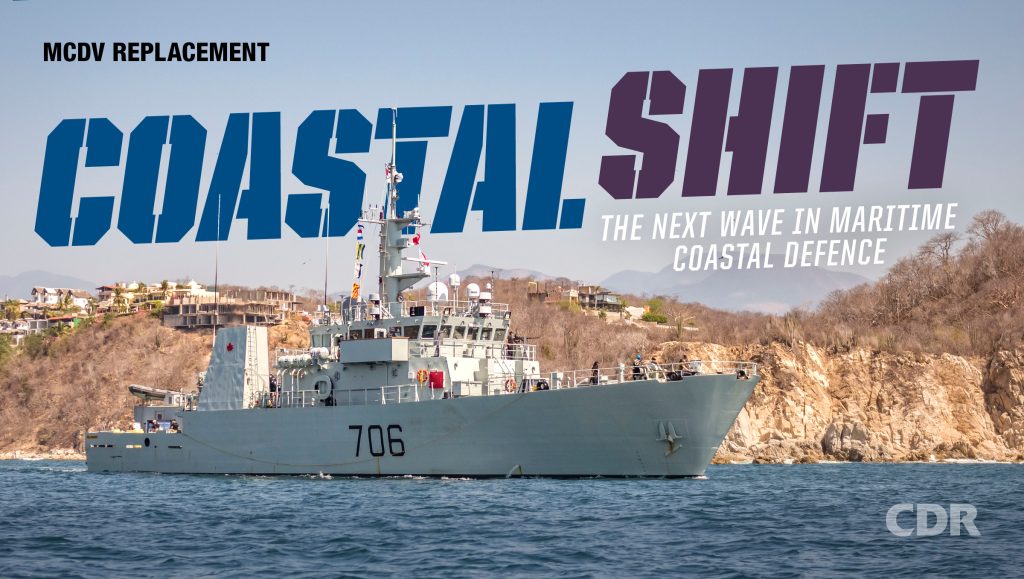
In the fall of 2025, the Royal Canadian Navy (RCN) will begin paying off the Kingston-class Maritime Coastal Defence Vessels (MCDVs). While the Department of National Defence (DND) has established the Canadian Multi-mission Corvette (CMC) project to replace the fleet, no decision regarding a replacement has been identified as of yet. With this in mind, CDR asked its writer, Richard Nghiem, to explore some of the options available to Canada and the RCN. Here is our report.
READ: CMC – Canadian Multi-mission Corvette Project
For the last decade, the Royal Canadian Navy (RCN) has embarked on multiple ship building projects under the National Shipbuilding Strategy (NSS) to not only modernize its surface fleet, but also revitalize the country’s shipyards and maritime industry. So far, 6 Arctic Offshore Patrol Ships (AOPS) have been completed with 5 in active service while 2 Joint Support Ships (JSS) are currently under construction. At the same time, the first steel for the Canadian Surface Combatant (CSC) fleet, also known as the River Class Destroyers (RCD), has been cut, marking the start of full-rate production.
READ: NSS Update – National Shipbuilding Strategy
These projects, collectively, showcase the Department of National Defence’s steadfast commitment to strengthening its sovereign shipbuilding capabilities and supply chains so that the Royal Canadian Navy (RCN) is properly equipped to conduct operations at home and alongside allies in an increasingly complex environment. Having said that, most if not all of these new platforms are currently facing delayed timelines. The most glaring example of this issue is the projected delivery schedule of the RCD fleet which anticipates the commissioning of the first destroyer of the class, the HMCS Fraser, taking place in the early 2030s with the final ship’s completion being slated for 2050.
While the fact that construction has started on these ships is a good start, this time frame is unacceptable, especially considering the current and future challenges faced by the RCN and Canada as a whole. Ultimately, if Ottawa is to properly rebuild and recapitalize the Navy in a timely manner, its main focus must be on ensuring that the service’s acquisition process, specifically for future programs such as the Canadian Multi-mission Corvette (CMC) Project, is not influenced by political pressure or the demand for domestic jobs. This shift in emphasis will not only expedite procurement and enhance the RCN’s interoperability with allies, but also ensure that Canada’s maritime force continues to maintain a high level of combat readiness and effectiveness.
DECREASE IN FLEET SIZE
Such a drastic, proposed change to the way in which the Navy sources and acquires new warships is particularly of great importance right now as with the complete retirement of the Nation’s fleet of Kingston-class Maritime Coastal Defence Vessels (MCDVs) deemed imminent, a large capability gap will almost certainly open up within the maritime branch of the CAF. Furthermore, it is all but certain that the service will experience a significant decrease in the size of its fleet. This was confirmed on July 24, 2025 when the RCN officially announced that the Kingston-class would begin to be paid off and retired starting in late 2025 without immediate replacements. Eight ships are planned to be retired later this year, followed by one (Yellowknife) in 2026, one (Edmonton) in 2027 and the final two (Moncton and Nanaimo) in 2028. In place of these decommissioned vessels, the Nation’s 5 newly constructed AOPSs will take over the coastal defence mission temporarily, signalling a minimum reduction of 7 ships from the fleet.
CAPABILITY DEFICIT
Having said that, some defence analysts will undoubtedly point out that the Navy’s CMC Project has been well underway for a number of years with regards to searching for and attempting to identify, “a potential successor for the Kingston-class.” A final procurement decision on the replacement platform, therefore, should not be far away. In any case, such a significant shortfall in combat capacity would still be almost insurmountable as the RCN would be very hard pressed to complete the functions that it has traditionally been responsible for, including coastal defence, law enforcement, minesweeping, and maritime interdiction.
This situation is compounded by the Canadian Coast Guard’s ongoing modernization process, which will not include an increase in size. The service has received 9 new Mid Shore Patrol Vessels, but these are rather small maritime craft with limited range and endurance. These boats are only designed to operate 120 nautical miles from shore. More importantly, it must be highlighted that the Canadian Coast Guard (CCG) is very different from its U.S. counterpart. Canada’s coast guard is a rather small organization that is unarmed. Their primary purpose is to ensure the safety of shipping by maintaining navigational markings and routes, conducting ice breaking operations, and playing a large role in search and rescue (SAR). That said, Ottawa recently announced that the CCG is going to be a special operating agency at the Department of National Defence and will be given a formal mandate to contribute to coastal surveillance. Despite that fact, the CCG cannot completely fulfill the roles that the RCN is no longer able to perform.
Even with regards to the Navy’s interim solution of relying on its new AOPSs for coastal defence, this stop-gap measure is also far from adequate. Due to high inflation rates, enormous cost overruns, and repeated delays, the original design of the AOPS had many requirements scaled back and capabilities reduced. These changes included a lower maximum speed of only 17 knots while the hull design was altered to become a compromise between one optimized for ice-breaking and patrol. The end result, consequently, was a ship that had some ice-breaking capability but which was slow and had poor seakeeping performance.
IMPORTANCE OF MCDVs
However, despite the subpar quality of the AOPS vessels, Ottawa must make do with them in order to fulfill its international maritime security obligations and protect Canada’s global interests, but also execute its main mission of defending the Nation’s littoral waters. As crucial naval assets, coastal patrol ships are heavily leveraged for ISR operations, minesweeping tasks, law enforcement duties, undersea infrastructure protection, maritime raids, and counter-narcotics missions. These vessels also play a vital role in sovereignty enforcement, particularly in the Arctic, and are essential for conducting SAR operations in coastal and offshore areas.
That said, while most of their responsibilities lead them to be primarily deployed close to home, RCN patrol ships are still sometimes tasked with international collaborations and contributing to global security. Some of these joint missions include anti-smuggling efforts in the Caribbean Sea, anti-piracy patrols off the coast of Somalia, humanitarian assistance for typhoon-ravaged Pacific islands, and counter-terrorism operations in the Middle East. Overall, given all of its unique capabilities, it is easy to understand why the Navy has long relied on its Kingston-class coastal defence vessels to safeguard both its territorial waters and its national interests abroad. However, with these ships now nearly 30 years old, the service desperately needs to expedite the replacement of these vessels. That is why a new Canadian Multi-Mission Corvette (CMC) project has recently been created by DND.
NEW CAPABILITIES FOR A NEW
GLOBAL SECURITY ENVIRONMENT
In addition to opening a competitive bidding process for the procurement of a new corvette fleet, Ottawa must also study and examine other countries that have already diversified the composition of their fleets and integrated larger, more heavily armed offshore patrol vessels (OPVs). Australia and the United Kingdom, for example, have added 5,000 tonnes OPVs, outfitted with larger, more powerful main guns as well as missiles, to their fleets to provide a cost-effective means of achieving their defence objectives and safeguarding their territorial sovereignty. Such a force design choice by these two modern navies should motivate the RCN to also consider the procurement of a ship with the size, displacement, and armament of a naval vessel in between an AOPV and a CSC. Equipped with a respectable weapons magazine along with a moderate radar and infra-red signature, cheap, lightly-manned missile corvettes will not only enable the Navy to judiciously redistribute and redeploy its personnel but also maximize the lethality of its limited force. These OPVs can additionally be tasked with conducting littoral warfare missions against adversaries like China in high-intensity conflicts while carrying out Anti-Submarine Warfare (ASW), Anti-Surface Warfare (ASuW), and Intelligence, Surveillance and Reconnaissance (ISR) operations.
Lastly, but equally important, the use of larger displacement patrol vessels / missile corvettes would be less expensive than traditional warships both in terms of initial procurement and in-service costs. This is due to the fact that an OPV could easily deploy with a crew in the 50 to 80 range which would represent huge savings in terms of personnel. A frigate or destroyer, comparatively, would need a minimum complement of at least 200 sailors. Furthermore, with dimensions less than half the size of a Halifax-class frigate and one third the size of an AOPS, a missile corvette would also be much more economical to operate due to general maintenance costs. Overall, given all of these aforementioned advantages, large displacement patrol vessels should be seriously considered by the RCN as a cost-effective way to diversify, strengthen, and expand its fleet.
READ: Team Vigilance article to get an update on their offering to the Canadian government and learn more about the Vigilance-class vessel.
POTENTIAL OPTIONS
THE VIGILANCE OPV
While there are numerous replacement options to choose from, from a versatility and reliability point of view, one can make the argument that there are really only 3 or 4 platforms that fully meet Canada’s needs, one of which is Vard Marine Inc.’s Vigilance Offshore Patrol Vessel. Under pillar 2 of the National Shipbuilding Strategy (NSS), Vard aims to replace the Navy’s Kingston-class MCDVs with Vigilance next-generation patrol ships that are designed, built, and equipped right here in Canada.
These warships will be specifically designed for the needs of the RCN’s future fleet, striking the right balance between flexibility, adaptability, and size. It will not only be capable of high-tempo sovereignty missions, but will also be engineered for global deployment and forward basing abroad. Most importantly, though, it is expected that the Vigilance next generation naval vessel will fulfill a variety of critical operational needs through the seamless integration of various cost- effective CUBETM plug-and-play mission modules and payload handling systems, enabling core naval missions such as minesweeping, maritime interdiction, and surveillance operations. This adaptability is crucial as it ensures that this OPV remains future-proof, mission ready, and relevant regardless of the tasks assigned to it.
With that said, it appears that Vard Marine Inc. is still making improvements to the Vigilance and implementing feedback given to them as it recently posted an updated version of their pitch for the yet-to-be-funded Kingston-class replacement project. The company’s newly proposed Flight II solution, as a result, provides a major capability increase over their initial offering, and bridges the gap between the Harry DeWolf-class AOPS and future Canadian Surface Combatant quite nicely. Not only is it now able to conduct oceanic transits, but it can also now house operators in an oversized operations / communications room for all kinds of uncrewed systems (UAS, AUV, USV). The Vigilance OPV additionally has new, dedicated landing, hangar, and maintenance facilities for runway-independent VTOL UAVs/UASs such as Bell’s V-247.
This particular aerial drone is a prime uncrewed platform for the Vigilance as it is fully capable of performing a variety of missions including Electronic Warfare (EW), Counter-Uncrewed Aerial Systems (CUAS), ASW, Airborne Early Warning (AEW), long-range ISR-T, ASuW, and resupply. Out of all of these core competencies, however, the V-247’s expertise in undersea warfare would probably be its greatest contribution to the RCN and the CAF as a whole as it would be able to effectively complement the Navy’s current CH-148 Cyclone helicopters as well as the Air Force’s soon-to-be-acquired P-8 Poseidons with a specifically tailored payload of air-dropped sonobuoys and Mark 50 lightweight torpedoes. Additionally, it can also provide 24/7 ISR (two-aircraft team needed) over a given area which is quite attractive for a navy like Canada’s which is small – personnel-wise – and tasked with monitoring vast amounts of coastal territory.
However, while the Vigilance OPV clearly has significant aerial drone capacity, its uncrewed reach also extends to the deep depths of the ocean as it can deploy Extra Large Autonomous Underwater Vehicles (XL-AUV) such as Anduril’s Dive-XL. This UUV is equipped with a highly configurable architecture that can support ISR, strike, or seabed survey payloads along with AI-enabled Copperhead torpedoes. It is also capable of undertaking extended undersea operations as it leverages an all-electric powertrain that executes long-range, long-duration missions without surfacing in order to increase time on mission as well as platform survivability.
Last, but not least, Vard’s Flight II solution includes additional modifications to its Modular Mission Deck, weapons and countermeasures, and its main sensors. With regards to the OPV’s mission deck, it now has the capacity to hold multiple HADR mission containers, 2 RHIBS, or an ASW suite, consisting of a CAPTAS-2 Variable Depth Sonar and a Mk 54 Lightweight Torpedo System. Additional payload options also include Pathmaster Mine Countermeasures USVs for stand-off MCM capability, 6 Cube™ based Naval Strike Missile (NSM) launchers, armed with 24 containerized Naval Strike Missiles (NSM), for a sustained ASuW capability, and 3 to 4 Mk 70 vertical launch systems. Finally, in terms of the Vigilance’s new standard weapons, countermeasures, and sensor load out, it is now outfitted with 24 CAMM surface to air missiles, a Bofors 40mm main gun, two 20mm Remote Weapons Systems along with a NS-100 4D AESA Radar and a Bluewatch/Bluehunter Hull Mounted Sonar, enabling it to successfully operate, fight, and win in a distributed maritime environment.
SA’AR 72-CLASS CORVETTE
However, the Vigilance next generation naval vessel is by no means the only viable replacement option available to the RCN. Another choice is the Sa’ar 72 which is a new class of Israeli Navy corvettes designed by Israel Shipyards Ltd. as an improved and stretched Sa’ar 4.5-class missile boat. In terms of its role, the ship was primarily developed for surface and undersea warfare along with naval force protection and EEZ law enforcement.
As a result, to accomplish these missions, the new corvette can reach speeds above 30 knots, operate a medium size marine helicopter, and control both the open sea as well as the littoral with an armament consisting of 8 RGM-84 Harpoon or Gabriel anti-ship missiles, 16 Barak 8 surface-to-air missiles, an Otobreda 76 mm naval gun, 2 Typhoon Weapon Stations and 6 Mark 32 torpedo tubes. The warship is also capable of carrying two RHIBS and supporting Special Forces units for maritime interdiction missions. Overall, after taking into account its capabilities, one can make a strong argument that the Sa’ar 72 is a highly attractive procurement choice as it can not only be offered as a missile corvette or in an OPV version depending on a nation’s operational requirements, but also enable navies to effectively protect their country’s sovereignty, control their economic waters, and win naval battles in times of war.
Having said that, though, with Israel’s ongoing controversial war against Gaza and claims of war crimes being committed by IDF soldiers, a purchase of warships from Tel Aviv may currently be viewed as politically unacceptable, thereby forcing Ottawa to look elsewhere. South Korea, a growing ally of Canada, fortunately, is another potential viable defence export partner that has a suitable alternative: the HDP-1500 Neo.
HDP-1500 NEO OPV
As the export variant of a new offshore patrol ship design developed by Hyundai Heavy Industries for the Republic of Korea (ROK) Navy, the HDP-1500 Neo features a stealth design with a clean superstructure for reduced radar cross section (RCS) signature. The vessel also provides an extended range of 5,500 nautical miles, and possesses weapons systems ranging from a 76mm main gun, to Close-In Weapon Systems (CIWS), along with sensors such as 3-D surveillance & target indication radars, electro-optical targeting systems, and IFF (Identification Friend or Foe) systems. However, while all of these qualities and capabilities are unquestionably valuable, the HDP-1500 Neo OPV’s greatest aspects may in fact be the reconfigurable spaces it has below its helicopter deck which can accommodate four mission modules for various operations as well as its configurable topside mission deck. The latter is particularly important as it offers additional growth potential for new Surface-to-Surface Missiles (SSMs), torpedo launchers, Electronic Counter-Measures (ECMs), and Remote Controlled Weapon Stations (RCWSs).
AIRCAT BENGAL MC
Lastly, in terms of manned platforms, the RCN should also seriously consider Eureka Naval Craft’s AIRCAT Bengal MC. While Ottawa is understandably trying to avoid the future purchase of any new U.S. military equipment due to tense political relations with Washington, to do so in the maritime domain would be extremely shortsighted. This reality could not be any more evident than with the AIRCAT Bengal which is an optionally manned / autonomous naval attack / patrol / interdiction / reconnaissance / air defence / logistics and medivac vessel with a 1,000 nautical mile range. Besides being outfitted with AI software and having a small optional cost-effective crew of only 5-7 sailors, the Bengal is also well equipped for contested littoral combat operations with a primary armament including three 30mm remote weapon stations, each with individual radar coverage paired with a 360 4D hemispheric radar, as well as onboard Anti-Tank Guided Missile (ATGMs), ‘kamikaze’ attack drones, and numerous remote and manual machine guns. The vessel additionally has space on its aft deck capable of accommodating 40-tons of payload, including long-range cruise missiles, anti-ship missiles, swarming loitering munition drones, air defence systems, torpedoes, sea mines, and/or MCM systems.
More importantly, though, besides being a solid and logical choice for the RCN from an operational point of view, the AIRCAT Bengal also makes sense from both an economic and industrial perspective. The acquisition of this platform would not only present an enormous opportunity for Canadian shipbuilding as Eureka Naval Craft would be willing to grant Ottawa the right to obtain a license to all pertinent intellectual property and technology needed to build these vessels, but also bolster the skills of Canadian shipbuilders to ensure that the benefits of the NSS will be realized.
PROTECTOR UNCREWED
SURFACE VEHICLE
Finally, given the defence and security challenges posed by Canada’s vast geographic size and limited military manpower, the RCN should also look at the option of exploiting AI for its own MCDVs. A prime example of such a platform is the Protector USV which is an uncrewed integrated naval combat system developed and produced by Rafael Advanced Defence Systems.
The Rafael USV Protector is based on a 9-meter V-shaped RHIB and is stealthy, fast, and highly maneuverable. It is additionally designed for high robustness and survivability and incorporates complete redundancy of all sailing functions to provide a “never stranded at sea” policy.
More impressively, the vessel’s low profile upper structure is completely sealed and aerodynamic while its modular platform design allows it to be reconfigured to meet changing mission requirements, such as force protection, ISR, naval warfare, minesweeping, ASW and ASuW, as well as harbour security missions.
Having said that, the Protector’s ability to execute these operations can only be as good as its weapons systems. The USV, fortunately, is by no means short on firepower as it is equipped with an advanced Mini-Typhoon remotely controlled integrated weapon station. This highly stabilized and accurate weapon system is not only well armed with the choice of a Browning .50 calibre machine gun, a 7.62mm general-purpose machine gun, a GAU-17 Gatling gun, or a 40mm grenade launcher, but is also extremely precise due to its sophisticated Toplight electro-optical ISR-T system which provides the drone operator with a high target hit and kill probability. This is not to say that the Protector cannot be outfitted with anything else, though. Instead of a Mini-Typhoon weapon station, a stabilized Spike LR missile launching system may alternatively be integrated to provide a remote, precise strike capability. This same system can also be fitted with a water cannon system to provide less-lethal engagement at close range as well as firefighting capabilities.
Besides its impressive modular design and weaponry, what also sets the Protector USV apart from other maritime drones or patrol vessels are its core technical systems. These include a formidable C2 network and exquisite sensor suite, providing extensive situational awareness as well as elaborate mission planning and execution capabilities. The sensor suite, specifically, consists of a radar, electro-optical director, all-around 360º panoramic navigation camera, and provides automatic day/night detection, identification and tracking of targets. Equally as impressive, the Protector’s C2 system also supplies real-time ISR from the sea as well as elaborate remote control over USV maneuvering and mission module operation and can be incorporated into a wider defence array via an open interface to an external C4I network.
Lastly, but most importantly, though, the biggest and most unique trademark of this uncrewed patrol vessel is its extreme automation paired with a small minimum crew size requirement, a characteristic that may be extremely beneficial for Canada given the size of its Navy. It not only offers the RCN a unique solution to its current readiness and personnel crisis, but also allows it to regularly operate its 12 Halifax-class multi-role patrol frigates without having to scale back deployments of its 12 MCDVs as these patrol ships would now be automated and completely uncrewed. This solution would also free up a significant number of sailors from coastal defence duty who could then be retrained and reassigned to the fleet’s future RCDs and attack subs. Overall, regardless of which patrol vessel is chosen, Canada’s navy will unquestionably have a new, highly capable platform that can continue to effectively defend the Nation’s coastal waters without further exacerbating the service’s existing personnel crisis.
A HYBRID NAVY
Ultimately, with the imminent retirement of its Kingston-class MCDVs, the RCN is facing a severe reduction in the number of platforms it will potentially have in its fleet. Unless DND increases the budgets for the AOPS and RCD projects, a minimum ship deficit of 7 ships will unfortunately become a reality for the service. This decrease in fleet size will result in the degradation of the ability of the Navy to complete its mandate both abroad and at home. However, Canada’s maritime service is far from the only navy experiencing these challenges as the RN and RAN have also gone through similar shortfalls. These modern navies, however, are responding by adding cheap OPVs or missile corvettes to their fleets to allow for a more balanced range of capabilities at a reduced cost. Such an approach could also work for the RCN as MCDVs can perform many of the roles and functions listed in the current Canadian naval doctrine.
Consequently, while it is essential for Ottawa to field an Arctic-capable, ‘blue-water’ navy to meet defence and security challenges in the coming decades and ensure the Nation’s economic prosperity throughout the 21st century, it is also imperative that Canada acquires and maintains a supplementary ‘green-water’ navy to protect its territorial waters. The RCN therefore must thoroughly investigate the potential benefits of adding a larger, more heavily armed class of OPVs to its fleet. A ‘green-water’ navy of new MCDVs would be able to cost-effectively perform many roles and functions and potentially free up future frigates/destroyers for more demanding tasks by taking on roles like maritime interdiction, surveillance, reconnaissance, minesweeping, and even some combat activities. As a result, this approach would allow destroyers to focus on higher-priority missions like ASW, air defence, and strike operations, while OPVs handle less critical, but still important, tasks.
Richard Nghiem is a Regular CDR Contributor

