


F-35 Finland – Over the Frozen Atlantic
The 10-hour F-35 Winter Ferry Mission to Finland That Pushed Limits
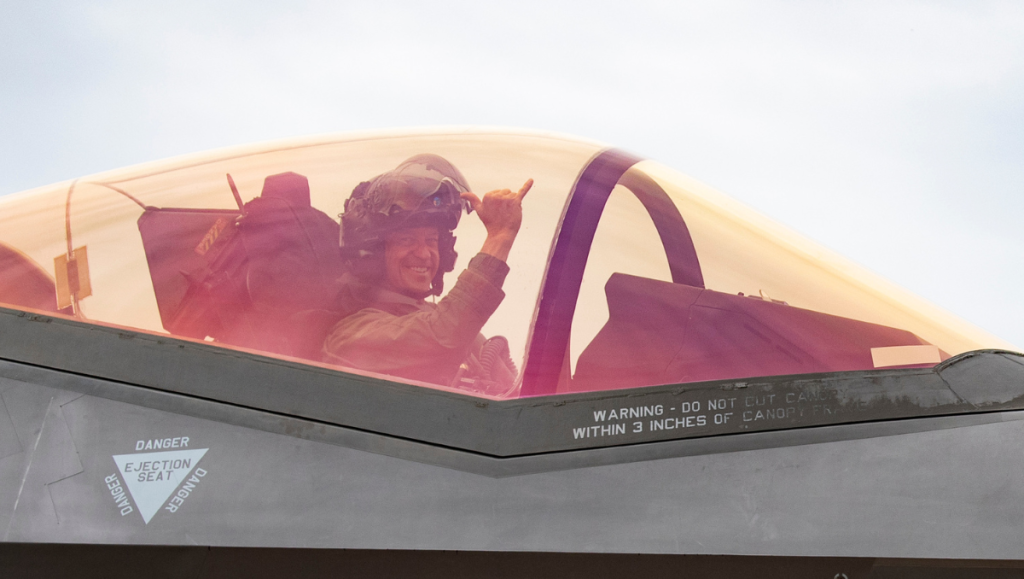
By Lieutenant-Colonel (Ret’d) Billie Flynn, CD, former Royal Canadian Air Force
The cockpit was dark except for the glow through my “Ironman” helmet-mounted display and cockpit touchscreens and the dull reflection off the snow clouds below. As a veteran test pilot and Lockheed Martin‘s lead for the Finland evaluation, I slid behind the refueling tanker and eased into position. Outside, –50°C air and an ocean churning with ice and 60-foot waves. It was the dead of winter, and my team and I were ferrying one of the most advanced fighter jets through some of the planet’s harshest flying conditions.
Getting two F-35s across the ocean wasn’t our only mission. During Finland’s fighter replacement competition, we had to prove performance in the worst conditions imaginable. For me, though, it was more than that. It was a test of endurance—man, machine, and the technology built to keep pilots like me alive in skies and conditions designed to kill us.
The Finnish Fighter Competition
When Helsinki announced its search for a new fighter to replace its aging F/A-18 Hornets in 2018, it issued a unique challenge: prove it works in Finland’s winter. Five aviation companies answered the call. Lockheed Martin’s F-35 Lightning II faced off against Boeing’s Super Hornet, Dassault’s Rafale, the Eurofighter Typhoon, and Sweden’s Saab Gripen.
In 2020, each contender underwent operational trials at the Finnish Air Force’s Pirkkala Air Base near Tampere. To get there, my team had to ferry two F-35s across the Atlantic in February—through near-constant darkness, storms, and bone-chilling Arctic air.
The best needed to be chosen, and I was honored to lead the team. They picked me—the Canadian, the guy who grew up flying in winter—because I knew Arctic flying. I’d become so accustomed to flying up north that I was the only one with real experience in snow and extreme cold. I was the natural choice.

Preparing for the Crossing
Our team plotted the route from the U.S. East Coast to Finland, crossing through Greenland and Iceland. This route stretched over 10 hours—by fighter standards, more marathon than sprint.
The North Atlantic in winter is unforgiving. At high altitude with temperatures that low, limited diversion options, and weather that changes by the minute, you plan for every contingency.
The route required multiple aerial refuelings—both lifeline and hazard. One small misalignment in turbulent air could cost the mission entirely.
Planning didn’t stop with the route. Our survival gear required equal care. We looked like the Michelin Man from those tire commercials. Under our flight suits: thermal long underwear and an immersion dry suit with a watertight layer sealed at wrists and neck to guard against the freezing ocean if we had to eject. If you go down in the North Atlantic, you have moments—if you’re lucky. These suits make those moments more bearable. Over those: G-suit, Arctic over-pants, flight jacket, and outer gear.
But even with all this preparation, our bodies needed to be ready too.

Endurance at 30,000 Feet
When you’re strapped into an ejection seat for ten hours, you can’t move much. You can’t stretch. And every 20 to 30 minutes, you’re meeting back up getting more fuel from the refueling tanker. This isn’t a flight mission on cruise control—it’s powered by sheer determination and constant mental focus. And I was thankful for the technology that let me focus on the skies instead of my bladder.
For decades, pilots resorted to “tactical hydration”—not drinking liquids to avoid having to pee while flying, which compromised their ability to remain sharp. In the skies, hydration becomes tricky. Pilots must stay alert, but traditional relief options were nearly impossible with all the bulky flying gear and immersion suit. To stay sharp, I needed proper hydration for the duration of the flight. Tactical dehydration wasn’t an option.
Thankfully, there was a system that revolutionized long-duration fighter missions. While NASA astronauts wear diapers and fighter pilots have long used piddle packs, these options were always messy and unsafe. We trialed an automated bladder relief system, widely used today, known as SKYDRATE® (developed by Omni Defense Technologies) — a custom-fitted cup connected via hose through the flight suit to a small pump and collection bag. It wasn’t glamorous, but it offered a highly functional, hands-free solution to the age-old question: “How do I pee without peeing on myself?”
All the preparation was complete. Then it was our time to shine.
We sent a pair of jets across the ocean to Finland and met them there. We would split the flying duties before my wingman and I ferried the jets back home once the flight trials were completed.

Trials in the North
Once in Finland, we flew every day for a week—two-hour test flights that pushed both aircraft and pilots to their limits. Each mission had a purpose: air-to-air combat one day, precision ground attack the next, maritime defense scenarios along Finland’s rugged coastline. The Finnish evaluators were everywhere—on the ground, in control rooms, listening to radio calls, watching telemetry data stream in. You could feel the quiet scrutiny every time we took off.
Each test was designed to be intense. The air-to-air engagements demanded split-second decisions against a vast armada of simulated enemy fighters and stealth management. You’d climb into the cold, gray sky above the Arctic Circle, sensors alive, engaging threats that appeared and vanished on displays as fast as your eyes could move. The ground-attack scenarios were just as demanding—threading through enemy defenses, locking targets on frozen ranges, weapons systems humming with precision that made you forget how much technology you were sitting on. And when we turned toward the Baltic for maritime defense tests, the horizon felt endless, the blue-gray expanse of sea and sky merging as the jet sliced through the cold air, steady and sure.
After seven days, the results were unambiguous: the aircraft, the technology, and the pilots performed flawlessly.
The Return Journey
The return flight mirrored the first—another ten-hour, sixteen-refueling trek over Arctic seas. I remember keying the radio and giving the tanker crews what I jokingly called “geography lessons” as we crossed over Iceland, Greenland, Newfoundland, and down toward Delaware. I told endless stories from the 15 transatlantic crossings I’d done in the CF-18, F-16, and F-35. I’m sure all the crews had heard enough by mission’s end. The exhaustion was setting in, but none of us would admit it.
Between refuelings, we traded stories and jokes—the kind that only make sense after hours of engine hum and oxygen masks. It was camaraderie at altitude, the kind of bond that only comes from shared fatigue and shared purpose. We talked about our families during the holidays to keep our minds sharp.
Later that year, our efforts earned the highest compliment: Finland announced its decision to purchase 64 F-35s to replace their current fleet.
A Northern Alignment
When Finland selected the F-35, I knew it was more than just aircraft procurement. It was a statement—a clear sign that Finland’s strategic alignment was shifting toward the West. At the time, few could have predicted how swiftly that decision would lead to something far larger: Finland joining NATO. What began as an effort to modernize air defenses ultimately became a bridge into the alliance itself, extending NATO’s reach along an 800-mile border with Russia.
From my perspective, the F-35 represented more than technology. It symbolized trust—a commitment to interoperability, shared intelligence, and a future where Finland’s security would be woven into a collective shield. When we tested the jet in Finland’s frozen skies, I could feel that shift taking shape. The aircraft performed beautifully in sub-zero temperatures, proving itself not just as a fifth-generation fighter, but as one perfectly suited for the northern environment some of us call home.
For me, leading the F-35 mission in Finland carried special significance. As a Canadian who’s spent decades flying and testing aircraft in Arctic conditions, I understood what it meant to prove a fighter in an environment this demanding. It felt like everything in my career had led to that moment—a northern country validating a fifth-generation jet in its own element. Watching the F-35 perform flawlessly against the backdrop of Finland’s frozen skies, I felt immense pride. This wasn’t just about data or test points; it was about seeing the future of airpower come alive where cold and light challenge even the best machines. It was, in every sense, the perfect convergence.
The Human Edge of Technology
Looking back, I see that mission as a testament to the intersection of technology, endurance, and human adaptability. The F-35 is an incredible machine, no question. But what gets the jet across the Atlantic in February isn’t just engineering—it’s the systems that keep you alive and the discipline it takes to stay sharp after ten hours in that seat.
I still smile when I think about that final descent into Delaware—after two transatlantic crossings and a week of flawless flying. That’s when it really hit me: this wasn’t just about proving what the jet could do. It was about proving that we could do it—the pilots, the engineers, the teams who made it all possible.
About Billie Flynn: Lt Col (Ret’d) served 23 years in the RCAF as fighter pilot, test pilot and combat commander. He went on to fly the Eurofighter Typhoon as a test pilot with EADS and then to Lockheed Martin testing the F-16 E/F and all variants of the F-35. He is recognized as one of the world’s leading experts on 5th Gen fighter integration. Read more about him on his website, https://billieflynn.com/
