


BY JAMES CARELESS
Automated Threat Detection for the CAF & CCG
Using computer passwords has become more irritating than ever, due to the demand for increasingly complex number/letter/symbol/case combinations and the move to two-step verification — where you have to go through a second step to prove who you are after having done so once already.
Then there’s the move to so-called ‘Zero Trust’ network access, where a user is challenged to re-prove their identity after gaining entrance through a main password-protected portal. This is akin to outfitting a high-security facility with access-controlled doors, to keep the general public out of secure areas that they don’t belong in.
Given the seemingly rapacious drive of hackers to violate every network they can find, all of these security measures make sense. But they are nonetheless time-consuming, error-prone, ultimately hackable with sufficient AI-enabled effort and yes, irritating to users.
Fortunately, Zighra has a way to address all of these problems while enhancing cybersecurity for their users. Based in Ottawa, Zighra’s security solutions combine the power of AI, behavioral biometrics, sensor analytics and environmental intelligence to reduce or eliminate the need for passwords.
HARNESSING THE POWER OF AI
The way Zighra does this is by applying On-Device AI — that’s right, loaded onto users’ smartphones, tablets, laptops, and desktops — to support ‘continuous authentication’ of their users. “What we do is create a unique profile for every user based on their habits and interaction patterns,” said Deepak Dutt, Zighra’s CEO. “In the case of mobile access, for instance, we sample data provided by the user’s smartphone that measures how they hold the device, the angle at which they hold it, the pressure they apply on the touchscreen, and the acceleration at which they move. Collecting data from the device’s various sensors allows us to create a unique profile for every user and make sure that it’s them. So, let’s say they log in using their username and password, but then their motions don’t match those in their user profile? At this point, we can step up authentication verification and, if they don’t pass, block the user or take appropriate actions.”
The result: By using Zighra’s AI-enabled continuous authentication, network operators can definitively know when they are interacting with authorized users and when they are not, on a second-by-second basis. This capability helps an organization and its users against remote attacks, phishing attacks, and other credential threat approaches. With Zighra onboard, network operators can eliminate credentials-based vulnerabilities while keeping users secure and productive, wherever they work.
WORKING WITH THE CAF
With a cybersecurity solution this advanced, it is not surprising that Zighra is pitching its services to the Canadian Armed Forces. And the company’s efforts are paying off. For example, after Zighra successfully completed an Innovative Solutions Canada (ISC) Testing Stream contract with the Royal Canadian Navy, the company was approved to sell its digital identity security innovation directly to the Government of Canada without further competition. Direct purchases of Zighra’s continuous authentication system can be up to $8 million per contract and are available to all federal government departments.
Let that sink in for a moment: Zighra so wowed the feds by delivering what it promised, that the company’s products have been made widely available to the public service. Given the particularly slow and sticky process of the federal procurement process, this represents a massive show of official approval.
In the case of the RCN, the platform that won the day was Zighra’s SilentEdge digital identity software solution. According to Zighra, SilentEdge provides simple, secure passwordless access to both digital and physical systems, and features the world’s first patented FIDO (Fast Identity Online) certified behavioural biometric technology. SilentEdge is purpose-built to work in Zero Trust cybersecurity environments, while replacing legacy protective measures such as access cards, one-time passcodes, and traditional Multi-Factor Authentication (MFA), like the 2-step verification process described above.
This is just one instance of Zighra stepping up to bolster Canada’s cyber defences. The company has also won a pilot contract with the Canadian Coast Guard (CCG) to test its Explainable AI cybersecurity solution, Zighra DeepSense. The testing will take place at ports across the Canadian coast, under the Innovative Solutions Canada Testing Stream project.
DeepSense is another smart solution to a seemingly insurmountable problem; in this case, maintaining the security of Canada’s ports and ships when there is so much data associated with them to sift through on a real-time ever-changing basis. But DeepSense doesn’t just take in and analyse ships’ locations, potential threats, and other sensor-based data to spit out inscrutable AI-driven suggestions and directives. It uses an architecture known as ‘Explainable AI’ so that its data compilations, analyses, and suggestions can be assessed by humans before, during, and after events.
CCG CONTRACT
“The CCG and other government departments are facing challenges that necessitate the use of intelligent, autonomous systems that can perceive, learn, and make decisions, both independently and in collaboration with humans,” Dutt explained. “To do this with confidence, users must be able to understand and trust how the AI makes decisions. This is why Explainable AI systems like DeepSense provide auditable traceability, verification, and validation — ensuring transparency and accountability in AI-driven processes.”
At the same time, Zighra has signed a new contract with the CCG for the company’s
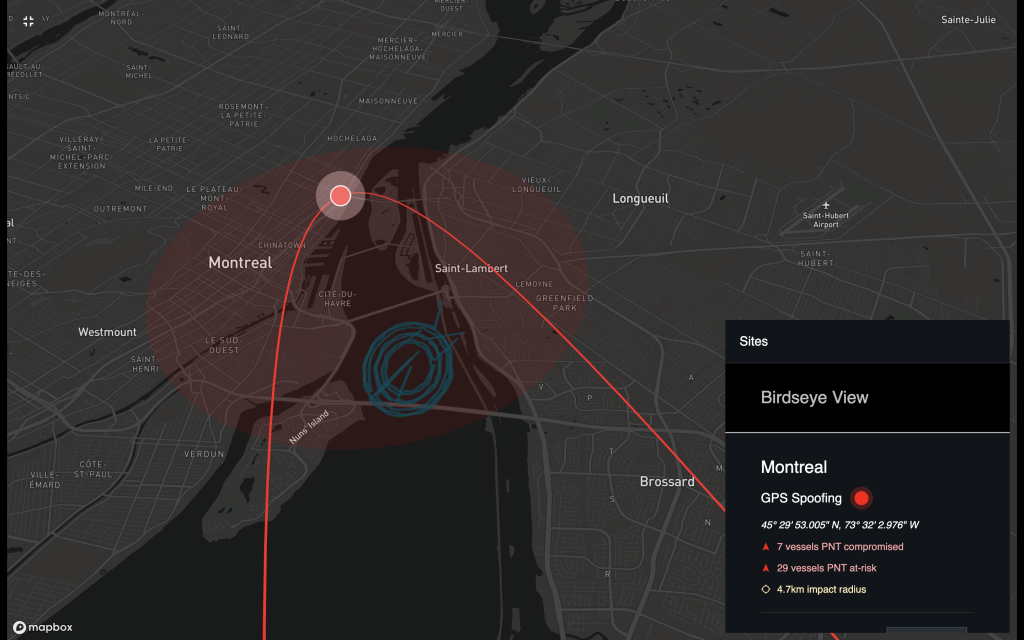
GenesysInsights platform. According to the company, GenesysInsights is a situational awareness and cyber security solution that leverages machine learning and AI to analyze geospatial signals and remotely identify disruptions, and detect malicious information such as jamming and spoofing; thus helping to secure government infrastructure and operations and enable cyber secure digital environments.
In the case of the CCG, GenesysInsights collects and assesses information from Global Navigation Satellite System (GNSS) signals and terrestrial/space-based Automatic Identification System data from ships to improve the Coast Guard’s ability to detect and respond appropriately to maritime threats. (This initiative is also part of the Innovative Solutions Canada program.)
The bottom line: Zighra’s development and application of cutting-edge AI technology is transforming the very nature of cyber secure user access, situational awareness, and threat detection. And at no time do any of its users have to prove that they are human.
James Careless is CDR’s Ottawa Bureau Chief

