


Vard Marine is Engineering Tomorrow’s Ships Today
BY JAMES CARELESS
Russia’s invasion of Ukraine has generated tremendous advances in drone warfighting technology on land, sea, and in the air. The military lessons of these advances — which have been arguably as significant as the introduction of aircraft and tanks in World War I — are being pondered and applied by companies such as Vard Marine. With offices in Vancouver, Ottawa, Houston, Gdansk, and Vietnam, Vard Marine is a Canadian naval architecture and marine engineering firm with a proven track record for designing complex vessels across the defence, commercial, and offshore sectors. The company specializes in tailored platform design, supporting operations in challenging environments and integrating emerging technologies including autonomy, electrification, and modularity.
“Vard Marine is part of the global VARD Group, a Fincantieri company and one of the world’s leading shipbuilders of specialized vessels,” said Bruce Phillips, Vard Marine’s Senior Specialist of Combat Systems and Autonomy. “Through this affiliation, Vard Marine and its clients benefit from direct access to world-class shipbuilding expertise, system integration capability, and a global support network.”
VARD’S RECENT WORK
ON AUTONOMOUS VESSELS
For today’s naval architects and navies, uncrewed autonomous ships have become the Holy Grail of maritime warfare. Small wonder: When ships no longer have to support a payload of human sailors and the facilities needed to sustain them, what remains can be entirely dedicated to naval missions — and stay on station at sea much longer.
Taking its place at the cutting-edge of maritime autonomy, Vard Marine has been directly involved in two of the U.S. Navy’s advanced uncrewed surface vessel initiatives. The first is the U.S. Navy’s Large Unmanned Surface Vessel (LUSV), with Vard Marine supporting L3Harris Technologies’ role as platform design partner. The second is the Defense Advanced Research Projects Agency’s NOMARS (No Manning Required Ship) project. “Under DARPA’s NOMARS initiative, L3Harris contracted Vard Marine to develop early stage novel platform designs optimized from the outset for zero onboard crew, fundamentally rethinking hull forms, arrangements, machinery access, and control systems to support sustained uncrewed operations,” Phillips told CDR.
In the civilian world, the VARD Group has designed and constructed a series of advanced, remotely controlled, reduced crew vessels for Ocean Infinity’s offshore survey and inspection missions. The company also built the Yara Birkeland, the world’s first fully electric and autonomous container ship.

A NEW DESIGN PARADIGM
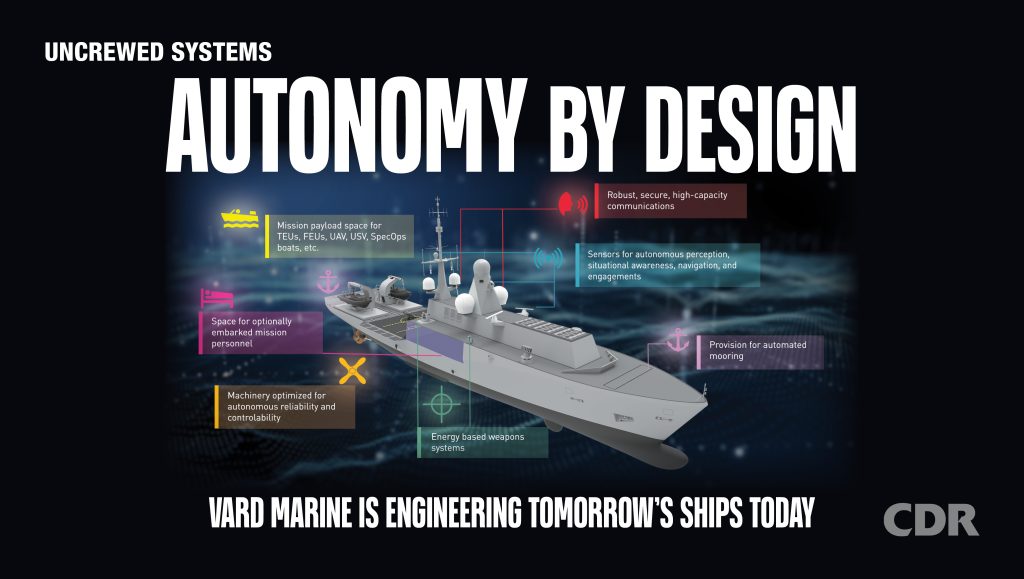
As a naval architectural and marine systems design organization, Vard Marine’s role in vessel autonomy is to understand, enable and efficiently apply autonomy in new vessel designs.
From a tactical and logistical perspective, autonomous ships offer numerous advantages to naval architects and vessel operators alike, but they also require a fundamental shift in systems-level thinking. For instance, designers must compensate for not having humans aboard to see, hear, smell, touch, adjust or correct anything that goes wrong. What autonomous sensing and response systems will be required to take their place, and how will they function?
“How will vessel status be remotely monitored robustly and in real- or near-real time — ashore or by other fleet elements — especially under dead-ship conditions, and for how long until physical intervention is feasible? How and to what extent will damage control be implemented?” Phillips asked. “What about the political, legal and convention implications of a fully autonomous armed or otherwise sensitive vessel operating without in-situ crew, particularly in congested or contested waters? Will the vessel’s security and force protection provisions allow for uncrewed onboarding of persons in distress?”
On the flip side of this new naval design paradigm, just imagine what becomes possible when a ship doesn’t need to support a human presence. For certain vessel and mission types, the added flexibility available to autonomous ship designers could be significant. Compared with an equivalent crewed vessel, both capital and operating costs may be reduced on an autonomous ship, while much more of its space can be devoted to mission-related requirements.
“In summary, medium-to-large uncrewed vessels offer significant advantages in long-duration, high-risk, and routine missions, including loiter, forward and consort weapons deployments, picket and forward observation, route survey, mine countermeasures, sovereignty and constabulary operations,” said Phillips. “Additionally, autonomous vessels may help address personnel shortages faced by many navies, reducing demand for trained crew on persistent or hazardous missions. All of these aspects are central to Vard Marine’s autonomous vessel design work.”
REVAMPING NAVAL DESIGN
FOR AUTONOMY
To date, most attention in marine vessel autonomy has focused on navigation, typically in smaller vessels with limited displacement, relatively simple machinery and straightforward mission profiles. Far less attention has been paid to the arguably more demanding problem of autonomous machinery management on larger uncrewed vessels with more complex machinery – particularly under failure and damage conditions. Here, notionally, thousands of parameters must be monitored, autonomous decisions made, and appropriate system reconfigurations executed on the order of seconds.
Correspondingly, all devices such as valves that could require state changes during vessel operation must either be remotely operable or, where possible, avoided through smarter system design and instrumentation design must simplify the autonomy software’s job as much as possible. “This demands a new approach to machinery design, instrumentation, and control, all grounded in a deep understanding of autonomy and AI implications,” Phillips said.
That’s not all. For long-duration autonomous naval missions, the absence of physical intervention drives demanding reliability requirements, particularly in propulsion, electrical, control, and communication systems. “Meanwhile, the inability to reload most current kinetic weapons autonomously also calls for reconsiderations of weapons fit and engagement strategies,” he said. “For force protection and low-intensity threats, directed energy weapons such as lasers offer potential advantages, especially as drone and shore-based air threats evolve. Nevertheless, weapons release authority will in most cases remain under direct human control via robust, secure data links to operations centers.
These are some of the Big Issues of maritime autonomy that Vard Marine and the VARD Group are dealing with today. “Collectively, we are at the cusp of a new wave of naval architecture — one that will be as much of a change to current maritime design as self-propelled iron vessels were to wooden sailing vessels,” concluded Phillips.
James Careless is CDR’s Ottawa Bureau Chief
