


Engineering Northern Security
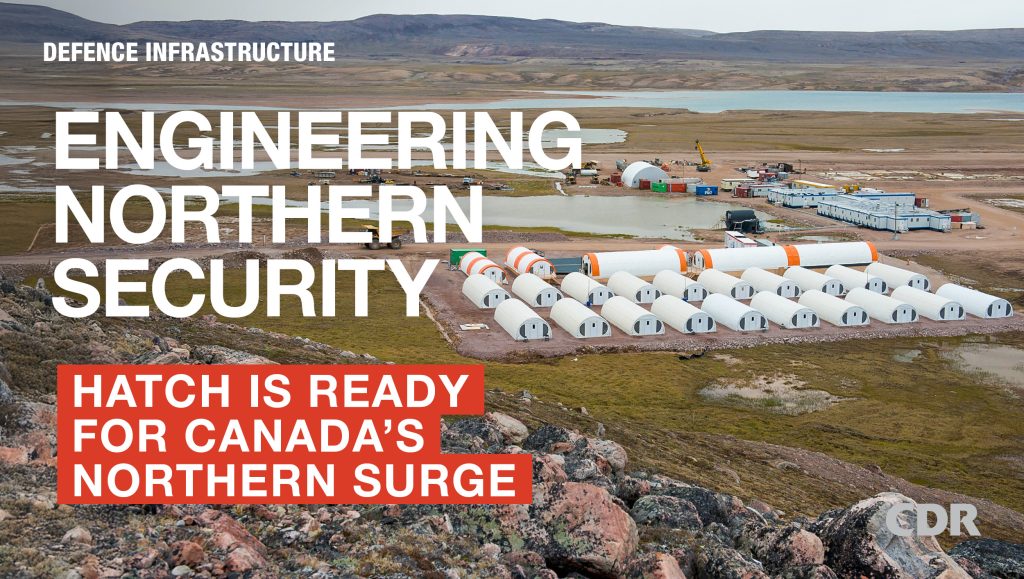
Hatch is Ready for Canada’s Northern Surge
DEFENCE INFRASTRUCTURE
BY JAMES CARELESS
Canada’s decision to increase defence spending—especially for Arctic sovereignty protection and northern basing—means the Canadian Armed Forces (CAF) have a significant amount of new infrastructure to build. Hatch, one of the largest private engineering and project management companies in the country, is ready to help the CAF achieve its construction goals.
Founded in 1955 in Toronto, Hatch has grown to become a global multidisciplinary consulting firm with more than 10,000 staff across 70+ offices. They provide services like engineering, project and construction management, process and technology development, and environmental, digital and business consulting. The company is well-known for its work in Energy, Infrastructure, and Mining and Metals.
For decades, Hatch has delivered engineering and project management expertise on some of Canada’s most complex and remote undertakings. From the Baffinland-Mary River Iron Ore project on Baffin Island—featuring Canada’s northernmost deepwater port and one of its most isolated airfields—to the Gahcho Kué Diamond Mine in the Northwest Territories, where logistics posed unique challenges, and the Halifax Shipyard Modernization Program, Hatch has consistently enabled critical infrastructure, especially in demanding environments. These projects show Hatch’s ability to deliver technically sound and innovative solutions that help shape Canada’s future.
Hatch is making defence a strategic priority, building on its experience with major Department of National Defence (DND) initiatives and previous work on Bases such as CFBs Shearwater, Esquimalt and Gagetown. “We did a lot of work in the environmental cleanup of the original Distant Early Warning (DEW) line,” said Robert Francki, Global Managing Director for most of Hatch’s infrastructure sector (transportation, water, tunneling, and defence) and a 20-year member of its global Board of Directors. “We also have a specialist team whose expertise is fuel depots: They assisted the RCAF and the RCN in managing their fueling facilities at numerous locations.”
READY TO HELP
Hatch has a good reason for positioning itself as a partner for the CAF in the north. “We have been involved in building almost all of the industrial infrastructure that has been done north of the 60th parallel in the past two decades,” Francki told CDR. “We’ve done at least a dozen projects in the Arctic for industry, and we’ve been very helpful to the governments and communities there in building power generation plants, bridges, and roads. As well, Hatch has learned how to manage logistics for incredibly complex projects in the North—including managing the logistics for a massive ice road for material and equipment delivery used in the winter, similar to ice road deliveries shown on reality TV shows. As a result, we feel certain that we’re uniquely and well-qualified for helping the military plan, design, construct, and commission the types of facilities that they need in the Arctic.” These facilities could include airfields, forward operating bases, navy ports for ships and submarines, and radar sites.
WORKING WITH INDIGENOUS COMMUNITIES
As a company with extensive Northern experience, Hatch is dedicated to building constructive relationships and collaborating with Indigenous and Inuit communities in Canada, and other countries where they operate. Given the proximity of many planned CAF projects to Indigenous communities, Hatch’s approach provides a strategic advantage.
“Many of our projects are located in Indigenous lands and near communities,” said Francki. “As a socially responsible company, we at Hatch learned long ago that one has to go about this in the right way. You have to be ready to listen to and learn from communities about what’s important to them, and co-design projects on their land. This is why Hatch has a group within the company that specializes in these efforts.”
Robert Francki stressed the importance of sincerity and true collaboration with Indigenous communities in order to achieve mutually beneficial goals. “It’s not trite to say that such efforts only succeed if you’re dedicated to building relationships with communities, so that you can have open and fruitful conversations. This means not rushing the process: You have to take the time that is required to build trust. So, whenever a client gives us the mandate to assist them with Indigenous community relations, engagement, and participation, we are able to point to a good track record of being able to establish such collaborative relationships, so that the project can proceed on faster timelines and actually achieve social and economic outcomes. This is why we feel very well prepared for this work, especially because we already have many existing long-term relationships with various Indigenous and Inuit communities from coast to coast to coast.”
ADVICE TO GOVERNMENT
As a company with extensive expertise in challenging construction projects, Hatch knows what is required to work in harsh climates and remote locations. This is why Francki believes his firm has a lot to offer DND and the CAF in translating their ambitious building plans into practical realities. “We know from our experience that Arctic projects are challenging to do,” he told CDR. “This is why DND will need to consider how these projects have to be managed differently from the ones they are accustomed to building in the South. Trying to use the same processes up North, without compensating for the environment and supply chain issues beforehand, can lead to unintended and unwanted consequences.”
Fortunately, Robert Francki has noticed a new willingness in government circles to do things differently. “The last time I was in Ottawa, I observed an openness to explore some new approaches as the government draws up its plans to procure new projects, which include a whole series of forward operating bases and support hubs (airfields and ports) across the North,” he said. “How to manage and then execute these projects more efficiently and effectively is something that Hatch is well-positioned to do. Of course, it would not hurt for Canada to have a new approach – based on efforts developed by C.D. Howe, the World War II minister who rapidly expanding Canada’s output of ships, planes and other military materials by creating an impressive defence-industrial complex in very short order. Hatch is ready to step up to help DND and the CAF achieve their goals as best we can, for the safety of Canada and our people going forward.”
With decades of northern engineering and project delivery experience, deep Indigenous partnerships, and a track record of executing complex megaprojects, Hatch is ready to be a key CAF partner in Canada’s next generation of defence infrastructure.
James Careless is CDR’s Ottawa Bureau Chief
