


DEFENCE PROCUREMENT – Defence Investment Agency
What It Is, What the Experts Think
BY JAMES CARELESS
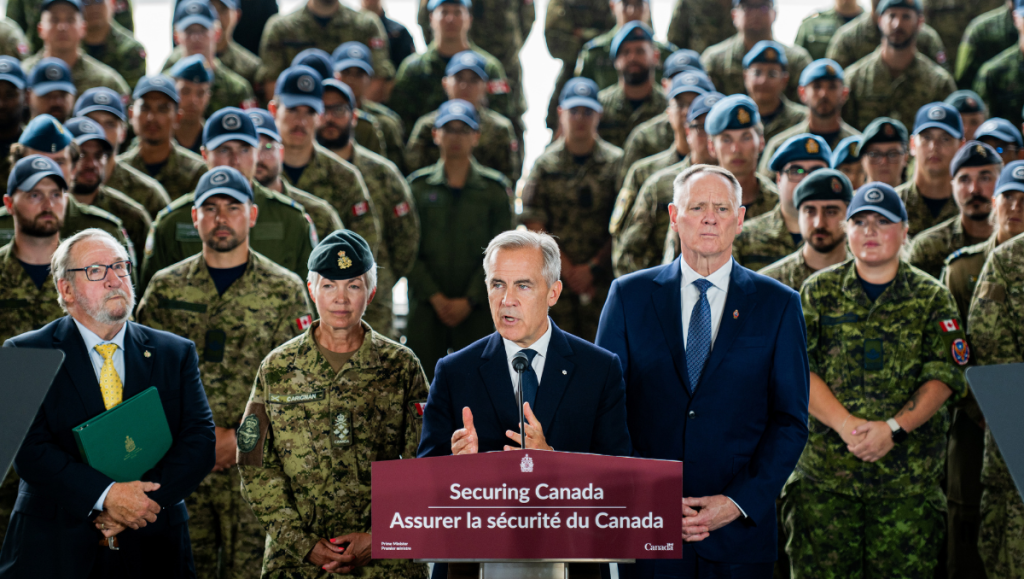
On October 2, 2025, Canadian Prime Minister Mark Carney officially announced the creation of the much-anticipated Defence Investment Agency (DIA). It is a single point of contact/management for Canada’s defence procurements going forward.
For decades, defence companies have struggled with Canada’s notoriously slow and complex procurement system. The DIA promises to change that.
“In a dangerous and divided world, Canada’s new government is ensuring the Canadian Armed Forces get the equipment they need, when they need it,” said Prime Minister Carney. The new agency will bolster our defence industrial capacity, create new careers, and ensure that in this new era, Canada’s leadership is not defined by the strength of our values, but also by the value of our strength.”
READ: Defence Investment Agency awards contract to Colt Canada to replace CAF assault rifles
The DIA is definitely an answer to the Canadian defence industry’s prayers. So how will it function, and what do people who are knowledgeable about this country’s troubled procurement process think about this change? To find out, Canadian Defence Review interviewed the DIA and some noteworthy industry experts. Here is what they told us.
WHAT IS THE DIA?
CDR began by going straight to the Defence Investment Agency for answers. Here are the answers that the Canadian defence industry needs to know.
“The DIA is a new Special Operating Agency (SOA) within Public Services and Procurement Canada (PSPC), created to accelerate and modernize defence procurement for Canada,” said Nicole Allen, a PSPC spokesperson. “Its mission is to deliver equipment, technology, and capabilities to the Canadian Armed Forces (CAF) and the Canadian Coast Guard (CCG) more quickly and efficiently, while growing Canada’s domestic industrial base through strategic partnerships, targeted investments, and active engagement with Canadian industry.” To make this happen, “The DIA will foster collaboration with industry and international partners, support innovation, and ensure the CAF has timely access to modern equipment and technology.”
READ: First Procurements in Defence Investment Agency Announced
The DIA is being led by Chief Executive Officer Doug Guzman, formerly Deputy Chair of the Royal Bank of Canada. The agency is overseen by the Secretary of State (Defence Procurement). An interdepartmental governance committee, including Deputy Ministers from key departments, will advise on its strategic direction.
AN AMBITIOUS MISSION
The DIA’s mission is to centralize Canada’s various procurement authorities into one, streamline decision-making, and reduce bureaucratic delays. To achieve this mission, integrated procurement teams will be formed within the DIA, drawing on expertise from PSPC, the Department of National Defence (DND), the CAF, the CCG, and Innovation, Science and Economic Development Canada (ISED). “This integrated staffing model will ensure continuity, leveraging existing expertise and fostering cross-departmental collaboration,” Allen told CDR. “The DIA will also engage industry earlier and adopt flexible procurement strategies tailored to defence needs.”
The Agency is starting its work by focusing on high-priority procurements, particularly those valued over $100 million. “Projects already in advanced stages or those below this threshold may continue under current departmental oversight,” said Allen. “However, over time, the DIA may assume responsibility for more projects as its capacity grows, and processes mature.”
READ: Defence Investment Agency to engage Canadian industry on future submarine fleet sustainment
MORE CLARITY FOR INDUSTRY
The old multi-ministry approach to Canadian defence procurement was often confusing and inefficient. By replacing it with a single point of contact, “The DIA will provide greater clarity, consistency, and predictability for companies bidding on defence contracts,” Allen told CDR. “By streamlining approvals and consolidating procurement processes, the Agency aims to reduce delays and improve transparency.”
Here’s the part that CDR readers have been waiting for. “The DIA is prioritizing early and ongoing engagement with Canadian industry,” she said. “Dedicated teams will work directly with contractors to clarify requirements, improve contract design, and provide guidance on new procurement models. The Agency will host industry days, consultations, and provide updated resources to help businesses navigate the new system.”
To be specific, the DIA intends to: • Engage earlier in the procurement lifecycle, starting at the planning and options analysis phase; • Use integrated teams with technical, commercial, and project management expertise; • Adopt modern and flexible procurement approaches, including tailored contract templates and innovative acquisition models; • Reduce the number of required approvals and increase financial authority to accelerate contract awards; • Align more closely with international partners for joint procurements and shared best practices; • Strengthen the domestic industrial base through strategic partnerships, targeted investments, and active engagement with Canadian companies, helping to drive innovation, economic growth, and job creation.
“The DIA has already started advancing and onboarding a first wave of high-priority defence procurements,” Allen concluded. “Additional information will be made available in the near future.”
A VIEW FROM A PROCUREMENT GURU
In his former career, Alan Williams was Assistant Deputy Minister (Materiel) at DND. As such, he developed a deep and insightful understanding into Canada’s defence procurement process. Today, Alan Williams is President of The Williams Group, where he provides expert advice in the areas of policy, programs and procurement.
“For 25 years, I have been a strong advocate for a Defence Procurement Agency with one minister in charge of defence procurement,” Williams told CDR. “It was the key recommendation in my book, ‘Reinventing Defence Procurement: A View From The Inside’, published in 2006.”
According to Williams, the DIA’s creation is a good first step to addressing Canada’s procurement woes, but more remains to be done. “The following initiatives must also be introduced,” he said. “First, system-wide performance measures must be introduced. Without performance measures open to public scrutiny, performance suffers. We need indicators that, at a minimum, measure cost and timeliness. If costs are rising, why are they rising? If delays are occurring, where in the process are the bottlenecks? It’s impossible to make improvements, if we don’t have a clear understanding as to where the problems lie.”
“Second, we need to improve our costing and reporting on our capital programs,” continued Williams. “With respect to the costs of large capital programs, two fundamental questions need to be answered. The first is, what is the cost of the program? The second is, can we afford it? Today both questions are inadequately addressed. Typically, the government reports on the acquisition costs. The fact is, acquisition costs only represent about 30 per cent of the life-cycle costs. Providing full life-cycle costs will help address the first question. The issue of affordability can only be answered with a publicly available, fully-costed, cabinet-approved, long-term capital plan.”
Finally, Alan Williams is “deeply concerned over the announcement that the DIA will only be accountable for procurements above $100 million,” he told CDR. “It is hard to understand why a $95 million procurement should be handled separately from a $105 million procurement. It ‘snatches defeat from the jaws of victory’.”
CADSI UNCERTAIN ABOUT DIA
The Canadian Association of Defence and Security Industries (CADSI) has long advocated for changes to this nation’s procurement process. As for CADSI’s reaction to the establishment of the DIA? “The notion of a central agency to handle defence procurement had been floated repeatedly over the years, by different governments and experts, so it’s not a new idea,” said Nicolas Todd, CADSI’s Vice President of Government Relations and Communications. “We’d cautioned strongly against it because of the sheer complexity of this kind of machinery-of-government change, and the potential for it to grind the system to a halt as people and resources are shuffled around and authorities are sorted out. We still have those concerns. How this new approach will affect the day-to-day operations of our members — how they pursue, win, and deliver on contracts — is also still unclear.”
So what will it take to persuade CADSI and its members that the DIA is the fix to the procurement problem? “Industry still needs more information to determine if and how the DIA will drive toward Prime Minister Carney’s ambitions, which involve not only reforming procurement but using it to drive economic growth and to decrease our reliance on other nations,” Todd replied. “There are no silver bullets in defence procurement. The challenges in Canada’s system stem not just from the layers of bureaucracy and approvals, but things like an ingrained culture of risk aversion and the need to work earlier and more closely with industry to identify capability gaps and figure out how to fill them. [So] The DIA will need to be just one part of a much broader and coordinated plan – tied into the massive increase in defence spending, the recently announced Buy Canadian policies, the upcoming Defence Industrial Strategy, and defence export plans and supports.”
CGAI MORE UPBEAT ABOUT DIA
The Canadian Global Affairs Institute (CGAI) is renowned for bringing together defence, government, and industry to discuss the many military challenges facing the Canadian Armed Forces, DND, Canada as a whole, and NATO. As such, CDR asked CGAI President and CEO David Perry for his assessment of the DIA.
“The Carney government is the first in generations to come forward with an institutional restructuring of the government of Canada’s procurement system,” Perry told CDR. “That sends a very clear signal that they want a different outcome, and that signal on its own has a real value in making it clear to the bureaucracy and military that they’re looking for better outcomes. It’s a very positive signal of a government putting a higher priority on defence and defence procurement at a time when we’re trying to make major new investments in our defence.”
So is the DIA the long-sought-after solution to Canada’s procurement woes? “It’s too early to tell whether it is the magic solution or not,” he replied. “We don’t know enough yet about how it’s going to function, work with the other procurement departments and organizations, and how much scope it has to work differently.”
Of course, moving from the multi-ministry model that has controlled Canadian procurement to a process solely controlled by the DIA can’t happen overnight. This being the case, “I think the more clarity the government can provide about what the DIA will focus on, and what the transition process looks like, the more comfortable people will be with the evolution,” said Perry. “I think we also need to rethink our processes, administrative policies, procurement rules and regulations and assess our workforce to see if it’s the right size with the right skillsets and training. It’s hard to think that simply having a different group of people do the same work, the same way will lead to major changes in its own right, even if more of them work for a single organization. So we need to move forward with deeper structural changes to the way the system works and is resourced in parallel. That too will take time.”
In the interim, David Perry says that the government can speed things up by prioritizing the procurements that matter most and pushing them through first. “We’ve seen evidence of what can happen when we do that with the Canadian Patrol Submarine Project, which is moving lightning fast.”
CDR’s TAKEAWAY
Whether the DIA succeeds will depend on how quickly it can move from good intentions to tangible improvements. But, for the first time in a generation, the foundations for meaningful change are being laid.
James Careless is CDR’s Ottawa Bureau Chief
