


Airbus Helicopters: Charting Canada’s Flight Path to the Future

BY JAMES CARELESS
Airbus is a longstanding, reliable and trusted partner of the Canadian Armed Forces (CAF).
The company is represented in Canada by three different operating units. Airbus in Canada – based in Mirabel, Quebec – focuses on the commercial sector (including the A220 program), Airbus Defence & Space – based in Ottawa, Ontario, and Airbus Helicopters – based in Fort Erie.
Airbus Defence & Space has a significant and expanding role in supporting Canada’s defence. Its current activities are centered on three key projects for the Royal Canadian Air Force (RCAF). They are the CC-330 Husky, the CC-295 Kingfisher, and the CT-153 Juno for the Future Aircrew Training (FAcT) program.
In 2023, the Government of Canada awarded Airbus Defence & Space a contract for its new CC-330 Husky fleet, which consists of four new A330 Multi Role Tanker Transport (MRTT) aircraft and five converted A330-200s. This fleet will be used for air-to-air refueling, military airlift, and strategic transport, strengthening Canada’s continental defence capabilities.
Next, the CC-295 Kingfisher is Canada’s newest fixed-wing search and rescue (FWSAR) aircraft, with 16 being acquired to replace older fleets. It features advanced sensors and successfully completed its first SAR mission in May 2025, just weeks after beginning operations.
Lastly, in 2024, Airbus secured a historic contract to provide 19 twin-engine H135 helicopters for the FAcT program. This marks the first time the Canadian military will operate Airbus helicopters, which will be used to train all future RCAF pilots. The first production test flights of these H135s have recently taken place and first deliveries are anticipated to begin in early 2026.
Richard Morris is the company’s key man here. He is the Director of Government Programs with Airbus Helicopters in Canada. Prior to joining Airbus, Richard Morris had over 30 years’ experience as a Tactical Helicopter Pilot with the Canadian Armed Forces.
AIRBUS LOOKING TO THE FUTURE
Given the depth and complexity of Airbus’ current CAF commitments, one might think that the company has its hands full. However, as the world’s largest aircraft manufacturer, Airbus has substantial capacity and capabilities. As a result, it is ready and willing to serve the CAF in even more ways, if given the chance.
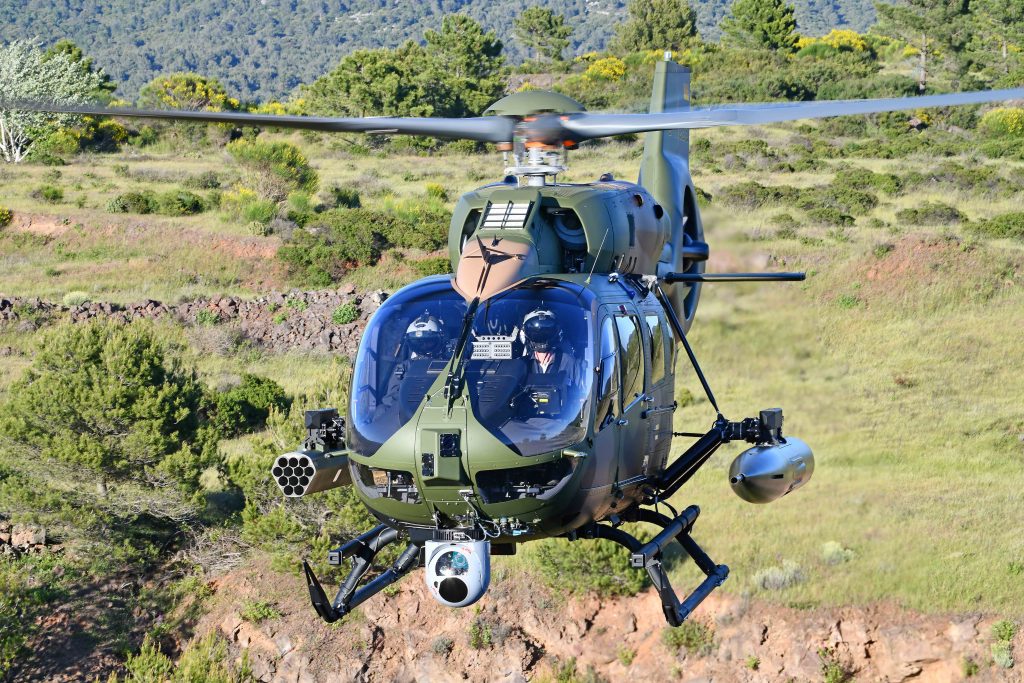
According to Richard Morris, this is precisely what the company has in mind. “Today, Airbus Helicopters has our sights set on expanding our involvement even further through future defence opportunities with the Canadian government, such as nTACS [Next Tactical Aviation Capability Set, to fill gaps in the CAF’s aerial tactical capabilities] and the Canadian Coast Guard Polar Helicopter project,” he explained. “Airbus has helicopters adapted to excel in all types of military missions, including armed reconnaissance, utility, attack, naval, maritime and special operations, and we believe we offer the strongest ‘Made for Canada solution to meet Canada’s unique operational needs.”
READ: nTACS REPORT – Rotor Reset
Airbus is certainly well-positioned to meet Canada’s nTACS requirements with up-to-date helicopters that are modern, affordable, and Military Off the Shelf (MOTS). “That distinction is important,” Morris told CDR. “While you can certainly put modern avionics into an older airframe, at its core it is still an older platform. Our product portfolio – including the H145M, H160M, and H175M – is made up of modern, mission-ready helicopters. Their key advantage is Airbus’ technology: Our helicopters are built from the ground up with the latest technology, which translates to better operational efficiency and a lower total cost of ownership over their lifespan. This also gives our platforms the ability to evolve as requirements change.”
The Airbus Helionix avionics suite is a good example of this company’s cutting-edge helicopter technology. Often referred to as a ‘glass cockpit’ due to its use of large LCD displays, the Helionix cockpit system comes with a 4-axis autopilot that significantly reduces the pilot’s workload. This allows the pilot to be more aware of their surroundings, which enhances their flight safety. In the same vein, the Helionix’s three large electronic displays congregate all of the data that used to be spread across a field of analog console gauges for fast and easy reference. This cockpit system is also Night Vision Goggle-compatible and comes with First Limit Indicator that highlights the appropriate engine instrument data using just one indicator.
The Helionix avionics suite is a standard feature across Airbus’ twin-engine helicopter fleet. This includes the 19 H135 military training helicopters that will be delivered to the RCAF beginning early next year.
“This commonality ensures an easier transition for pilots between aircraft, saving time and money on training,” said Morris. “Airbus has also recently introduced HTeaming, a modular solution that pairs a crewed helicopter with an Uncrewed Aerial System (UAS). This allows the crew to take full control of the UAS during missions, a valuable feature as mission requirements evolve.”
All told, Airbus isn’t just offering helicopters to the RCAF and the CCG, but a complete package. “We can provide a comprehensive system of systems that’s ready to meet the diverse and demanding needs of the CAF, including special operations and conventional aviation requirements,” Morris said. “In addition to providing robust solutions for nTACS, Airbus’ desire is to strengthen our relationship with Canada and firmly establish ourselves as a trusted, reliable, and strategic partner for defence aerospace solutions; contributing to both national defence and security, and economic benefit – now and into the future.”
AIRBUS AND THE BOOM IN
CANADIAN DEFENCE SPENDING
The federal government’s promises to hit the 2% GDP NATO spending goal this year and the 5% GDP goal by 2035 means that billions more will be spent on Canadian defence. But just spending money is no guarantee of making Canada safer. To make this happen — to better protect us against our adversaries, serve as a more effective partner in NORAD and NATO, and to build a stronger and more resilient Canadian economy in the process — requires taxpayers’ dollars to be spent on the right military purchases and programs.
Richard Morris is keenly aware of this fact. “From Airbus’s perspective, defence procurement is a critical opportunity to fuel a broader economic impact in Canada, moving beyond simple acquisition to an investment in strengthening the domestic defence industry,” he told CDR. “As such, an Airbus solution would be directly tied to the company’s commitment to expand its Canadian footprint. By investing in a Canadian Original Equipment Manufacturer (OEM), the government can directly contribute to economic growth and job creation.”
In making his case, Morris cited hard, cold facts. “Airbus currently has a substantial presence in Canada, with a network of over 850 suppliers and over $2 billion CAD sourced from Canadian companies annually,” he noted. “As a result, a significant fleet contract, such as the one for nTACS, would lead to more highly skilled jobs. This would strengthen Canada’s domestic supply chain and make the country more self-reliant in defence capabilities. This is why Airbus’ commitment to additional in-country investment, local job creation, and building a robust domestic supply chain is a fundamental part of its value proposition to Canadians. Our approach thus aligns with the Industrial and Technological Benefits (ITB) Policy, which ensures that defence spending creates tangible, long-term economic benefits for Canada, fostering innovation and sustainable jobs across the country.”
At the same time, Airbus is not seeking preferential treatment. “While we understand that governments reserve the right to use directed procurement, we firmly believe in and prefer a fair and open competition,” said Morris. “It ensures that the government can fully evaluate all the options and ultimately select the best possible solution, while also maximizing the economic benefits for Canada.”
BALANCING SHORT & LONG-TERM GOALS
With billions of defence dollars to spend, and a taxpaying public that demands value for its money, the federal government will need to balance Canada’s immediate defence needs against its long-term requirements.
Airbus has a recommendation. “The Canadian government should balance long-term value against immediate needs by adopting a long-term vision for defence spending that considers not only initial cost but also the total cost of ownership over the life of the asset,” Morris said. “While speed and urgency are a priority, it is crucial to avoid a short-term focus that could lead to higher costs and lower operational efficiency in the long run.”
To strike this balance effectively, the federal government should establish a coherent Defence Industrial Strategy along with strong strategic partnerships. “This would go a long way in ensuring that Canada receives long term value in its defence procurements and ensuring that industry is well positioned to meet urgent and unplanned requirements,” he said. “This is an important point, and it speaks to the challenge of balancing immediate needs with a long-term vision. We’ve seen a lot of pressure to get things done quickly, but we need to ensure that a push for speed doesn’t come at the expense of a comprehensive, long-term solution.”
At the same time, “a smart procurement decision must focus on the total cost of ownership, not just the initial price tag,” said Morris. “This means looking at operational efficiency, maintenance costs, and the platform’s ability to evolve over its decades-long service life. An Airbus solution offers an approach that provides both affordability and sustainability, avoiding the high long-term costs and limitations of an older platform. It’s about making a choice that serves the country well for decades to come, not just for the next few years.”
THE IMPORTANCE OF INTEROPERABILITY
From the European battlefields of WWI and WWII through the Korean conflict, the Balkans, and Afghanistan, the importance of the CAF being able to interoperate with other nations’ armed forces has rung through loud and clear. The same truth holds today: “In today’s shifting global landscape, interoperability is no longer optional, it is a strategic necessity,” Morris told CDR. “By selecting an Airbus helicopter, Canada would ensure their fleet can seamlessly integrate with NATO and allied partners. Airbus helicopters are widely used by more than 140 armed forces worldwide, giving Canada strategic value through enhanced joint operations and simplified logistics.”
Morris has a point. Airbus’ global footprint means that Canada would not be acquiring a one-off or unique fleet that is difficult to maintain and dependent on external critical support (as has happened in the past). Instead, a CAF Airbus Helicopter fleet would be a domestically sustainable fleet with a robust global support network. This fact would reduce long-term operational costs and increase the fleet’s readiness and effectiveness in multinational operations, allowing Canadian forces to work more efficiently and confidently alongside our allies.
AIRBUS’ ROLE IN CANADA’S FUTURE
It is clear that Airbus has given serious thought to its long-term role in Canadian society — going far beyond the usual considerations of a major defence contractor looking for a short-term sale.
In this long-term view, “Airbus sees itself as a ‘Made for Canada’ solution provider for defence, becoming a strategic leader and partner in the Canadian defence and aerospace sectors,” said Morris. “The company’s vision is to leverage its extensive Canadian footprint -including manufacturing, engineering, and support facilities – to directly address Canada’s defence and security needs.”
To realize this vision, Airbus plans to build on its existing Canadian partnerships and contracts, like the FAcT program, Fixed Wing SAR, and the Strategic Tanker Transport Capability (STTC) project, to expand its role. This includes providing tailored solutions for future defence projects, such as nTACS and the Canadian Coast Guard Polar Helicopter project, that are designed to meet Canadian operational requirements while also strengthening the domestic aerospace ecosystem. By continuing to invest in local jobs, supply chains, and innovation, Airbus aims to be a cornerstone of a more self-reliant and prosperous Canadian defence industry.
“For the future, we want to continue to build on this foundation,” Morris concluded. “Our commitment is to work with the Canadian government to ensure that our defence programs not only deliver the best possible equipment but also create lasting economic benefits for Canadians. By choosing an Airbus platform, Canada would not only be acquiring a world-class military capability but would also be fostering a domestic industry that is ready to take on the challenges of the future.”
James Careless is CDR’s Ottawa Bureau Chief
