


Commander Maritime Forces Atlantic and JTF-Atlantic
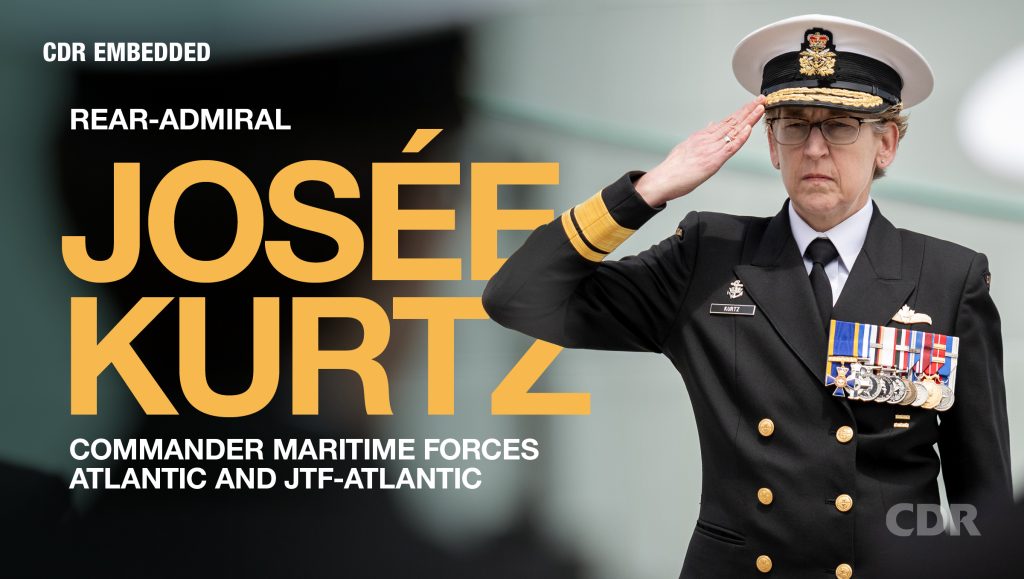
In a recent interview with CDR’s Ottawa Bureau Chief, James Careless, RAdm Kurtz provided an update on the status of the RCN’s Atlantic Fleet, the challenges of keeping this fleet provisioned and ready for deployment, and the impact of the Ukrainian war on the Royal Canadian Navy (RCN). Here is that conversation.
Born in Joliette, Québec, Rear-Admiral Josée Kurtz joined the Canadian Armed Forces in 1988 as an officer in the Royal Canadian Navy. She specialized in navigation, then graduated from the Operations Room Officer Course in 1997.
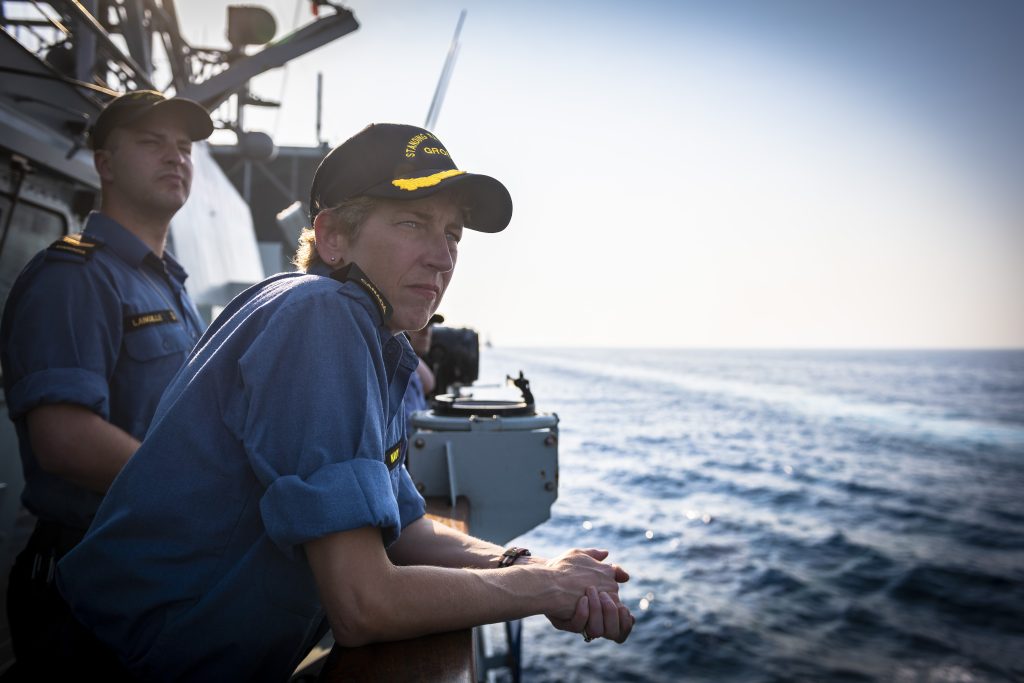
During her career, Rear-Admiral Kurtz has served with HMCS Vancouver as Weapons Officer and Combat Officer, and as Executive Officer of HMCS Ville de Québec (2007-2009). During this period, HMCS Ville de Québec was deployed with the Standing NATO Maritime Group 1 (SNMG1), which saw it being diverted on short notice for an anti-piracy escort mission with the United Nations World Food Programme off the Horn of Africa.
After this second-in-command tour, Executive Officer Kurtz was appointed as Commanding Officer of HMCS Halifax (2009-2011). The ship’s missions during this time included being tasked to the Humanitarian Assistance and Disaster Relief mission in Haiti after the devastating January 2010 earthquake. She was then appointed Commandant of the Canadian Forces Naval Operations School (2011-2012). Rear-Admiral Kurtz has also fulfilled staff assignments from Desk Officer to Director General level in various capacities.
In 2019, Rear-Admiral Kurtz was the first woman to serve as Commander of Standing NATO Maritime Group 2 (SNMG2), the Alliance fleet in the Mediterranean and Black Sea region. She was then appointed Commander of Cadets and Junior Canadian Rangers (2020-2021) and Commandant and Vice Chancellor of Royal Military College of Canada (RMC) Kingston (2021-2023). She was appointed Commander Maritime Forces Atlantic and Joint Task Force Atlantic (JTF-Atlantic) in June 2023, again being the first woman to serve in this position.
Rear-Admiral Kurtz earned a Bachelor of Arts degree from the University of Ottawa (2005) and a Masters in Defence Studies degree from RMC Kingston (2007). She is a graduate of the National Security Programme (2013) at the Canadian Forces College in Toronto. When off-duty,
Rear-Admiral Kurtz dedicates her free time to family activities, photography, and watching the Toronto Blue Jays.
STATUS UPDATE
CDR: Admiral Kurtz, thank you so much for speaking with us. The last time we spoke was back in August 2020, shortly after your command of SNMG2. Needless to say, lots has changed. Can you start by giving us a rundown on the status of the Atlantic Fleet today?
RAdm Kurtz: As you know the Royal Canadian Navy, is undergoing the most significant force modernization and cultural evolution process in our peacetime history, and Maritime Forces Atlantic (MARLANT) is squarely part of this endeavour. As we introduce the newest class of ships, the AOPVs, prepare for the delivery of the Joint Support Ships, and shape for the future capacity of Canadian Surface Combatants, we strive to bridge our current capabilities to our future fleet. This work includes focusing on the recovery of our personnel situation through unique initiatives, such as the Naval Experience Program and reconstitution efforts. Though we remain short personnel across the Royal Canadian Navy, here in Maritime Forces Atlantic, we continue to meet operational requirements assigned to the East Coast fleet while listening to the sailors on deck to learn and evolve our business in support of retention priorities.
CDR: What are the challenges associated with keeping your fleet provisioned, equipped, and ready for action?
RAdm Kurtz: Crewing and Maintenance are two of the biggest challenges.
Like the rest of the Canadian Armed Forces, the Navy has encountered challenges with recruiting, training, and retaining diverse Canadian talent. Therefore, the Navy is rethinking how it attracts, recruits, and trains sailors.
The Naval Experience Program is the newest initiative to help accomplish this. The overall concept is to reduce the amount of time it takes to train civilians into sailors while allowing them to experience life in the Navy before committing to longer terms of services into a specific occupation. The Naval Experience Program’s aim is simple: to foster the development of sailors who love their work and who enjoy the unique lifestyle that the Navy offers.
The RCN is undergoing the most comprehensive fleet modernization in its peacetime history. Part of this modernization is the close management of the operational schedule and work periods required for each ship.
Our sailors are some of the most proficient in the world. As each platform comes through its work and maintenance cycles, we ensure that the ship and our crews are ready to execute their missions at home and abroad following a comprehensive Tiered Readiness and Reactivation Program.
Ongoing maintenance of our platforms will continue to ensure the RCN has the capacity required to support operations until the transition to its future fleet is complete. The maintenance period needed for each ship is specially determined based on the requirements of each individual hull. A customized maintenance and work period is determined for each hull through its work and maintenance cycles. Our ships execute complex missions in challenging areas of operations around the world, and the impact of those operations on the hull and equipment varies from hull to hull.
CDR: It has been just over a year now since you were appointed as Commander of Maritime Forces Atlantic and Joint Task Force Atlantic (JTFA). Can you give our readers a rundown of the last year and some of the major accomplishments and challenges that you faced?
RAdm Kurtz: The position as Commander MARLANT is complex with five areas of responsibility assigned to a single individual. They are MARLANT as the Force Generator of naval capability in the Atlantic, and Assistant Chief of the Naval Staff Afloat Training and Readiness developing the Operational Assignment Schedule for the Navy and certifying crews to the requisite level of readiness (both these functions are responsible to Commander Royal Canadian Navy); Joint Task Force Atlantic poised to respond to domestic operations across the four Atlantic provinces; Joint Rescue Coordination Centre responding to air and marine incidents within the Halifax Search and Rescue Region; and Maritime Component Commander responsible for the planning and execution of naval operations globally (these three functions report to the Commander Canadian Joint Operations Command).
It is obviously a hefty portfolio within which there is overlap in and synergy in some areas. However, success across these lines of effort on a daily basis is owed to the commitment of highly dedicated staff.
Every ship that deploys according to the operational schedule is a success story because they are delivering effect to and on behalf of Canadians as directed by the Government. This is significant in a global context of growing instability.
Sailors continue to bring tremendous credit to their Navy despite the challenges of personnel shortages and managing and operating an ageing fleet while introducing new platforms. That said, I think our greatest mark of success this year is how east coast sailors rallied to help crew west coast-based HMCS Ottawa for their upcoming deployment to the Indo-Pacific. Adopting a whole-of-navy philosophy vice the traditional coastal approach will be key to contemporizing our institutional endeavours.
OPERATIONS
CDR: What are some of the major Operations that Maritime Forces Atlantic is currently involved in?
RAdm Kurtz: MARLANT is currently involved in operations around the world; ships from Canadian Fleet Atlantic are rotating through different missions on an ongoing annual basis. Some of these missions are but are not limited to Operation Reassurance Standing NATO Group 2, of which a Canadian Commodore is in Command, Operation Reassurance Standing NATO Mine Countermeasures Group, and Operation Carribe. So far, in 2024, there have been two ships on three separate patrols, Operation Horizon and Operation Nanook.
SNMG2
CDR: Commodore Matthew Coates, Commander of HMCS Charlottetown, has assumed command of Standing NATO Maritime Group Two (SNMG2). As mentioned, you commanded SNMG2 back in 2019. Can you give us some insight into some of the challenges associated with that deployment?
RAdm Kurtz: While Commodore Coates has assumed the same command I held in 2019, it is also clear that the global environment has evolved and the strategic reality in the SNMG2 theatre— namely the Mediterranean and Black Sea region, has evolved. Just consider that at the onset of my tenure one of the first ports the Group visited was Odessa in Ukraine whereas at the moment, there are no patrols in the Black Sea.
That said, their mission as part of the maritime component of the NATO Response Force remains the same: Participate in exercises to generate readiness, conduct patrols to provide presence through their area of responsibility and focus on priority sectors in support of stability and deterrence.
The biggest challenge is leading a multinational Group where units and staff rotate based on national commitments. Working within the strength of the NATO alliance and with the diversity of experience provided by allies is also a tremendous asset and extremely rewarding. I know that Commodore Coates’ leadership will act as the connective tissue to generate the capacity expected for SNMG2 to face the rapidly evolving challenges in the Eastern Mediterranean and in the Middle East.
CDR: How is the war in Ukraine affecting how the RCN deploys its assets to the Mediterranean?
RAdm Kurtz: Canada’s commitment to sending ships to NATO’s Standing Naval Forces remains unwavering, even in the face of ongoing global tensions. The routine deployment of RCN ships, as part of the broader Op REASSURANCE mission, is a continuous effort to support NATO’s assurance and deterrence measures in Central and Eastern Europe.
This ongoing commitment is part of the biggest reinforcement of the Alliance’s collective defence in a generation. Canada’s contribution to Op REASSURANCE, as the largest CAF overseas mission, is a testament to our enduring commitment to global peace and stability. The ongoing deployment of HMC Ships, such as Charlottetown, on a persistent rotational basis since 2014 is a clear demonstration of Canada’s ongoing commitment to NATO.
CDR: A final question: You were the first woman to command a major warship (HMCS Halifax, 2009), Standing NATO Maritime Group (SNMG2, 2019), and RCN coastal formation (Maritime Forces Atlantic, 2023). With that said, do you have any advice for young women entering the RCN?
RAdm Kurtz: The best advice I can offer to young women considering a career in the Navy is to not let challenges or resistance get in the way of their aspirations. If I had heeded opposing views when I went to enroll in 1988, I would not be here today.
As the first cohort of young women integrating in a traditionally male environment, we no doubt faced significant challenges. But together as women, and with some great allies and friends as our shipmates, we made some great strides and I think the Navy, if not perfect, is a much better place today.
We need young Canadians to join and continue this evolution process and bring their ideas forward to ensure our institution reflects contemporary times. I will also offer to anyone joining the Navy to work hard but not put excessive pressures on themselves individually. To me, the key to success in the Navy is learning to work as a team.
James Careless is CDR’s Ottawa Bureau Chief
