


BY JAMES CARELESS

Keeping the RCN’s Ships Liveable
Ship-based marine heating, ventilation, air conditioning and refrigeration (HVAC-R) systems are not the kinds of technology that usually catch people’s attention. But make no mistake: HVAC-R systems are essential to keeping ships liveable for their crews. Without them, modern ships could not function.
Providing HVAC-R systems to the Royal Canadian Navy (RCN) and other Western allies is what Bronswerk Group does best. Founded in Holland in 1947, and becoming a Canadian-owned company in 2006, Bronswerk manufactures complete (HVAC-R) systems for commercial and military vessels — managing the entire process from concept through installation, commissioning, and life cycle support. Its Naval HVAC system designs, system integration and Mil-Spec equipment manufacturing processes comply with all international standards (LR NSR, ANEP 77, DEF STAN 59-411 and MAP 01-470), while Bronswerk itself has attained ISO 9001:2015 accreditation.
STRONG CANADIAN ROOTS
Bronswerk’s Canadian roots stretch back to the 1980s, when the RCN selected Bronswerk to install HVAC-R systems on its 12 Halifax-class frigates. “That was our first work for the RCN at the time, which is why we established an office in Canada,” said Francis Fontaine, Bronswerk Group’s CEO. “To this day, the Halifax-class frigates are equipped with our HVAC-R systems, which we support through a service contract with the RCN.”
Having been purchased by its Canadian management team in 2006, Bronswerk is now headquartered in Montreal, with manufacturing facilities in Dartmouth, Nova Scotia and offices in Canada and the United States. “We also have a presence in France, Singapore, and Turkey,” Fontaine said. Beyond Canada, Bronswerk has executed marine HVAC-R and special projects for military clients worldwide, including the United States, the United Kingdom, France, Netherlands, Denmark, Germany, Spain, Belgium, Pakistan, Turkey, Bahamas, Thailand, Mexico, and Indonesia.
A VITAL SUPPLIER TO THE RCN
In addition to maintaining the Halifax-class frigates’ HVAC-R systems, Bronswerk has helped modernize these systems during the frigate’s lifespans. But this is just the tip of their marine iceberg: Bronswerk is a vital HVAC-R supplier for Canada’s National Shipbuilding Strategy (NSS). It has, is, or will be providing HVAC-R systems and related environmental systems for Canada’s six Arctic Offshore Patrol Ships (AOPS), 15 Canadian Surface Combatants (CSC), two Joint Support Ships (JSS), and the MV Asterix supply ship. Bronswerk has also supplied HVAC-R systems to Canada’s three Offshore Fisheries Science Vessels (OFSV) and one Offshore Oceanographic Science Vessel (OOSV). Internationally, the company is providing similar products and support to the U.S. Coast Guard’s Polar Security Cutter, the Pakistan Navy’s Fleet Tanker, and the Turkish Navy’s Ada-class antisubmarine corvettes, among others.
“We are the HVAC-R systems integrator on all of these Canadian programs,” said Fontaine. “We’ve been supporting them from design to providing equipment installation, and commissioning/in-service support for the ships that are now in operation. It’s true life-cycle support from the beginning to the 40 years that the ships will be in service.”
EXPANDING INTERNATIONALLY
Bronswerk’s long standing support of the RCN has enhanced its reputation globally. This is helping the company expand its footprint into international markets, particularly the USA.
Playing a central role in the NSS is boosting the company’s international prospects. “Having those Canadian programs, plus the trust of the NSS shipyards and the Canadian government, gives credibility to our ability to support larger programs in the U.S.,” Fontaine told CDR. “At the same time, we are using this international success to build our Canadian supply chain and boost small/medium enterprises (SMEs) who work with us here. This is why we’re actively involved with the domestic associations and players that want to enter the marine market in Canada. I personally come from an entrepreneurial background, so I am always interested in helping the SMEs who support us to thrive as well.”
PULLING IT ALL TOGETHER
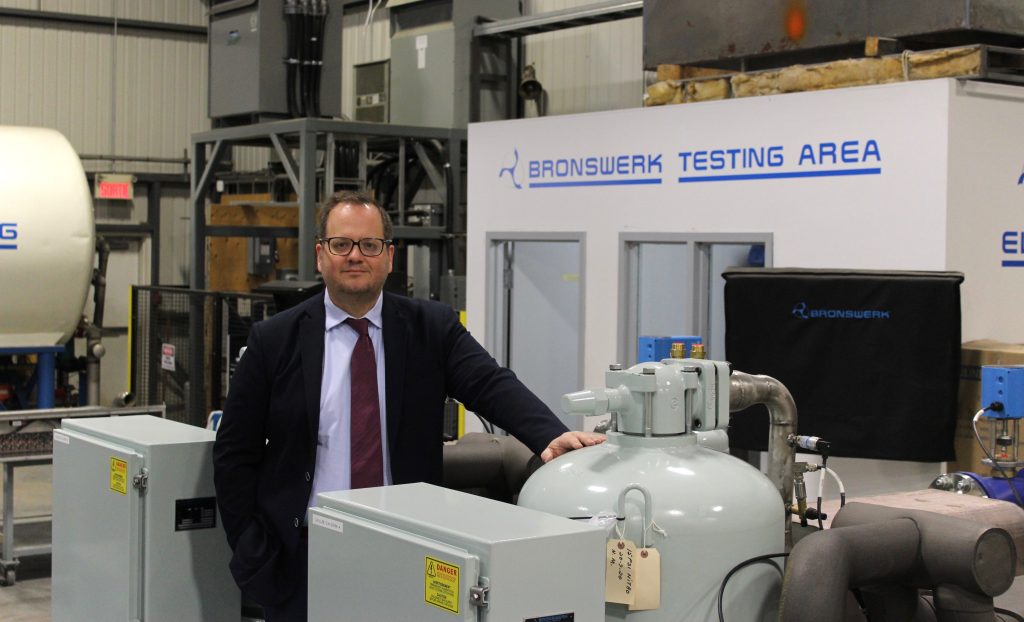
Starting with a modest footprint in 2012, Bronswerk now has multiple sites in the Halifax area. But this is about to change: “We are currently finalizing a plan to bring all our operations and companies in Nova Scotia into a single state-of-the-art facility in Dartmouth,” said Fontaine. “This facility will be able to properly support our manufacturing, engineering, logistics/warehousing, in-service support, and installation services from a single location.”
As envisioned by Bronswerk, its new Dartmouth facility should be close to 70,000 square feet in size. This will help the company enhance its service/support to the RCN, the Canadian Coast Guard, and Irving Shipbuilding. Given that the CSC project has just ‘cut steel’ (started physical production), and the other NSS projects are now full steam ahead, building a centralized, modern manufacturing hub is good news for Bronswerk’s Canadian clients.
HARNESSING THE POWER AI
In line with building its new plant in Dartmouth, Bronswerk is focussed on doing things better and more efficiently in the future. This is why the company is exploring ways to implement artificial intelligence (AI) into its design, manufacturing, and management processes.
“We’ve been thinking about AI for a long time,” Fontaine said. “But it is really in the last 12 months that we have been looking at implementing AI into our processes in detail. We see AI helping us to increase our operational efficiency and the quality of our HVAC-R equipment. After all, 80-85% of our business is with government clients in the defence realm. This being the case, maximising the quality of our equipment is very important to ensure its reliability and readiness to action, which are the key qualities that all the navies in the world are looking for.”
Using AI will also allow Bronswerk to move towards a preventive maintenance model for its clients, which will save them money and minimize operational downtime.
“Being able to identify potential failures based on known patterns — which we could detect in our equipment using data from real-time sensors — will help us detect and remedy issues before they become serious,” concluded Fontaine. “This will allow us to execute preventative maintenance when needed, which typically is faster, cheaper, and much less disruptive to clients than fixing things after the fact. That’s the kind of service Bronswerk wants to deliver to our clients — who are the reason for our very existence.”
James Careless is CDR’s Ottawa Bureau Chief
