


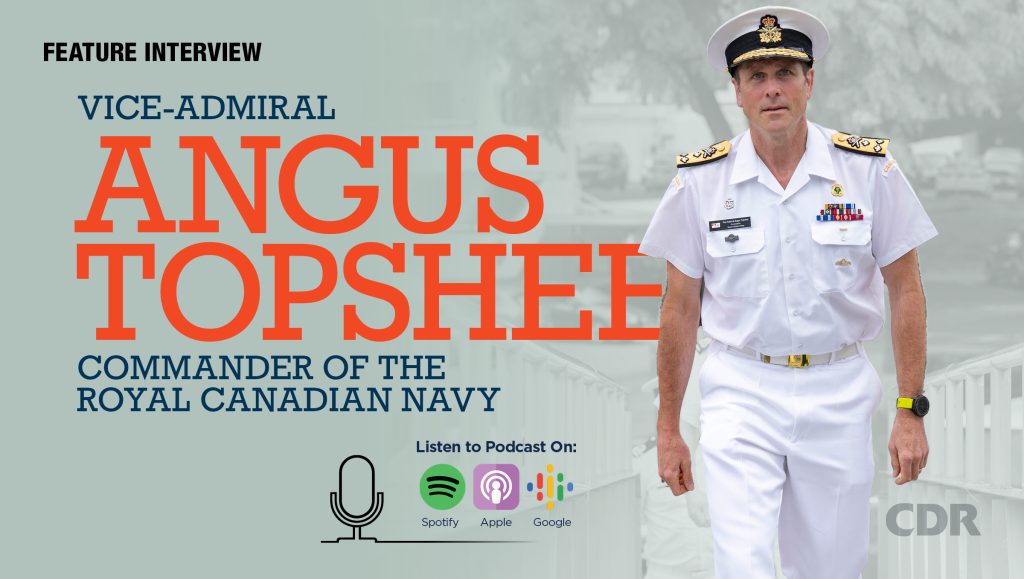
Angus Topshee – Commander of the Royal Canadian Navy
CDR recently sent Senior Staff Writer, Joetey Attariwala, to interview the Commander of the Royal Canadian Navy (RCN), Vice-Admiral Angus Topshee. Their discussion focused on the challenges and the transformation that the Navy is going through. Listen to the full breadth and depth of VAdm Topshee’s comprehensive comments of the CDR Radio Podcast, with an abridged version of the interview available below.
Sponsored by Saab.
CDR: Admiral Topshee, thank you for joining me today.
VAdm Angus Topshee: It’s a pleasure to be speaking with you again, Joetey. Thanks for your continued interest in the Royal Canadian Navy.
CDR: Thank you, sir. So, the Canadian Armed Forces (CAF) has a new Chief of Defence Staff, General Carignan. Have you received any guidance or direction from her yet?
VAdm Angus Topshee: We’ve had one of the first meetings of the senior leadership of the CAF. So far, we know we’re going to get together to do a strategic retreat in September, and I’ve already been given homework — two books to read and a movie to watch. So, I’m excited about that. I think she’s hit exactly the right tone in the speech she gave at the War Museum, and I’m excited to see where we go under her leadership.
CDR: I am as well, Admiral, and I’m looking forward to seeing how the CAF evolves under her command. The General made comments in her speech that Canada has five years to prepare for emerging threats. If we reflect on how procurement has traditionally been in Canada, do you think that that’s enough time to prepare for emerging threats?
VAdm Angus Topshee: I think one of the challenges we face right now is trying to figure out what timeline we’re all working on. Until recently, Australia had what they viewed as a 10-year horizon to prepare for strategic threats, but with their recent national defence strategy update, they threw that timeline out and said they need to be ready now. So, I think General Carignan’s 5-year timeline is as good as anything we’re going to get. I think we have to recognize the reality that our current procurement setup means that we are looking at 15 to 20 years before we deliver a full spectrum of capability in any project that we do, but I think we can do better than that and I think it’s not so much about the big picture things that we do, but what are all the little things we need to do to make sure that we’re as ready as we can be with what we have now.
READ: SHIPBUILDING – Replacing the KINGSTON-Class

CDR: That’s a very fair statement. I think it’s safe to say that the Navy is undergoing a period of stress, while also undergoing a massive transformation to new classes of warships. All of that is underpinned by sailors serving in the Navy. You have been very clear that the Navy is challenged when it comes to personnel. How is the Navy doing in that context now?
VAdm Angus Topshee: We are challenged by personnel. I’m quite comfortable describing it as a personnel crisis at the moment because we are 20% short in the trained effective strength — that’s the sailors that we need to do the jobs for the Navy. We’re working hard to recruit and attract Canadians into the Navy, and we’re revamping the training system so that as we bring people in the door, we can get them trained to be effective and contribute as quickly as possible. But nothing’s going to change the fact that it takes five to ten years to build five to ten years of experience of naval operations. So, we are going to be dealing with this for a period of time. But you’re also right that the future’s bright for the Royal Canadian Navy in the sense that we are just about to take delivery of the fifth Arctic and Offshore Patrol Vessels, the Harry DeWolf-class, and those have been absolutely fantastic deploying around the world and doing great things for Canada. We will be launching and naming the future HMCS Protecteur likely in November in Vancouver, so that will be putting us back on a path to having a proper replenishment capability designed to go to the forward edge of battle. And then the Canadian Surface Combatant, the River-class destroyers — we started the production process with the production test module back in June. I’m excited to see what we’re building with that ship, and while I want it to come faster, the reality is at least now we have actually started the physical work of producing that ship.
CDR: You’ve commented that the Canadian Forces Recruitment Group has not provided you with the number of sailors that you need. Has that critique of them led to improvement in their processes for intake of sailors for the Navy?
VAdm Angus Topshee: The first thing I want to note is that we have a lot of great people in the CAF, and the people in the Military Personnel Generation Group and the Canadian Forces Recruiting Group are killing themselves trying to deliver the sailors, aviators, soldiers, and operators that we need into the CAF, but there are a whole series of systemic and process related problems that have been impeding their path.
On the positive side, the Associate Deputy Minister has convened a recruiting campaign board — that is a very high-level executive body with decision making authority designed to create rapid and effective change across all elements of the recruiting enterprise. The initial indications are positive that we are attracting more Canadians than ever, and that we are beginning to see evidence that we’re able to process them, not as fast as I want to, and not as many as I might wish, but we are presently on track to hit our target, so there are some positive indicators there.
But that’s only the beginning of the problem. Just getting the people in the door, like I said, is the necessary precondition to solving our personnel crisis. The next step is really making sure that we get those people through the training system as quickly as possible. And that’s really where my focus is now.
NAVAL EXPERIENCE PROGRAM
CDR: You instituted the Naval Experience Program, which is now past the one year mark, so I’d love to know how that is going?
VAdm Angus Topshee: It’s been a tremendous success for us so far. We’ve recruited over 200 people through the program this year. For the one year mark, our target had been 144, and we achieved 160, and like I said, we’re now over 200. We are reaching the point where people have the option to decide whether or not they want to continue serving and the initial indicators are positive. We’re seeing quite a few people who have decided to make a career with the CAF and are signing up for full time service in the Navy, and in some cases in the Army, the Air Force, or conversely, they’re going into the Reserves.
Our value proposition was: ‘Join the Navy, it’s fully paid, room and board are included, there’s leave, and it’s an opportunity to experience everything that the Royal Canadian Navy has to offer.’ I think the testimonials that you can see online are demonstrating just how attractive that can be. The caution I offer is that it’s a small sample size at this point, so I am not really getting caught up in any of the statistics right now. This is a five-year pilot project so I think by this time next year, we’ll have our first really solid indication of what we are seeing. My target remains that 80% of the people who enroll in the Naval Experience Program remain in the Navy full time. We are in the vicinity of that, but it’s not a statistically significant sample yet.
DEFENCE POLICY UPDATE AND THE NAVY
CDR: The Defence Policy Update was recently released. How do you view it from a Navy lens?
VAdm Angus Topshee: Well, it and the subsequent announcements from the NATO Summit paint a very clear picture of a country that is determined to ensure that we can control our sovereignty and security in all three of our oceans. There is no doubting the Arctic focus of Our North, Strong and Free, and I’m excited by that because we’ve delivered a class of ships in the Harry DeWolf-class that are designed to operate in that environment. We’re delivering capabilities that will ensure we know what’s going on in Arctic waters, and that we can do something about it. There’s still a lot of work to be done to get where we need to be and Our North, Strong and Free, talks about the need for underwater surveillance systems and persistent and deployable sensor systems that we’re working on. But the other exciting thing for us is the announcement that the Minister and Prime Minister made — the Minister announcing that we’re going to procure up to 12 conventionally powered under ice capable submarines; and the Prime Minister committing that Canada will reach the 2% of GDP target by 2032. Those announcements indicate that there’s a substantial investment being made in the CAF, and so my job right now is to ensure that we spend that money wisely and that we get the right capability mix out there, and that we are meeting the very clear mandate the government has given us, which is to make sure that our North remains strong and free.
CDR: What lessons has the Royal Canadian Navy learned from operating the Victoria-class, and how do you foresee the Navy applying those lessons to the new class of Canadian Patrol Submarines?
VAdm Angus Topshee: Availability — that would be the number one lesson I take from the Victoria-class. It doesn’t matter how good the submarine is, if it can’t get out of the harbour, it’s of no use to anyone. So for us, this is all being driven by two things: one, we need to replace the Victoria-class as quickly as we possibly can. And two, whatever that solution is, it needs to have a maintenance package that ensures an availability that’s greater than what we’ve achieved with our current submarines. So, how will we achieve that? Well, the first thing is that we have committed that this is intended to be a military off-the-shelf procurement — buying a submarine that is in production. So not a design, not a concept, but something that actually exists and buying it as is. We have about 215 qualified submariners in Canada — we are not going to adapt a submarine to them, we are going to adapt them to the submarine that we buy because we are too small of a force to do it any other way.
Whoever builds that submarine, we need to make sure that they build a maintenance enterprise in Canada, on both coasts, to sustain submarine operations. 70% of the value of the submarine contract is not the acquisition, it’s the in-service support here in Canada, and that is where we’ll see the Canadian jobs, the Canadian technology growth, and the Canadian benefits. So that’s really our focus. From my point of view, very selfishly, getting that right ensures that we get boats that can do the job and will be available when we need.
CDR: You mentioned that steel has finally been cut on a production test module for the new Canadian Surface Combatant. That occurred in conjunction with the official naming of the class. How did the Navy pick the name River-class destroyer?
VAdm Angus Topshee: We have a ship naming committee that brings together a very wide group of people not just within the Navy, but really to try and reach into as many different perspectives as possible. So, we brought in all sorts of different diverse voices and perspectives, including the indigenous community, 2SLGBTQI+, Francophone Canadians, everyone that reflects our heritage.
We landed on recognition that rivers have always connected Canada. When you think about it, the Saint-Laurent seaway goes all the way to Thunder Bay, so it reaches halfway across this country. The Fraser River on the West Coast is critically important to the economy of British Columbia; and then the Mackenzie River winds its way across much of the north. So, the fact that our first three ships will be the Fraser, the Saint-Laurent and the Mackenzie is absolutely perfect from my perspective of highlighting that heritage. They are three ships that have a very proud history in the Royal Canadian Navy — Fraser and Saint-Laurent were the first two to sail for convoys in the Second World War. For much of the war period and after the war, River-class destroyers were the heart of the Canadian fleet and so to go back to that heritage seems perfectly appropriate.
DELIVERY TIMELINE FOR CANADIAN SURFACE COMBATANT
CDR: When are you expecting the first CSC?
VAdm Angus Topshee: We’re doing everything we can and I wish I could accelerate it further. If everything goes according to plan, we are looking to cut steel on the first one in April of next year. The difference between the production test module and the cutting steel on the first ship is the production test module is proving Irving’s readiness to build the ship — doing the things that they haven’t done before in terms of steel work, armour plating, specific types of cuts and welds and fabrications that they have not done for the Arctic and Offshore Patrol Ships. So that’s all the stuff that they’re proving right now, that they can convert the detailed design drawings into actual production output so when they hit start, so to speak, that the parts are delivered to the right places, and cut and assembled in the right way, and that the workers and the production material are all aligned and arriving and sequencing through the production process properly.
We’re estimating that the first operational deployment of the River-class destroyer, the HMCS Fraser, will be about 2035, so we’re still 10 years away from that which is an incredibly long time, and that’s just the first one. We know the Halifax-class has to keep going until 2040.
We’ve been making decisions to give precedence to schedule above pretty much all else, while balancing cost, obviously, and that means that we have favored systems that have already been proven, that are in service and that have already been integrated into the core systems that will be a part of the River-class destroyer. So, everything we can do to bring this along as quickly as possible is being done.
CANADIAN MULTI-MISSION CORVETTE
CDR: You have mentioned that the Navy has needed to prioritize the Halifax-class over the MCDVs. Is that still the case and what does that mean for the Maritime Coastal Defence Vessels (MCDV’s)?
VAdm Angus Topshee: I think what it means is we need to get out of the old ship business as quickly as we can. You may have seen some remarks by the Minister a couple of weeks ago where he says he’s waiting for me to deliver a recommendation with respect to the future of the MCDVs. When you look at that class, the reality is that they were designed to last 25 to 30 years. We’re at that window and they have been absolutely fantastic. They’ve got a new lease on life right now with the off-board systems and technology that we’ve got for Mine Counter-Measures. In fact, I’m really proud of the fact that HMCS Shawinigan and Glace Bay are deployed right now with the Standing NATO Maritime countermeasures group in Europe, so it’s fantastic to see that that platform can still be relevant today. But when you step back, and you look at what it is, a Maritime Coastal Defence Vessel is effectively an offshore support vessel. It’s the type of vessel that is used routinely around the world to support the offshore industry. It is something that, if we really needed to get more of them, we can do so quite quickly. They’re not heavily armed nor are they designed to survive a massive conflict. MCDVs have a couple of machine guns and some sophisticated communications systems. We can replicate that quite quickly, and we’re really confident in the offboard systems. I think our number one question is whether or not we need to be out of the MCDV business? Should we make sure that we are transitioning to the future fleet, that we are embracing autonomy, uncrewed systems, remotely operated things, and all sorts of other systems that can go on to vessels of opportunity that are not necessarily part of the Navy fleet.
CDR: Is there going to be a follow on to the class? People have been talking about a Corvette type ship.
VAdm Angus Topshee: The nuance that I would offer is that the MCDV replacement will not be an MCDV. We have started some theorizing around what would a Canadian Multi-mission Corvette look like? It’s a nod to our history — I love the fact that we were a corvette and destroyer navy in the Second World War. What we’re probably building is something that’s going to be more capable than what might come to mind with a corvette because it has to be a real warship. The driving philosophy behind whatever comes is that it needs to be what we could not quickly replicate in a time of war. I think what we need to make sure we do with what’s being called the Canadian Multi-mission Corvette, is figure out the core sort of warship systems that we need to have, the type of thing that you can’t build quickly in wartime. The first part of any project is always that sort of initial identification of requirements, and that’s very much the phase of the thinking that we’re at right now.
CDR: It’s exciting times, Admiral. Thank you for taking the time to speak with us.
Joetey Attariwala is CDR’s Senior Staff Writer


1 thought on “FEATURE INTERVIEW: Vice-Admiral ANGUS TOPSHEE”
Wow someone is a yes man . Hard to get recoupment up when we don’t have good equipment for are soldiers and sailors. When they go on these UN missions & they see every other country there has new & modern equipment it’s hard on the morale . We have new ships with no military capabilities. Not sure how that makes sense. I’m proud that my son serves but as a parent I worry my son’s biggest dangers in his job is from are government’s neglect of all are armed forces. We have sailors serving on ships that are over stressed & not safe in large seas & that should never happen. Waiting for 2035 for a proper military vessel is not acceptable at this point.
Comments are closed.