


BY JAMES CARELESS
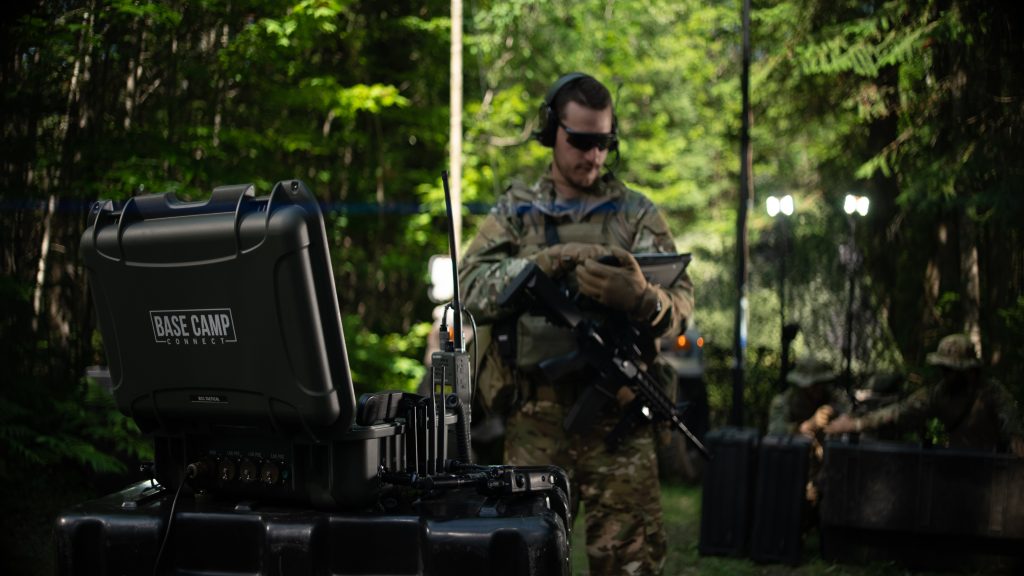
systems through the use of its field-deployable communications hubs
Base Camp Connect is ready to help ‘bridge the gap’ in communication technology, as the requirement for interoperability increases amongst Canada and its NATO Allies.
We simplify interoperability: That’s the motto of Base Camp Connect. They are an indigenous owned company in Lévis, Quebec that enables connectivity between disparate communications systems. Base Camp Connect makes this happen via its field deployable communications hubs composed of commercial off-the-shelf technology (COTS) and the company’s proprietary software and systems designs. These hubs deliver affordable, easy-to-use interoperability kits to the Canadian Armed Forces (CAF), NATO allies, public safety agencies, and Search & Rescue teams.
Francis Raveneau is Base Camp Connect’s Vice-President and Head of its Advisory Group for Government & Defence. In a wide-ranging discussion with CDR, he provided an update on the company’s recent progress, its plans for CANSEC 2024, and its ventures into international markets.
BUSINESS IS BRISK
In the November-December 2023 issue of Canadian Defence Review (Volume 29, Issue 6), CDR reported that Base Camp Connect was in the middle of a three-year contract with the Department of National Defence (DND), to provide them with a portfolio of emergency, disaster response and other equipment/systems. “With extensions this could form a potential $20 million six-year deal,” we wrote.
“We were waiting a long time for that standing offer, which came into effect in November 2022,” Raveneau said. “Once it did, we pushed production hard all the way to March 31, 2023 to honour the fi rst year of that contract. The demand for the product is way bigger than what we originally thought and what was originally budgeted for. It’s a very good problem to have because this means that what we’re doing continues to have value.”
In September 2023, DND issued a directive on the need to disperse command posts, a lesson learned from Ukraine’s destruction of many Russian centralized command posts during that conflict. With their ability to connect distributed communications systems over large distances, Base Camp Connect’s hubs are inherently suited to this approach. “It really falls in line with the core business of our company and what we do,” said Raveneau. “We are ready to support the dispersal of command posts any way we can.”
CANSEC 2024
CANSEC 2023 was good to Base Camp Connect, with lots of productive visits to its booth and that of its partner, General Dynamics Mission Systems-Canada (GDMS-C).
For CANSEC 2024, Base Camp Connect plans to highlight a number of themes to visitors. “Secure networking between multiple locations is going to be one of them,” Raveneau told CDR. “Another is ‘rapid fielding’ in partnership with GDMS-C. What we mean by rapid fielding is communications interoperability equipment that can be put in theatre and made operational very quickly. Take the enhanced forward presence (eFP) groups that Canada is leading in Latvia, which is one of the fi ve or six countries in Europe where a lot of people are coming in with different gear. There are 11 countries now in Latvia, so there’s a lot of different equipment that needs to talk to each other. This is an area where Base Camp Connect and GDMS-C can make a real difference.”
GROWING THROUGH PARTNERSHIPS
GDMS-C is an important partner that Base Camp Connect is working with, to the mutual benefit of both companies. But Francis Raveneau is always on the lookout for more. To maximize success, Base Camp Connect selects partners whose communications defence products/services mesh neatly with Base Camp Connect’s own. One such company is BAE Systems, which has developed a deployable secure networking solution called NetVIPR. According to the BAE Systems website, NetVIPR “provides intelligent and secure military communication networks linking everything from small reconnaissance drones to combat vehicles, fighter jets, aircraft carriers or military commands.” To ensure secure and reliable connectivity at a time when adversaries are actively jamming channels, “NetVIPR uses the full spectrum of communications infrastructure to avoid being solely reliant on satellites or fixed infrastructure.”
Base Camp Connect is working with BAE Systems to integrate its communications hubs with NetVIPR, and to use their partnership to grow sales internationally, to the benefi t of both players. “It opens up a whole new approach to international business development that is parallel to what we do on our own,” said Raveneau. “As an example, BAE has a larger presence in countries like Australia, where Base Camp Connect does not have a presence. However, Base Camp Connect has a strong presence in Southeast Asia; countries like Malaysia, Indonesia, Taiwan, and Thailand. So, BAE’s sales efforts can complement our own efforts on the international scene. That’s a diverse approach that allows us to really cover the globe without maintaining a physical presence everywhere.”
THE IMPACT OF WAR IN EUROPE
No one can predict if Russia’s invasion of Ukraine will extend beyond that victimized country’s borders. What is clear is that other countries in Europe are taking this possibility seriously and are starting to enhance their military capabilities to prepare for it.
Base Camp Connect is keeping a close eye on the European security situation and interacting with NATO friendly countries in numerous ways. “We’ve been talking to the Ukrainians at various levels,” Raveneau told CDR. “They are interested in what we do. But as you know, this is a donation-based effort coming from other countries, such as the €50 billion support announced by Europe in recent weeks. So Base Camp Connect may be able to help out in future, but this is dependent on whatever the Canadian government chooses to do. If the Ukrainians raise their hands and say, ‘hey, we want to have this in the next package’, Base Camp Connect will be there with the products they need.”
“I could tell you I’d be happy about this possibility as a VP of commercial operations, but the reality is we’re talking about armaments escalation here because there’s a threat,” he concluded. “So yes, it could very well be good commercial opportunities for us, but we’re looking at a bigger picture: We want to make sure that Canada and our partners within NATO are as prepared as they can be on the communications side, whatever happens.”
