


By Joetey Attariwala
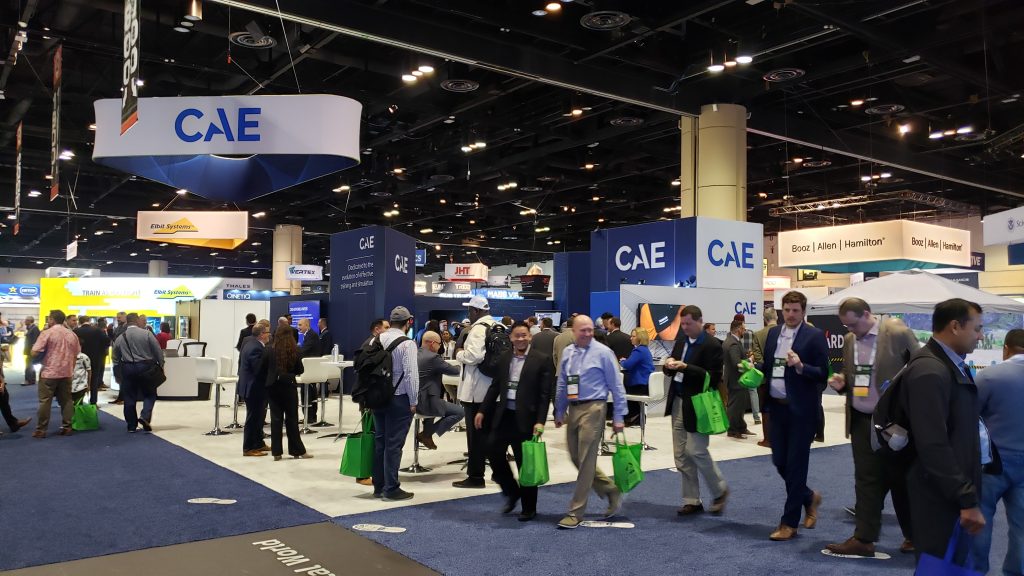
CDR’s Editor-in-Chief, Peter A. Kitchen, and Senior Staff Writer, Joetey Attariwala, had the rare opportunity for a one-on-one chat with Marc Parent, the Chief Executive Officer of CAE, and Dan Gelston, the Group President of CAE’s Defense and Security business while at the I/ITSEC convention in Orlando, Florida. Here is conversation.
CDR: Thank you for speaking with us. There’s so much to talk about. CAE is a world-leading Canadian company, and it has developed so many new technologies and expanded through acquisition, including CAE’s largest acquisition in its history, the acquisition of L3Harris Technologies’ Military Training business. You have been there through it all as a long-standing CEO.
Marc Parent: We are quite a way down the path on that one; Dan [Gelston] has led it all. We are working our way through a lot of legacy work that we’ve had on both sides. As you know, the industry has faced numerous part shortages and workforce challenges, which has had a significant impact, especially in defence, because you must have cleared personnel. We’re still working away, but I can tell you I am very excited about the future with many transformational programs like FAcT in our pipeline. And the reach of our training, basically training all U.S. military flyers at some point in their career — and that’s Army, Air Force, Marines, Navy, and Coast Guard. That’s pretty darn impressive. If I look at the macro side of the company, the Street — the financial community, doesn’t appreciate the opportunity with our defence business, and to be frank, we haven’t given them a reason to be optimistic.
If I could go back to a high level, as you say, I’ve been CEO for quite a while now, and I can’t tell you how proud I am of how we’ve developed together as a company. If you look at it from a high level today, just one statistic, out of the top 100 defence companies in the world, we’re number 67 and the only Canadian company. And, of course, we’re the largest Canadian defence contractor. Then, on the civil side, it’s no exaggeration that anywhere you go in the world, the chances are your pilot and co-pilot have been trained on equipment designed and built in Canada or in one of our training centers — we have 70 centers around the world, and that’s pretty impressive.
CDR: You purchased this company many years before, so this is the second go around, so what would you say is the key difference this time that’s going to make it a success?
Marc Parent: Well, I can only opine what happened before because I was around enough people who were involved at the time when I first started. One of the first jobs I had when I joined CAE was to run the military business, so I knew at the time that the onus, like 30-plus years ago, was a very different time in terms of the ability as a Canadian company to be able to work on U.S. military programs. They had profitability issues and no ability to do anything about it, with a lack of knowledge coming out of the other side because of security firewalls. So, I think the big difference is now with the U.S., because they tell us, the agency that we report to, they impress on us they want foreign companies to be able to come in and work with the U.S. counterparts to build the best solutions for the warfighter. They want you to be successful, and that’s a big difference right there.
I think our CAE USA board — the gravitas of the people we have supporting us helps as well. Like the head of our U.S. board, Mac Thornberry was Chairman of the House Armed Services Committee for about seven years. We have Tony Thomas, who was the Commander of USSOCOM, and we have Pat Walsh, who was Admiral of 5th Fleet command, and Lori Robinson, who commanded USNORTHCOM. They add tremendous value to our business and strongly support our mission.
CDR: We named your company our defence company of the year. One of the things we love is your development of new technology, and your global leadership in this particular field. Something we’ve heard in the industry is that the defence business is now more like L3Harris than CAE. I’d like to get your reaction.
Marc Parent: CAE is still the strong Canadian business it has always been, so I don’t get that one, to be honest. The reality of the business is that now, just in the U.S. DoD, we have over $1 billion in sales, which is fantastic. Just that sheer scale alone, and the opportunity now to export our capabilities that we acquired in the U.S. – for example, F-16s, F-18s, and the like – into the international sector, where CAE is very strong. Historically, and still today, the military business in the Canadian market is relatively small and episodic, so it goes up and down. CAE has always had a strong international business to support operations. A lot of U.S. contractors don’t have to do that. They have enough of a homegrown market to support their sales, and what they sell internationally, a lot of it is foreign military sales.
Dan Gelston: The Link business only had about 8% international sales when part of L3Harris. They really focused on U.S. sales and had limited Foreign Military Sales, and once those were delivered, they didn’t have anybody in the country. There was no follow-up, no servicing, and no touch points that continued to expand that enterprise. As part of the CAE ecosystem, we have 50% of our international sales across 35 different countries, with people everywhere. All those have the ability to bring on a product, and now that service, that touch, is with the CAE team in the country and understands the customer needs and culture.
F-35 TRAINING IN CANADA
CDR: Canada has now selected the F-35 as the future for its fighter force. Lockheed pretty much has a lock on F-35 training, so do you see anywhere where you would get any business on that?
Marc Parent: It is critical for national security that Canada has the ability to train its pilots. I think Canada, as part of the F-35 program, has said that they’re going to set up training centers in Cold Lake and Bagotville. I can’t speak for the Canadian Government, but you would hope that the government would recognize that being a world leader in training all platforms, its national champion should have a role to play. We can’t define that role, but it’s no doubt that we should be part of that.
CDR: CAE is well known for the training it provides in aviation and on the naval side, however the ground or land side seems to be the least well known. Are you going to invest more in that area?
Marc Parent: We are, and we’ve seen success. The best example is the U.S. Army selection for the Soldier Virtual Trainer prototype. It’s about weapons skills development and soldier qualification in the use of all their weapons — rifles, pistols, heavy machine guns, grenade launchers — all using your own weapons to train. The prototype utilizes the individual’s actual weapon, and I’m not talking about laser tag.
We were talking here at I/ITSEC with Mr. Doug Bush, the Assistant Secretary of the Army for Acquisition, Logistics, and Technology, and we were congratulating him on how progressive the SVT process was, allowing development to progress through the selection process. They worked industry teams in competition to develop a solution for their training. Through the process, we worked side by side with the customer to test and adapt technology to produce the best solution. This is what I’d like to see Canada do to work with an agile methodology. So, as you’re iterating a design, you’re working in concert with the customer to promote innovation and foster collaboration — to enable us to bring the art of the possible to life. At the end of the process, you have a best-of-breed solution with training that leverages the best technology you can offer and the enhanced readiness of our warfighters. This evolves much faster in a digital world.
DIGITAL TRANSFORMATION
CDR: Where do you see the future of the defence business and where do you want to place further emphasis?
Marc Parent: A lot of it is leveraging technology. I’m quite certain that nobody spends more on R&D, specifically in the simulation and training domain, than CAE. And we have an advantage as we can leverage our expertise in civil aviation to accelerate technology in defence. We have a great example here when we talk about leveraging analytics. Part of our digital transformation in civil aviation was to adapt our simulators into IoT [Internet of Things] devices, sending back data on a simulator during a training session. Leveraging the cloud, we can provide objective rather than subjective assessments of pilots to improve training worldwide. I can now go to an airline and tell them how their pilots are doing relative to the aggregate class flying that type of airplane. That’s pretty attractive and just one way we differentiate ourselves in the market. That was a key contributor to our contract with Boeing this past summer, establishing CAE as a global training partner delivering their training, starting in India.
The same thing applies in defence. We’re transforming how we do things, which obviously opens up tremendous opportunities. All these examples are why I see huge potential in defence. I’ll illustrate just a few examples, and Dan can expand on them. We have a training center that we set up in 2017 in Dothan, Alabama. We put a building in a peanut field, put simulators in there – which were built in Montreal – bought airplanes, and got the contract. We were recently re-selected for another seven years to do all the U.S. Army’s fixed-wing training. We have leveraged that same infrastructure to win introductory rotary wing training for the U.S. Air Force. And now we’re putting in a Bombardier Global 6500 simulator, a civil platform in our existing footprint, to train the U.S. Army on HADES [High Accuracy Detection, and Exploitation System]. We are Bombardier’s Global 6500 Authorized Training Provider, so we’re leveraging that expertise across our business to deliver that capability to the U.S. military.
Dan Gelston: Beyond our network and expertise, we are a platform-independent training provider, which sets CAE apart. That allows us to have relationships with multiple OEMs that expand our customer training capabilities. Marc mentioned Boeing, but we’ve also teamed with Textron, General Atomics, and others to support training on a broader range of platforms. In fact, there are other opportunities in partner nations like the UK, such as a program called ACTS to do land training for the UK Army, and we’re partnered with Babcock. We are part of Team Blackhawk with Lockheed Martin for the New Medium Helicopter. Our unique role as a training provider makes us a smart partner, particularly for the country where the services and products are being proposed. Training expertise is critical for defence customers to achieve mission readiness. You can see that in Canada with the selection programs like RPAS and FAcT.
CDR: I read an article that quoted you, Marc, talking about the air taxis and the potential that you see there. Where do you see growth happening, and in any particular areas?
Marc Parent: Air taxis will be a market in the future. We are already partnered for pilot training, amongst other things, sometimes helping them with the development of their aircraft themselves, with the leading and most highly funded companies in this space. I think that’s another example of technology we will deploy in terms of a training methodology framework that will apply across all markets. Our current focus in defence is transformational programs like FAcT, for which SkyAlyne, our Joint Venture with KF Aerospace, was named the Preferred Bidder. There are other contracts, like our teaming with Textron for the Bell FLRAA contract for the new tilt-rotor long range helicopters for the U.S. Army, that’s another huge one. These are just some of our large contracts. We are focused on delivering on these programs and enhancing our profitability, which will allow our defence business to continue growing.
CDR: We hear a lot about AI. What is CAE doing with that technology?
Marc Parent: We’re using it today. There are tons of applications, and obviously, we’re focusing very much on how that enhances our capabilities and training for our customers. At the end of the day, it’s leveraging data, so going back to what I was saying on the civil side, we’ve been working with that data for quite a long time in terms of pilots and how they train, using that data and leveraging AI unlocks great potential and enables us to compete in the market.
CDR: I tend to think of CAE as a training and simulation company but I got the impression that the company wants to be a systems integrator and provider. Is that still the case?
Marc Parent: We are a training company. Yes, we have evolved and vertically integrated into other areas, like mission-critical software to airlines on the civil side and decision support solutions in defence. But at our heart, CAE is an excellent training company.
CDR: Thank you.
Joetey Attariwala is CDR’s Aviation Editor, Peter A. Kitchen is CDR’s Editor-in-Chief
