


Canadian UAVs (CUAVs) – Defence Procurement
Leveling the Playing Field: How Ottawa Can Help SMBs Compete

BY JAMES CARELESS
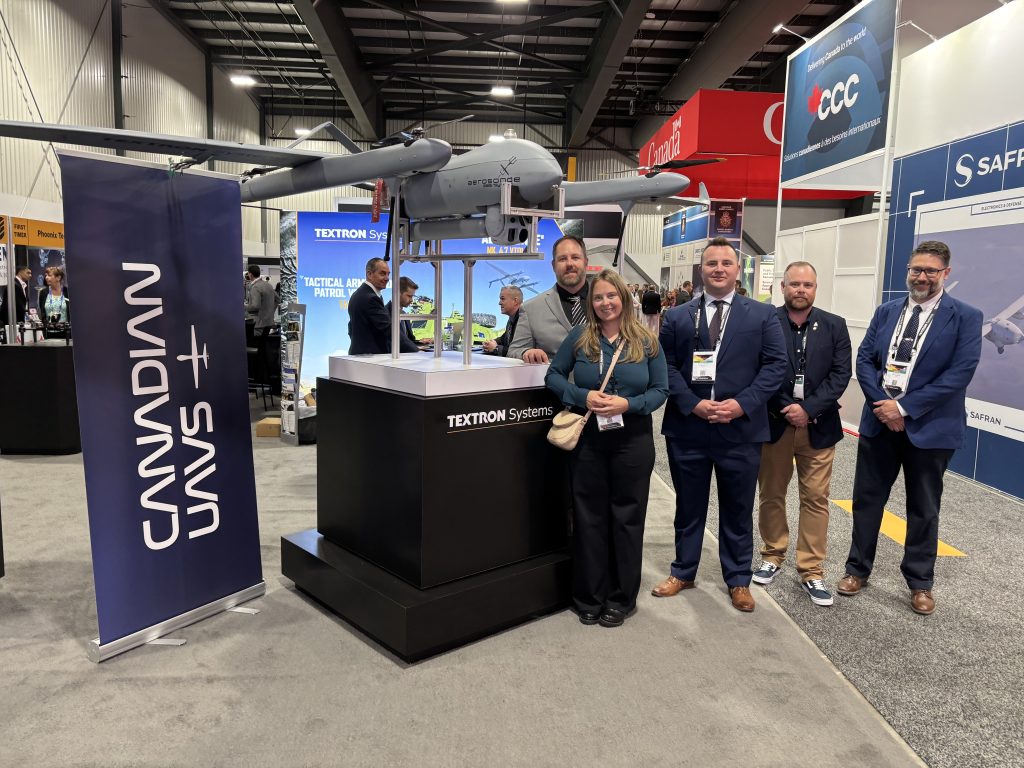
On August 5, 2025, the federal government chose MDA Space to provide six UAVs (Uncrewed Aerial Vehicles) to the Royal Canadian Navy’s Halifax-class ships. This competitively-bid contract, known as RCN-ISTAR (Intelligence, Surveillance, Target Acquisition, and Reconnaissance), was pursued by a number of companies. They included Canadian UAVs (CUAVs). It bid on the RCN ISTAR project in partnership with Textron Systems, maker of the Aerosonde HQ UAV.
As it turned out, CUAVs was ranked second in the bidding process behind MDA Space, thus missing out on the RCN ISTAR contract. Looking back, CUAVs has no complaints about the process, which the federal government carried out with integrity, professionalism, and fairness. However, as a 25-person SMB, CUAVs does believe that the current Canadian defence procurement process favours large prime contractors, simply because of its lengthy duration and substantial demands.
PROBLEMS WITH THE PROCESS
John Molberg is CUAVs’s Vice President of Military Programs. He played a central role in his company’s RCN ISTAR bid, from start to finish.
“When it came to conducting the RCN ISTAR competition, the diligence of the Navy was exceptional,” Molberg told CDR. “But the timeline was something else. Given that Canadian UAVs submitted our bid in August of 2024, it took an entire year to get the ‘no’. We had to sustain ourselves for that year waiting for a no, and it’s that timeline that will just break you as a small company. During the waiting period, you can’t afford to grow because you can’t predict whether or not you’re going to win it. You certainly can’t assume that you’re going to win it, yet the Canadian procurement process mandates that you carry all the staff to manage it if you do. You have to have program managers, quality assurance people, pilots, and directors of operations — people with all these certifications in order to even bid on the program. This is why CUAVs believes that the Canadian defence procurement process is built for incumbent primes and large companies who can carry extra employees to be able to bid on and win these contracts. Smaller companies can’t realistically afford to do so.”
Adding to the problem is the slow-motion pace of the Canadian procurement bureaucracy, which doesn’t share the same sense of urgency as the businesses that must wait for their verdicts. “The federal government waited 350 days of the 365-day maximum allowed by the RCN ISTAR project to award this contract because they were not ready,” said Molberg.
Unfortunately, the year-long schedule that applied to the federal government’s assessment of the RCN ISTAR bids did not apply to the bidders themselves. “Once the contract’s awarded, you have to start delivering things within 30 days,” he told CDR. “You have 30 days to meet with the government for a kickoff meeting. You have to be ready to deliver all the required planning documents that you had to have written in advance. We spent a year writing documents that we didn’t end up using, because we had to be ready to go whether we’re going to win or not.”
ADDITIONAL HURDLES
Canadian UAVs and the other RCN ISTAR bidders had to clear other hurdles in addition to the one enumerated above. For instance, all of the bidders had to be Controlled Goods-certified, have obtained the necessary security clearances for their people, and have their facilities inspected as well. “Oftentimes the U.S. government wants to come and see if you’re handling any ITAR (International Traffic in Arms Regulations) equipment that they have jurisdiction over,” said Molberg. “So you have to be approved for that.”
Canadian defence contract bidders also have to be certified compliant with various quality, health, safety and financial systems, with the specific requirements being changed from one contract bidding process to the next. “You never know which one they’re going to pick for any given program,” he said.
Cybersecurity is also a major requirement for Canadian defence contract bidders, which compels them to spend significant funds in order to compete. “For instance, some projects require bidders to spend $50,000 to $100,000 to build a hardened room for storing documents,” said Molberg. “There’s also different types of cybersecurity measures and certifications that you need to have in order to work with DND.”
Finally, there is the requirement for bids to include the product’s entire lifecycle support and maintenance expenses. In the case of the RCN ISTAR project, “The idea that you’re going to be able to accurately forecast the 20-year lifecycle cost of a drone system doesn’t make sense,” Molberg told CDR. “If you assume the first five years of support is probably going to be repeated over the next five years with some level of inflation, that would be reasonable. But after that, there’s simply no way to make it work.”
Then there’s the matter of how these lifecycle costs are analyzed during the bid assessment process. “In our case, the last 15 years of our preferred RCN-ISTAR platform came out as being way more expensive than the winning bid, which doesn’t seem to hold up based on our internal calculations,” said Molberg.
ONE BENEFIT OF THE PROCESS
In delivering his assessment of the Canadian defence procurement process and its problems, John Molberg took pains to be factual and fair-minded. Molberg credits DND’s Industrial and Technological Benefits (ITB) program as a major benefit of the procurement process. His company received a $9 million investment from Arcfield Canada through the ITB program for the SkySensus project. The SkySensus Project was a significant Canadian initiative, led by Arcfield Canada, to advance the research, development, and commercialization of Beyond Visual Line of Sight (BVLOS) technology for Uncrewed Aerial Systems (UAS). The project brought together a consortium of Canadian companies, including Canadian UAVs, to drive innovation in airspace management. “This put us on the map,” said Molberg. “The big company took the little company under its wing and mentored us. Arcfield Canada showed us how to set up the hardened document storage room and how to get the various certifications we needed to bid on the RCN ISTAR project.
Another company that helped CUAVs was QinetiQ. “They sponsored us as part of the CAF UAS Service program for which we were a Tier 1 subcontractor. This was crucial. In a lot of cases, you can’t get a Canadian defence security clearance unless your company has an existing DND contract or someone sponsors you under their existing contract. That’s a typical chicken-and-egg situation that SMBs struggle to deal with. QinetiQ helped us do that.”
Thanks to the $9 million investment from Arcfield Canada, CUAVs was able to develop and deploy its Sparrowhawk ground-based radar system. When paired with Automatic Dependent Surveillance–Broadcast (ADS-B), the onboard system that automatically broadcasts an aircraft’s GPS location in real-time, Sparrowhawk helps Canadian UAVs’ BVLOS drones fly safely in the same airspace as small crewed aircraft. “Due to Arcfield’s ITB investment and Transport Canada’s endorsement of the Sparrowhawk radar system, we’ve been able to sell it into four international markets,” said Molberg.
SOLUTIONS TO THE PROBLEMS
Having spent a year waiting for the RCN ISTAR decision, and many months before that preparing their bid, the people at CUAVs have some solutions to the problems described above.
The first solution is a much faster assessment process that doesn’t keep bidders like CUAVs in a self-financed year-long limbo. “There’s a motto that Elon Musk is fond of: ‘Fail Fast’,” said Molberg. “To help SMBs like Canadian UAVs compete viably in the Canadian procurement process, we need the decisions to be made much faster. If we get to a ‘no’ quicker this time, we can retool and figure out how to get to a ‘yes’ next time.”
To make this happen, the federal government should have all necessary personnel in place to assess the bids at the time these bids are submitted to Ottawa. If bidders have to be ready to hit the ground running, so should the bureaucrats who are assessing their bids.
The second solution is for the Canadian government to not expect its bidders to carry so many costs upfront. For instance, if the procurement process allowed the winner time to draw up plans after the contract had been awarded, it would save the losers from spending money that offers no returns.
Third, the federal government should be ready to aid bidders in obtaining the necessary security clearances and certifications required for the contract they’re bidding on. It is unreasonable to expect SMBs to compete against large well-funded prime contractors in this regard, given the disparity of resources and funding between the two.
In addition to these solutions, John Molberg can think of some other ways that Ottawa can make the procurement process more amenable to SMBs. For instance, it is vital for Canada to be the first customer for new, promising domestic products when they become available. “You need to be able to tell prospective international customers that you’ve already made sales at home, and have those domestic buyers confirm their purchases to those international prospects,” he told CDR. “After all, if you can’t show that you’ve been able to sell at home, why would anyone else want to buy your products?”
WHAT OTTAWA IS DOING RIGHT
In making his comments about procurement for this article, John Molberg wants it known that Ottawa is doing many things right and trends are moving in the right direction. “For instance, they raised the financial limit on minor capital projects from $10 million to $25 million,” he said. “This means that procurements under $25 million don’t need to go through a public procurement process: Ottawa can just go buy the items that the Canadian Armed Forces wants. Of course, there are checks and balances in this streamlined process, but it is still an amazing thing. You can buy a lot of drones for $25 million. And given that drones are the fastest evolving area of defence right now, this is good news for the CAF.”
Molberg is also impressed by the federal government’s investments in defence innovation, although he would like to see more. “We see it through the NATO DIANA (Defence Innovation Accelerator for the North Atlantic) investments, the IDEaS [Innovation for Defence Excellence and Security] program, and the Innovation Solutions Canada (ISC) program,” he said. “These programs are really popular with industry and they are helping to bring more products to market. But consider: For the first phase of the ISC program, they had 990 applicants, and only awarded 19 contracts. Clearly, more funding is needed for additional contracts.”
CHANGE IS NEEDED
Reflecting back on the RCN ISTAR bidding process, John Molberg remains impressed by its integrity. Due to the changing international political climate, CUAVs was worried that a U.S. manufactured drone may have been less desirable than a European one. “We were worried there’d be fingers on the scale at the political level, and that didn’t happen at all,” he told CDR. “That was a major fear that we had but it was unfounded. I’m proud to say the procurement process operated with an incredible amount of integrity.”
That being said, the fact that this procurement process was administered fairly (and slowly) doesn’t change the fact that Canada’s overall procurement system has been structured to favour well-funded prime contractors. Unless changes are made to address the problems raised above, this bias will remain.
Anyone who has tracked Canadian RPAS procurements over the last 20 years will see a pattern: Canada keeps buying systems to meet yesterday’s requirements. Funding arrives late, deliveries lag, and by then the battlefield has already shifted. That’s where small business can step in—bringing the agility this technology demands. “If Ottawa is truly serious about nurturing Canadian defence SMBs and rapidly advancing innovation, it has to level the playing field,” concluded Molberg.
James Careless is CDR’s Ottawa Bureau Chief
