


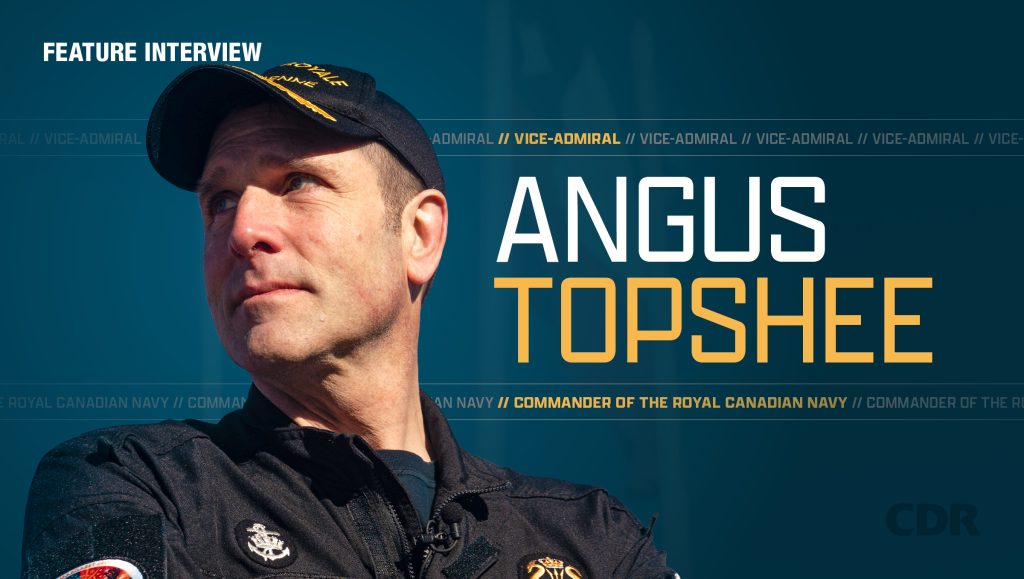
CDR recently sent Senior Staff Writer, Joetey Attariwala, to interview Vice-Admiral Angus Topshee, Commander of the Royal Canadian Navy (RCN). Their conversation covered recruitment & retention issues, the Canadian Coast Guard moving under the Department of National Defence (DND), timelines for the Canadian Patrol Submarine Project (CPSP) and the replacement of the RCN’s Maritime Coastal Defence Vessels (MCDVs). Here is that conversation in full.
CDR: Vice Admiral Angus Topshee thank you for taking the time to speak CDR.
VAdm Topshee: It’s always a pleasure to speak with CDR — I enjoy our conversations.
CDR: I do as well Admiral. Let’s start by talking about people, because without people, the navy is not able to do its mission. I know you have been laser focused on that, so how are you doing in terms of recruitment and retention?
VAdm Topshee: From a recruiting point of view, it’s good news by and large. Last year, we got the closest we’ve ever got to actually achieving the number of naval recruits that we really want. As for the Forces overall, we recruited the number of people — what we call the strategic intake plan — but we didn’t quite get the full diversity of occupations that we would like. I’m not getting the number of MAR TECHs recruited that I really need to continue to operate the ships, but we are seeing progress.
Last year, for example, we recruited more MAR TECHs than we have in any year in a long time — it still isn’t the number we need, but it’s better than not setting the most recent record. On the retention side, it’s a reasonable picture. I say that with a knock-on-wood, because while our statistics right now are in line with historic norms, we don’t appear to have a problem with excessive attrition, but that can change very quickly. If we’re not continuing to be an employer of choice, then we know our sailors are going to find other things, because there’s a lot of competition from industry. But the good news is we now know a pay raise is coming, and I think that we’re going to put in place some other benefits and changes that will continue to make us a pretty attractive employer.
CDR: That’s exciting news. How has the Naval Experience Program gone thus far?
VAdm Topshee: It’s been a tremendous success for us. A third of all new recruits to the Navy last year came in through the Naval Experience Program. Our target when we started out with that program is that we would retain 80% of them. I am really pleased to say we’ve met that target so far. We’ve now got over 600 people that have come in through that program. So, we’re starting to get out of the tyranny of small numbers, where this is a statistically significant sample and into saying we’re cautiously optimistic that we’re achieving the benchmarks that we set.
What I mean by that is that at the end of the program, we want to retain 80% full time in the Canadian Armed Forces, ideally in the Navy. We’re meeting the benchmark for the Canadian Armed Forces — about 50% of the people who successfully complete the program go into what we would call a hard sea trade. A whole bunch of others go into occupations where they wear the white shirt of the Navy, but they actually belong to Chief of Military Personnel because they’re in support occupations. But the best part about this is that we’re aligning people to what they want to do. The Naval Experience Program is showing us that if we can get people in the door, and onto the ship, so to speak, then odds are, there’s going to be something that really excites and interests them that they’re going to want to do.
CCG NOW UNDER DND
CDR: The Government of Canada has announced bringing the Coast Guard under the defence umbrella. What does that mean? Will the Coast Guard be subordinate to the Navy, or will it remain a standalone entity?
VAdm Topshee: The Coast Guard is going to be a special operating agency at the Department of National Defence. Mario Pelletier is the Commissioner of the Coast Guard, and he is going to remain the commissioner of the Coast Guard. They are going to be a special operating agency at the Department of National Defence.
The more important thing than where the Coast Guard reports is what the Coast Guard does, and the most notable part of the announcement is the Coast Guard is being given, for the first time, a formal mandate to contribute to surveillance, because the first and foremost thing that Canadians expect of the Government of Canada is that we know everything that’s happening on and under the waters that surround Canada. The Coast Guard has got a tremendous presence across Canada, so they’re now going to formally have the mandate to look and watch for what’s happening on the seas and to report that into the Maritime Security Operations Centres that we operate across Canada. The Navy runs the two that are on the coast, and there’s another focused on the Great Lakes. The Coast Guard has always been a part of the MSOCs, but now they’re formally tasked with surveillance.
As part of that, the Navy is going to help them out with refitting Coast Guard ships so that they’ve got the appropriate radars and equipment to do that surveillance mission, and they have the classified communications fit necessary to be able to see the full picture and to share that picture, because it’s one thing to see the bad actor in our waters, but if you can’t tell anyone about it, it’s not really that helpful. So, it’s how do we make sure we have the information exchange? All of that work is going to be done through the two Fleet Maintenance Facilities that the Navy operates on both coasts, for two reasons. One, we have the technical expertise to do that work, and that’s exactly what those incredibly advanced technological teams do on both coasts. And second, is if Canada does find itself in a war or in a major crisis situation, one of the things that we’ve historically always done in those times is we’ve brought ships in from trades, like the Royal Navy recently did with the brand new HMS Stirling Castle. They took an old offshore support vessel which they initially brought in as a Royal Fleet Auxiliary, and recently they commissioned it as a full-blown ship in the Royal Navy. That’s a commercial ship that is now a Navy ship. So this is an opportunity, as we do it with the Coast Guard fleet, for our Fleet Maintenance Facilities to become familiar with what exactly we need to be able to do to make sure that we can do this work — so the radars and the surveillance stuff all works, and that the classified equipment is all actually within spec so that we are not inadvertently creating security problems for ourselves.
I think it’s a positive development. I’m excited to see the Coast Guard as part of the Department of National Defence, though that is a tremendous amount of work. As you can imagine, shifting from one department to another department, because, you know, budgets are tied up in that department, HR capacity, human resources and all of that stuff — it’s a lot of effort, but it means we’re going to be focused where we need to be focused, which is making sure we know everything that’s happening on and under our waters, and that we have the ability to respond to that.
CDR: That is exciting. I believe it’s a good move, and I suspect it will allow the Navy and Coast Guard to work together more.
VAdm Topshee: Absolutely, and actually the real opportunity is we both have tremendous infrastructure needs. For example, HMCS Cabot, the Naval Reserve Division that’s in St. John’s harbour is right beside the Coast Guard station, and for years, we’ve been trying to get that Jetty upgraded and refurbished to be able to take bigger ships for the Coast Guard, and even a frigate alongside, but that’s been complicated by the fact we belonged to two different departments. Well, that problem has just gone away so hopefully a lot of that becomes easier.
We also have the same requirements to do refits — that’s all about dry docks, graving docks, heavy lift docks, and maintenance facilities. So where does it make sense that we could do that together? AOPS 7 and 8 are being built for the Coast Guard — there are definitely changes to the navy version, but a lot of these ships are the same, so is there an efficiency to be gained with how we operate them? The Coast Guard is, I would argue, among the world’s leading experts in ice breaking, but we in the Canadian Navy are amateurs at the moment, so this is an opportunity for us to make sure that we have even deeper and better access to their ice breaking skills and expertise. We’ve always worked well together, but this just makes it easier for us to continue to deepen that cooperation.
WHAT DOES INCREASED FOCUS
ON DEFENCE MEAN FOR THE RCN?
CDR: The Canadian government speaks about sovereignty and an increased focus on defence. The Navy is front and center when it comes to patrolling ocean approaches to Canada, so what does the increased focus on defence mean for the Royal Canadian Navy?
VAdm Topshee: What it means is that first, like I said, we need to know everything that’s happening on and under water. If you go back to Our North, Strong and Free, the most recent defence policy update, it talked about a series of commitments like rapidly deployable fixed array systems; Cobra, which is a containerized off board reelable array system. Some technologies are all about design and how we make sure that we can put equipment in our waters and understand what’s going on. We’ve put that together into a project called the Canadian Arctic Sensor Suite — that’s all about making sure we know everything that’s happening in the Arctic. Part of that is actually going to be solved by some of the other investments like the Arctic over the horizon radar, which is designed to pick up things that are on the water and above the water up to space. That’s perfect because I want the on-the-water picture, and so we’re working to make sure that we understand the limits between what they’re finding and what we need to find so that we overlap, but only in the amount that we need to in order to make sure that there’s no seams or gaps.
Also, just as Canada invests in NORAD, we probably want to look at continued investment and cooperation with the United States on the Integrated Undersea Surveillance System, or IUSS. We have Canadians that are stationed in U.S. facilities in Virginia and Washington states, because we share an interest in making sure that we understand the subsurface picture coming towards North America, and so we want to continue to make sure that we’re investing with people and money into that system because it serves us, so there’s a variety of different things that will happen in terms of that.
The other part is communications. It’s one thing to know what’s happening, but as I mentioned, you have to be able to talk about it. So, we will invest in naval communication modernization, supporting some of the Arctic communications projects, and some of the satellite-based communication projects that are really important to us. Pan-domain command and control — how do I make sure that it’s not just the Navy in isolation in the maritime domain, but that we have a fully nested Canadian Armed Forces response across all five domains that is in accordance with the whole of Canadian government effort. So that’s where we get after the pan domain command and control — there might be a navy sensor that picks up a threat, but it may be something else entirely that responds to it; or vice versa — it may come at us from a different place and the answer may be that a Harry DeWolf class ship goes up and takes a look.
CDR: How do you manage the pressures to be in Europe and in the Asia Pacific? Are you still committed to three ships a year in the Indo-Pacific?
VAdm Topshee: Yes, we are, and right now it’s HMCS Ville de Quebec. It’s basically going to be one or two East Coast ships a year that go around because the Indo-Pacific for us is a maritime theatre, so ships and maritime patrol aircraft are the best response in that particular theatre of the world. However, the Canadian Armed Forces is not a monolith — we have different services, different elements, different components that can go do different things.
The Army has got a very solid footprint in Latvia with the enhanced forward presence. The CAF Cyber Force provides support and effects across the full spectrum. The Air Force is very focused on the defence of North America, because NORAD and NORAD Modernization is a core part of what they’re doing as they recapitalize their fleet. And then, of course, Space Command falls under the Air Force. So, when you look at the CAF as a whole, I think we’re really balancing quite nicely.
No one loses sight that the primary mission is the defence of Canada. After that, the government expects us to be invested in European security, because stopping Russia is the best thing we can do right now from the Canadian security point of view. China is an interesting potential threat — how we manage the relationship with China going forward is going to be one of the defining features of this century. If we treat them like an enemy, then it could become a self fulfilling prophecy, but we can’t ignore that they have not always followed the provisions of the rules based international order. They have built islands illegally in the South China Sea, they’ve made threats, and they’ve taken their own people hostage. So, we have to have a realistic understanding of great power politics, and those are the two priority theaters outside of North America.
CDR: Are you confident in the timeline for the delivery of the first JSS, and do you think increased defence spending will allow for a third and maybe fourth JSS?
VAdm Topshee: Am I confident that the ship will be delivered to the Navy next summer in accordance with the current timeline? Yes, I think that’s a realistic and reasonable timeline. Is it the original timeline? No. I worked on that project in 1995, and so here we are, 30 years later. Now, to be clear, I was just working on the initial concept development of what we need, but I don’t think we thought it would take 30 years to get to the point where we’re about to take delivery of a ship in a year’s time.
More importantly, 15 years ago the Government of Canada made a commitment to a National Shipbuilding Strategy that prioritized the Irving shipyard in Halifax to build the combatants for the Royal Canadian Navy, and the Seaspan shipyard in North Vancouver to build non-combatants for the Navy and for the Coast Guard. Davie was added two years ago, and it’s exciting to see that Davie and Seaspan are now both building polar icebreakers that were initially talked about in 1970.
That 15-year investment has been expensive, and has been difficult. We’ve built two shipyards in Halifax and in North Vancouver. The Halifax yard, I would argue, is probably the best yard in North America for a shipbuilding point of view, and it has now started construction of the River Class Destroyer so we’re really excited about that. The Seaspan yard in North Vancouver has had a more challenging development because the most of anything they’ve built so far is three offshore fisheries and science vessels. Then they did JSS 1, then they did an Offshore Oceanographic and Science Vessel, and then they started JSS 2, and now they’re on Polar. Not many yards have built that many different ships, and so we’re seeing tremendous progress there in terms of their skill sets, and it’s really apparent in how much faster JSS 2 is coming together than JSS 1. There’s a lot of nonrecurring engineering costs, and a lot of cost of building up a shipyard capability. So, is there a really solid return on investment for Canada if we were to build a third and fourth JSS? Yeah, absolutely, I would say that would make sense, but JSS 1 and 2 have been more expensive than we would have liked, and so there are some cost challenges that we’ve got to overcome in the yard.
TIMELINES FOR CPSP
CDR: What do submarines mean to the Royal Canadian Navy, and what kind of timelines are you tracking for the Canadian Patrol Submarine Project?
VAdm Topshee: I talked about how every Canadian expects us to know what’s on and under the waters around Canada, and especially our Canadian waters, including our exclusive economic zones. If we’re serious about owning those waters, about controlling who can come into those waters, then the best capability for that is a submarine. And if we want to be able to protect all three of our oceans simultaneously, which is the expectation, then you need a fleet of 12, because that ensures that you have at least three available for operations and able to do any mission a submarine might need to take on at any time. Ideally, we’ll have three others to support training, force generation, potentially a deployment elsewhere, and to make sure that if one of those three high readiness submarines has a problem, there’s another to replace it. There’ll be three that are in depot level maintenance, and then three that are in lower levels of maintenance cycles because submarines are incredibly complex vessels. That ratio of four submarines to maintain one at high readiness is the internationally accepted standard.
The submarine we own today was a used submarine that was designed to do one thing for us, and that was preserve our ability to generate submariners and maintain the knowledge and skills required to successfully operate a submarine force. By that metric, it has been successful. We have over 200 qualified submariners currently in the Royal Canadian Navy. That’s the seed corn, the nucleus, of the sailors that we need for the future fleet, and we can grow that into enough sailors to operate 12 submarines. So I’m optimistic. The government seems to be as keen on this project as we are. The Prime Minister has been clear in his comments that the plan is to buy up to 12 conventionally powered submarines, and I’m hopeful that that project is moving at pace, and hopefully it will continue to move at pace.
What’s driving the timeline? It generally takes seven years to build a submarine from the moment you sign a contract. We will be retiring in Victoria class early in the 2030s, and 2035 at the latest, so the clock is ticking. We have to make a decision because we need to start building a submarine, because that day where the submarine is delivered is just the start of us learning to operate it. So from my point of view, I would love for us to be able to get to the place where we’ve made a decision about the right submarine for Canada, ideally by the end of the year. It’s a very ambitious timeline, but it is achievable.
MCDV REPLACEMENT
CDR: The Navy has announced it is starting to pay off the MCDV fleet. What do you want to see as a replacement of the MCDV?
VAdm Topshee: The Kingston class has been fantastic since its introduction into service in the 1990s. They’ve deployed to places no one ever thought they would go. The name gives it away: Maritime Coastal Defence Vessel. They were not supposed to ever go to Hawaii or repeatedly cross the Atlantic. They’ve proven to be remarkably flexible in what they’ve done.
The problem I face as we look at building the River Class Destroyers to take over the response capability of the main surface combatant from the Halifax class, and we recognize that we’ve got the Harry DeWolf class that can go up in the north, is there’s a gap between those two. We need something that can deal with most threats that isn’t going to provide air defence or protection to anyone else, but can defend itself in a fight, and is not afraid of ice. So not an icebreaker, but can go to the ice edge and can rip about at speed near ice. That should be consistent with a hull form that still allows it to have a sonar and still allows it to move with enough speed to be relevant as a combatant. It’s basically the same capability set that’s currently in the Halifax class, shrunk down to a smaller package with an ice edge capability, roughly a Polar Class 6. So that’s what we’re talking about as a Continental Defence Corvette, and we’re working to develop the high-level mandatory requirements for what exactly that would look like. We deliberately chose the name Corvette because we’re trying to indicate that it’s a tier of combatant — it definitely can fight, but it’s not the thing that’s the heart of the fleet.
CDR: Would you want it to have a flight deck that would be able to accommodate a Cyclone helicopter?
VAdm Topshee: The Cyclone has been a colossal disappointment. I’m exceptionally disappointed in Lockheed Martin/Sikorsky. I think they’ve delivered an absolute lemon. It is amazing what the incredible aviators at 12 Wing manage to do with it. The availability, the maintenance, the cost, it all needs to get better — it needs to get drastically better. And for all of those reasons, there’s no world in which I will design a Canadian Continental Defence Corvette to carry a Cyclone helicopter, because there’s no world in which I see that becoming a useful helicopter, and if that changes, great, but by the time it does, we’ll probably be really good at uncrewed and remotely operated systems.
CDR: Thank you, Admiral.
Joetey Attariwala is CDR’s Senior Staff Writer

2 thoughts on “Vice-Admiral Angus Topshee – Feature Interview”
Excellent and informative interview. I have always been surprised and really pleased by Topshee’s forthrightness. He is highly articulate which is really refreshing. He will be sorely missed when he retires.
I would like to see Vice Admiral Topshee bring back the Canadian Fleet Airm Arm back to the Navy as drone pilots and as he mentioned “unscrewed & remotely operated devices.”
Comments are closed.