


Type 212CD – Next-Generation Undersea Warfare
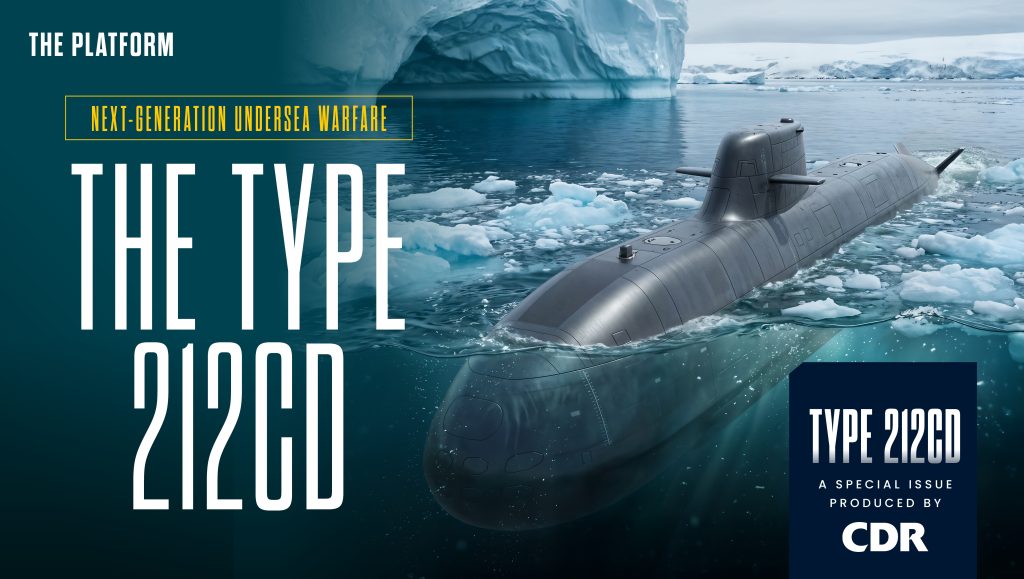
THE PLATFORM – Type 212CD Canadian submarine
BY JOETEY ATTARIWALA
As navies confront an increasingly contested maritime domain, the undersea battlespace is once again becoming a central pillar of deterrence and defence. At the forefront of this shift is the TKMS Type 212CD submarine, a next-generation platform designed to deliver unmatched stealth, endurance, and operational flexibility in complex littoral and open-ocean environments. Built to meet the evolving demands of NATO allies, the Type 212CD represents a significant leap in conventional submarine capability—combining advanced air-independent propulsion, cutting-edge sensor suites, and interoperability tailored for modern coalition operations.
Canada’s Canadian Patrol Submarine Project (CPSP) represents one of the most consequential defence procurements in the country’s modern history. Ottawa intends to acquire up to 12 conventionally powered, long-endurance submarines capable of sustained blue-water operations and, critically, under-ice deployment in the Arctic. This requirement demands more than a platform purchase; it calls for a strategic partnership with a proven design authority capable of delivering advanced technology, sovereign sustainment, interoperability with NATO allies, and enduring industrial benefits – for decades to come. In this context, Germany’s thyssenkrupp Marine Systems (TKMS) has positioned its Type 212CD submarine as a comprehensive and low-risk solution tailored to Canada’s operational and strategic needs.
READ: TKMS Goes Deep on Canada’s CPSP Submarine Project
TKMS is widely regarded as the Western world’s market leader in conventional, non-nuclear submarines. With roots tracing back nearly two centuries to the storied Howaldtswerke-Deutsche Werft (HDW) shipyard in Kiel, the company has evolved into a cornerstone of European naval shipbuilding. Today, TKMS submarines serve in 27 navies and operate in every major ocean. Notably, approximately 70 percent of NATO’s conventional submarine fleet is based on TKMS designs, underscoring a level of alliance interoperability and technical credibility that is directly relevant to Canada’s security commitments.


At the centre of TKMS’ offer to Canada is the Type 212CD (Common Design), the latest evolution in the company’s lineage of air-independent propulsion submarines. Jointly developed for Germany and Norway, the Type 212CD represents a new-generation expeditionary submarine optimized for stealth, endurance, and operations in challenging environments, including the High North. Six boats are currently planned for Germany and six for Norway, forming a multinational backbone of interoperable undersea capability within NATO and a reliable delivery schedule adjustable to accommodate Canadian needs. For Canada, participation in a mature and expanding user community would mitigate the risks historically associated with small, orphan fleets and ensure access to shared training, logistics, and upgrades.
TYPE 212CD SPECS
The Type 212CD builds upon the operationally proven Type 212A submarines already in service with Germany and Italy. However, the 212CD is not a simple derivative; it is a substantially enlarged and enhanced platform. With an approximate displacement of 3,000 tonnes and a length of roughly 73 meters, the 212CD offers significantly increased endurance, expanded mission payload capacity, and improved habitability for extended deployments. Its distinctive diamond-shaped outer hull geometry, combined with non-magnetic steel construction and advanced signature management measures, is designed to minimize acoustic, magnetic, and infrared detectability. These characteristics are especially relevant for Arctic and North Atlantic operations, where stealth and survivability in contested environments are paramount.
AIR-INDEPENDENT PROPULSION &
HYBRID ENERGY ARCHITECTURE
A defining technological feature of TKMS submarines is their hydrogen fuel cell-based Air-Independent Propulsion (AIP) system. Developed and refined at Kiel, this system enables the submarine to remain submerged for prolonged periods without snorkeling to recharge batteries. Because the fuel cell plant contains no moving parts, it operates with exceptionally low acoustic output, contributing to the platform’s reputation for ultra-quiet performance. For Canada, whose submarines must operate discreetly in vast maritime approaches and potentially under Arctic ice, extended submerged endurance without reliance on atmospheric oxygen is a decisive operational advantage.
While AIP provides sustained low-speed endurance, TKMS is also advancing the integration of lithium-ion battery technology to complement traditional diesel-electric systems. Lithium-ion batteries offer higher energy density, faster recharge rates, reduced maintenance demands, and lower weight compared to legacy lead-acid systems. When combined with AIP, this hybrid energy architecture enhances tactical flexibility: commanders can choose between silent, long-duration AIP operations and high-energy battery-powered manoeuvres. This layered propulsion concept strengthens the submarine’s ability to conduct intelligence, surveillance, and reconnaissance (ISR), anti-submarine warfare (ASW), sea denial, and long-range patrol missions across Canada’s Atlantic, Pacific, and Arctic theatres.
The diesel-electric foundation of the 212CD remains central to its effectiveness. Conventional submarines, particularly those optimized for acoustic discretion, often achieve lower radiated noise signatures than their nuclear-powered counterparts at tactical speeds. In littoral environments, choke points, and under-ice conditions, acoustic superiority can be decisive. TKMS submarines are globally recognized for their low acoustic signatures, achieved through raft-mounted machinery, advanced propulsor design, hydrodynamic refinement, and meticulous systems integration. These attributes align directly with the Royal Canadian Navy’s requirement for survivable, stealthy patrol submarines capable of operating in contested waters.
COMBAT SYSTEMS
Combat system capability is equally critical. The Type 212CD is equipped with the ORCCA Combat Management System, a next-generation architecture jointly developed to meet German and Norwegian requirements. ORCCA integrates advanced sensor fusion, decision-support tools, and network-enabled operations to enhance situational awareness and engagement timelines. As a total design authority, TKMS maintains control over platform architecture, allowing flexible integration of national sensors, communications systems, and weapons.
The 212CD’s weapons capacity is designed for multidimensional threat environments. In addition to heavyweight torpedoes and the potential for cruise missile integration, TKMS submarines will benefit from major developments contracted by NATO, Germany and its allies. They will be the only submarines available in the world incorporating the self-guided SeaSpider anti-torpedo torpedo hardkill system, whose design has been spearheaded in part by TKMS in Canada and whose rocket propulsion system will be manufactured in Canada. With groundbreaking performance in both deep and shallow waters, SeaSpider will ensure decisive protection for submarines and ships, and their crews, setting a new standard in defence against torpedoes.
The Type 212CD is also designed to field the active self-defence weapon system known as Interactive Defence and Attack System for Submarines (IDAS). Developed in close cooperation between Diehl Defence and TKMS, both companies are combining their expertise in the IDAS Consortium to develop a guided missile that can specifically engage air threats from a submerged submarine. This globally unique technology will revolutionize the protection of submarines and their crews, thereby enhancing survivability in increasingly complex multi-domain battlespaces.
The submarine is also configured to support Special Operations Forces, with accommodations for additional embarked personnel beyond its core crew of approximately 28. Such flexibility broadens mission profiles to include clandestine insertion, strategic reconnaissance, and support to joint operations.
Longer patrol cycles, particularly in remote regions such as the Arctic, impose psychological and physiological demands on submariners, so habitability and crew endurance have been given significant attention in the 212CD design. The 212CD incorporates improved accommodation standards and automation to reduce crew workload. High levels of systems automation also contribute to operational efficiency and lower through-life personnel costs — an important consideration for Canada as it seeks sustainable force structures over decades of service.
STATE-OF-THE-ART SHIPBUILDING FACILITIES
Industrial credibility is fundamental to any major procurement. In recent years, TKMS invested approximately €250 million in a new state-of-the-art shipbuilding hall in Kiel, reinforcing its ambition to be Europe’s most modern naval company. The facility incorporates advanced composite workshops, precision weapons tube machining capabilities, pressure hull fabrication areas, and a dedicated AIP development center.
TKMS also plans additional investments of over €200 million for their site in Wismar which is being developed into a hybrid shipyard — this includes the modernization of hall infrastructure and the installation of the new production line for submarines. The current plan is to manufacture several underwater projects (including the 212CD option boats for Germany). The expansion of the Wismar site will thus provide TKMS with additional capacity and enhance production efficiency and schedule reliability — factors that are essential for meeting the timelines envisaged under the CPSP.
TECHNOLOGY TRANSFER
Beyond domestic production, TKMS has extensive experience in technology transfer and international industrial collaboration. The company has executed more than 50 technology transfer programs worldwide, training local engineers, technicians, and shipyard personnel, and establishing joint ventures and co-production arrangements. Submarines and material packages have been assembled both in Germany and in partner nations, demonstrating an ability to adapt to national industrial strategies. For Canada, which places strong emphasis on Industrial and Technological Benefits (ITBs) and sovereign sustainment, TKMS’ track record offers a credible pathway to in-country construction, maintenance, and lifecycle support.
Direct industrial participation in Canada could encompass co-production of propulsion components, electronics, and structural modules, as well as integration and testing activities. Indirect benefits may include investments in Canadian research institutions, partnerships with domestic technology firms, and support to educational and workforce development programs. A relevant precedent is the SeaSpider anti-torpedo torpedo system, elements of which have been designed and produced in Canada for final assembly and export. Such collaboration illustrates TKMS’ willingness to embed advanced capabilities within partner nations’ industrial ecosystems.
KEY INDUSTRIAL CAPABILITIES
Alignment with Canada’s Key Industrial Capabilities (KICs) further strengthens TKMS’ case. The company’s competencies span advanced materials engineering, artificial intelligence-enabled combat systems, clean propulsion technologies, cyber resilience, sonar and acoustic systems, and autonomous underwater technologies. By engaging Canadian firms and research centres in these domains, a CPSP partnership with TKMS could stimulate innovation beyond the submarine program itself, reinforcing Canada’s broader defence industrial base.
Strategically, the Type 212CD offers Canada entry into an established and expanding NATO submarine framework. The German-Norwegian co-development model demonstrates how common design programs can reduce risk through shared research and development costs, standardized training pipelines, common supply chains, and synchronized upgrade cycles. For Canada, integration into such a framework would enhance interoperability during multinational operations while preserving the option for sovereign customization. It would also avoid the pitfalls of operating a unique platform without a broader support community.
Oliver Burkhard, Chief Executive Officer of TKMS, has emphasized the company’s status as a total design authority encompassing research and development, detailed design, construction, outfitting, testing, training, and in-service support. This end-to-end control reduces interface risk and ensures accountability across the submarine’s lifecycle. Burkhard has also underscored TKMS’ readiness to transfer knowledge and certify a domestic workforce capable of sustaining the fleet independently — an essential consideration if Canada seeks post-delivery sovereignty in maintenance and upgrades.
From an operational standpoint, the convergence of AIP endurance, lithium-ion energy storage, advanced stealth geometry, and a modern combat management system positions the Type 212CD as a formidable undersea asset. Its design philosophy reflects contemporary threat realities: increasingly capable anti-submarine warfare networks, pervasive sensors, and the strategic importance of the Arctic. The ability to operate silently for extended periods beneath ice, to deploy special forces, to engage multidomain threats, and to integrate seamlessly with NATO partners directly addresses the CPSP’s demanding criteria.
“Team 212CD will provide an Arctic ready submarine platform which will serve as the catalyst for insertion of Canadian innovation to enhance Maritime sovereign dominance in shallow to deep water operations,” said Rick Gerbrecht, Managing Director TKMS Canada Ltd. “This compelling partnership with Germany and Norway will transcend Government-to-Government and Industry-to-Industry protocol to realize an unprecedented Sailor-to-Sailor ‘NATO trusted’ enterprise – all to the risk-mitigated and nation building benefit to Canada.”
THE PERFECT MIX: STEALTH, ENDURANCE,
ADAPTABILITY & INDUSTRIAL PARTNERHSIP
In assessing potential suppliers for the Canadian Patrol Submarine Project, Canada must weigh technical performance, program risk, industrial benefits, and long-term alliance integration. TKMS brings to the table decades of submarine expertise, a dominant share of NATO’s conventional fleet, a robust order book, and demonstrated success in multinational collaboration. The Type 212CD, as the latest expression of this heritage, embodies a unique combination of stealth, endurance, adaptability, and industrial partnership.
For Canada, whose maritime approaches span three oceans and whose Arctic sovereignty is increasingly central to national defence policy, the stakes are high. A submarine acquired under the CPSP must be capable not only of deterring adversaries and gathering intelligence, but also of sustaining operations in some of the most austere and strategically sensitive waters on earth.
In presenting the Type 212CD, TKMS is offering more than a platform; it is proposing integration into a mature NATO submarine ecosystem, supported by proven technology, modern infrastructure, and a willingness to invest in Canadian industrial and technological growth.
The Type 212CD’s advanced propulsion architecture, signature optimization, combat systems flexibility, and Arctic-relevant design characteristics align closely with Canada’s stated requirements. Taken together, these factors position TKMS as a formidable contender for the CPSP. Coupled with a demonstrated commitment to technology transfer, industrial collaboration, and sovereign support, the TKMS proposal represents a coherent, high-capability solution designed to serve Canada’s undersea needs for decades to come.
Joetey Attariwala is CDR’s Senior Staff Writer


1 thought on “Type 212CD: Next-Generation Undersea Warfare for Canada’s CPSP”
Incredibly tough choice between the two subs being proposed. At least to this lay person:))
Comments are closed.