


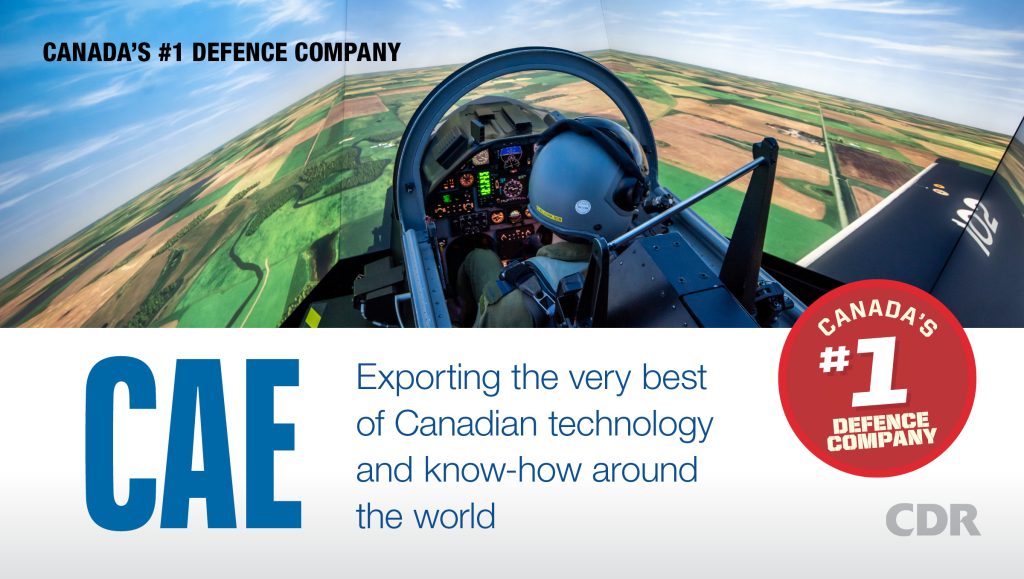
CANADA’S #1 DEFENCE COMPANY – CAE
Exporting the very best of Canadian technology and know-how around the world
BY JAMES CARELESS
When I was a kid, my mother would give me a dime to go to the candy shoppe. I would stand at the counter display, looking wide-eyed at the selection of red licorice strips, black jawbreakers, and other sweets that danced before me.
Even today, I remember that sense of amazement and wonder. Recently, I felt that same sense of wonder again when I walked into the lab at CAE’s complex in Montreal. They had invited me to spend three days with them at their Montreal offices and touring their simulator-manufacturing factory next to the Trudeau International Airport (formerly Dorval) back in January 2025.
The occasion was the opening of CAE’s first Air Traffic Services Training Centre. It marked CAE’s expansion beyond aviation flight training and full-flight simulators (FFS). Those are the ones that you sit inside, totally immersed, in a realistic aircraft cockpit. These simulators have interactive controls, video out the windows, and full motion in all directions. Their new direction takes CAE into air traffic controller training using realistic control rooms with full-motion aircraft landing and taking off through their ‘windows’ (full length video screens). It’s a perfect marriage, training controller and pilot.
For three days, I joined with a small group of aerospace journalists who walked the giant factory floor where CAE makes these full motion aircraft simulators from scratch. We got to try out AR (augmented reality) headset flight simulators capable of being controlled by finger flips and swipes. It felt a lot like I was on the set of a motion picture, rather than in a manufacturing facility. I flew a full motion Global 7500 aircraft simulator on a near vertical climb until the autopilot seized control. (I would have crashed!) And we saw where CAE is taking apart one of their gasoline engine flight trainers, and replacing that engine with an electric one. “That’s right: CAE is developing an electric aircraft conversion kit for its fleet of Piper Archer training aircraft.” The entire visit was incredibly cool!

Now CDR’s decision to select CAE as this year’s #1 Defence Company in Canada — which is the third time this company has received this honour (also in 2005 and 2014), making it the only three-time winner in CDR’s history — is based on many recent defence achievements that are extraordinary in their own right.
Chief of these is the success of the CAE-KF Aerospace SkyAlyne joint venture in winning the $11.2 billion, 25-year contract for Canada’s Future Aircrew Training Program (FAcT). Add the fact that CAE has been identified as a strategic partner to work with the RCAF in designing and co-developing the Future Fighter Lead-in Training (FFLIT) program to train pilots to operate Canada’s advanced fighters, and you can see, this company is clearly on a roll.
Did I mention that CAE is also the largest Canadian-owned OEM in the defence space? In this article we’ll take a snapshot look at how they achieved this lofty height, the many key defence projects that CAE is working on today, and the secret to their success.
BIG RESULTS FROM
HUMBLE BEGINNINGS
Apple and Hewlett-Packard both started in garages. CAE had a similar humble start: in a vacant hangar at the Saint-Hubert Airport (now known as the Montreal Metropolitan Airport) in Longueuil, Quebec. Officially, the company opened on Saint Patrick’s Day 1947, with 18 employees under the name of Canadian Aviation Electronics Ltd. That version of CAE was founded by retired RCAF officer Ken Patrick, who wanted to “create something Canadian and take advantage of a war-trained team that was extremely innovative and very technology-intensive.”
In those early days, CAE chased business wherever it could; no stranger to simply repairing and overhauling ground communication equipment, or installing antenna farms in the Arctic for the RCAF. By 1951, CAE’s Western Division was established in Winnipeg to repair and overhaul telecommunications and build everything from Geiger counters to moisture meters for use in grain elevators.
“They were into all kinds of things,” said Marc Parent, who joined CAE in 2005 and became its President and CEO in 2009 after a successful aerospace engineering career at Bombardier. Worth noting: Parent has been named as CDR’s Defence Executive of the Year twice. “Believe it or not, CAE even spent some time manufacturing radio and TV sets, and worked on designs for simulators in the nuclear industry.”
When the RCAF hired CAE to build a CF-100 Canuck project flight trainer in 1952, that started them down the simulator/training path that they globally own today. During this process, CAE developed new techniques in generating radar targets and weapons systems scoring, which made the simulator training experience far more useful. They subsequently built a DC-6B commercial flight simulator for Canadian Pacific Airlines and then cemented its success by building the F-104 Starfighter simulators for the RCAF in the 1960s. These F-104 simulators were so good that 26 more were purchased by five other NATO countries.
There are so many other achievements in CAE’s history we don’t have the space to give them all proper due, save for the fact that the company grew to become a global FFS powerhouse in the last quarter of the 20th century. “1982 was a big, big year because CAE worked with the FAA and United Airlines to develop the first Zero Flight Time simulator, which allows you to be fully trained and certified as a pilot without actually using an aircraft,” Parent said. “I myself have a Transport Canada Airline pilot rating, and the first commercial flight that I flew as a pilot, I flew with passengers in the back.” This one invention changed the face of pilot training forever.
CAE’s longstanding position in military flight training received a big boost in 2015. That was when it was awarded the contract to run the NATO Flying Training in Canada (NFTC) at 15 Wing Moose Jaw in Saskatchewan and 4 Wing Cold Lake in Alberta in cooperation with the Government of Canada. As prime contractor, CAE operates the NFTC base facilities, provides ground-school classroom and simulator training, and supports live flight training with ATO pilot trainees using Beechcraft T-6 (CT-156 Harvard) and BAE Systems Hawk (CT-155 Hawk) aircraft. CAE’s success in running NFTC aided its SkyAlyne bid with KF Aerospace, which currently runs the RCAF’s Contracted Flying Training and Support (CFTS) Services pilot training program.
In 2021, CAE purchased the L3Harris Technologies’ Military Training business. The US$1.05 billion acquisition saw CAE USA become the prime contractor or key subcontractor on the United States Air Force (USAF) Simulators Common Architecture Requirements and Standards (SCARS) program. They developed the USAF F-16 Simulators Training Program (STP), US Navy/Marine Corps F/A-18 aircrew training systems, USAF initial flight training, USAF Ground Based Strategic Deterrent (GBSD) training, and the USAF B-2 training system. Considering the US is quite pro-American, having a Canadian company take this lead was critical and key to their global reach.
“The US defence market is a very large market, and the L3Harris acquisition gave us essentially a full range of capability on US defence platforms,” said Marc-Olivier Sabourin, CAE’s Division President of Defense & Security, International. “Today, we can offer a complete spectrum of training that covers the entire range of US military platforms and be a credible training partner to the US government and US OEMs such as Boeing or Lockheed-Martin.”
SECRET TO SUCCESS
CAE has changed a lot since Marc Parent took command in 2009. “When I started as CEO, only about 20 percent of our revenue came from training services,” he said. “Today, it accounts for about 70 percent of our revenue worldwide. That’s quite a big shift, and that’s supported by 13,000 employees operating in 40 countries.” CAE is the ‘little’ Canadian company who could!
So how did CAE manage to achieve these results? Parent points to two ‘secrets of success’. “One, we believe in delighting our customers; not just satisfying them, but delighting them,” he told CDR. “Second, we deliver on the commitments that we’ve made to them. When CAE says it is going to do something for you, we do it.” And that my friends, is the true Canadian spirit.
These two secrets have made the difference to CAE’s performance during Marc Parent’s 16 years at the helm. “I would tell you — and I really believe this — that the real story of my career isn’t about planes or simulators, it’s about people,” he told CDR. “I am really, really proud of what we do for our customers, and I think that’s very clearly where my success has come from.”
Marc Parent is also serious about the way CAE treats its own people. “Building a successful company is all about building a strong culture where people feel that they’re part of something bigger than themselves,” he said. “Our employees are so proud of the mission that we have. And when you think about what we do, you can summarize what we do at CAE is to prepare people doing difficult and sometimes dangerous things to perform at their best, when safety and mission effectiveness are on the line.”
Finally, Parent believes in talking to his customers and others in the industry to always figure out what is coming next. “It’s very important to look around the corner to see what’s coming and adapt to it all the time,” he said. “You have to be proactive: You can’t make a strategy out of reacting all the time. And knowing what’s coming in your industry isn’t about divine inspiration. It comes from talking to your customers, talking to your employees, and anyone else who matters, and putting it all together.” They’re clearly really good at divining what’s next too.
DEFENCE ENDEAVOURS
There is no doubt that CAE is a very cool Canadian OEM. I mean, I was wowed by pushing their FFS simulator to its limit! Okay, actually I was a bit terrified, because taking a Global jet into a near vertical climb — my training pilot told me to do it — is not for the fainthearted.
This being said, CAE’s defence portfolio is just as impressive. I mean, taking the lead with the FAcT and the FFLIT jet fighter training programs – Top Gun all the way! (Good to know: CAE employs more than 1,900 veterans across its operations.)
Winning these contracts has positioned CAE as not only “the largest defence OEM in Canada, but the globally recognized leader in training and simulation,” said Sabourin. “This tells Canada’s allies around the world that CAE can help fulfill their own training needs using our open architecture, modular, and digital-driven approach. In today’s difficult geopolitical climate, this is important to nations around the world.”
Meanwhile, winning the FAcT contract and being named as the preferred bidder for the FFLIT contract “highlights our position as a global leader in training and simulation and our commitment to national defence,” said France Hébert, Division President, Defense & Security, Canada and Global Operations Lead at CAE. “For more than 75 years, CAE has provided the RCAF with advanced training solutions, cutting-edge technologies and mission critical services. The FAcT and FFLIT programs really reaffirms CAE’s role as Canada’s premier defence partner and the fact that we are a strong contributor to the modernization of the Canadian Armed Forces.”
Speaking of CAF modernization, CAE is bidding for the Canadian Land Vehicle Crew Training System (LVCTS) contract, and is already working alongside partner rms to deliver training solutions to the River Class Destroyer program for the RCN. With regards to the LVCTS contract, it will provide a networked synthetic training environment to allow Canadian Army troops to train on these vehicles without leaving their home bases. The plan is for the LVCTS to simulate all of the crew stations in the Light Armoured Vehicle 6.0, the Leopard 2 Main Battle Tank and the Tactical Armoured Patrol Vehicle to train individuals and combat teams. I can’t wait to see those simulators!
I had to wonder: Isn’t training people to drive tanks a lot different from flying airplanes? Well, according to France Hébert, they are basically the same from a simulation point of view. This is why bidding for the LVCTS is right within CAE’s wheelhouse. “We are much more than just a simulator company,” she said. “CAE offers training and mission support solutions across the air, land, maritime, and cyber domains. As such, we’re very well situated to support the LVCTS. It’s definitely in our wheelhouse.”
In doing all of this, CAE is always keen to apply the latest technology to training, which today is artificial intelligence (AI) and machine learning (ML). “For instance, we want to use AI/ML to support ‘digital coaching’ in our training simulators,” said Sabourin. “Basically, the ASI/ML in the simulator will track the beginner pilot’s flight control inputs and use this data to suggest improvements, long before they need to interact with a human instructor. This will allow the student pilot to raise their individual proficiency levels at a faster rate and a higher success ratio.”
Meanwhile, CAE wants to use AI/ML to analyze the quality of its flight training on an ongoing basis, “so we can see what creates student success and what doesn’t,” Sabourin told CDR. “Again, this will help us shorten the time for someone to go from basic learning to fully qualified in any of the training areas that we provide.”
A BRIGHT FUTURE
CAE has clearly prospered under Marc Parent’s reign, which is due to end with his retirement in August 2025. Parent is not worried about the company’s future after this point. “My successor, whoever they may be, will continue to grow the business,” he said. “We’ve established ourselves as the strong leader in every single one of our markets, whether it be civil aviation or defence anywhere around the world. And there’s new markets that are opening up such as Next Generation Defence Training. So, I know that this company will continue to have success for decades to come.”
The core of Marc Parent’s faith in CAE’s bright future lies in the company’s continuing commitment to innovation, digitalization, adopting new technologies such as AI/ML, and its heritage as a Canadian OEM that remains undiminished to this very day. France Hébert feels much the same way: “With everything going on in the world and programs such as FAcT and FFLIT, we very much see our role as one of strategic partnership with the Department of National Defence,” she said. “CAE has forged trust and confidence over the decades and with these recent announcements and with the recapitalization of the CAF, we really see us playing a crucial role in supporting government to grow a more resilient national sovereign defence and aerospace industry.” And CAE will continue to be a prime player in the global training marketplace, exporting the very best of Canadian technology and know-how to the world.”
As for me? My three days in CAE’s technological candy shoppe has certainly whetted my appetite for more. There’s just so many cool things going on at their Montreal facility, from flight training using Apple Vision Pro AR headsets with graphics that you can manipulate with a flick of a finger, to building electric-engine propeller trainers from scratch in a corner of their vast factory.
With any luck, CAE will win the #1 Defence Company Award a fourth time, which will give me an excuse to return to their tech shoppe again. Maybe this time, I could take some samples home with me. I can certainly make room for a small full flight simulator in the garage! I’ll have to ask the wife. (Actually, I already did. Being a former CAE employee, she said yes!)
Congratulations to the entire CAE team!
James Careless is CDR’s Ottawa Bureau Chief
