


TKMS Goes Deep on Canada’s CPSP Submarine Project – THE PITCH
BY JAMES CARELESS
As Canada prepares to replace its aging Victoria-class submarines, the Canadian Patrol Submarine Project (CPSP) represents far more than a fleet renewal—it is a once-in-a-generation opportunity to redefine the country’s sovereign industrial capacity and deepen its economic and strategic ties with Europe. At the heart of this decision is not just which submarine the Royal Canadian Navy will sail, but which partnership will best position Canadian industry for decades of growth, innovation, and export access. TKMS’ HDW Class 212CD offers more than an advanced undersea platform; it presents a trilateral NATO-aligned industrial model designed to transfer knowledge, embed Canadian companies into global supply chains, and open the door to Europe’s rapidly expanding defence market.
As the global security environment grows increasingly volatile, the protection of Canada’s Arctic, Atlantic, and Pacific marine frontiers has never been more critical. This is why the Canadian Patrol Submarine Project (CPSP) is so important to our national security. The CPSP is a monumental leap forward for the Royal Canadian Navy (RCN) – replacing the aging Victoria-class with a fleet of eight to twelve cutting-edge conventional submarines – at a time when such a leap is vital to keeping our nation safe.
For Canada, the choice of its next submarine is about much more than just military hardware. It is a generational investment in our sovereign industrial capability, a statement of our solidarity with NATO, and a potential opportunity to open fast-growing European defence markets to Canadian suppliers, capitalising on Canada’s accession to the EU’s $240B SAFE (Security Action for Europe) program.
READ: TKMS CEO Oliver Burkhard on Submarines, NATO and Allied Naval Power
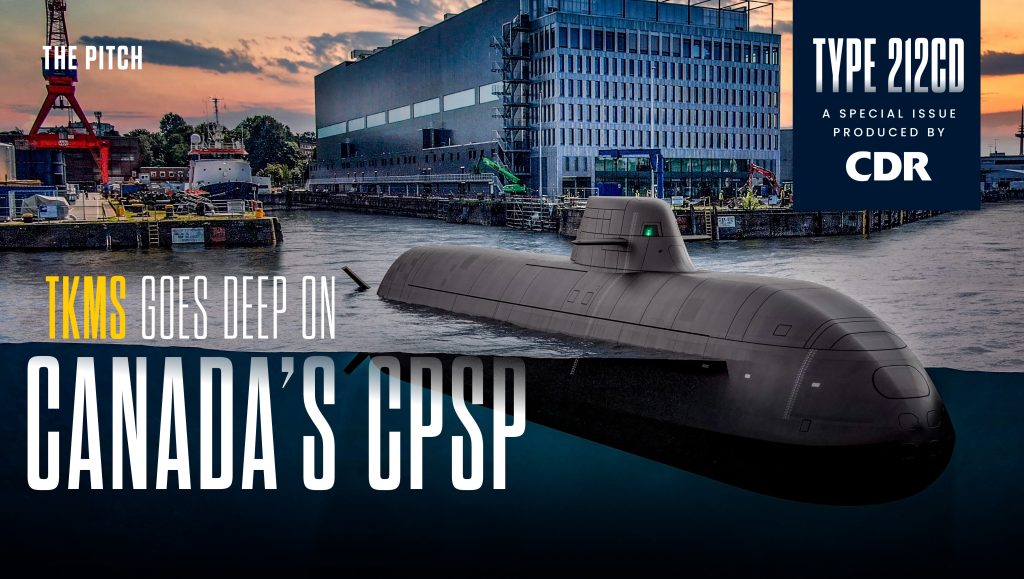
This is why the HDW Class 212CD (Common Design) submarine proposed by German shipbuilder TKMS (thyssenkrupp Marine Systems) for the CPSP fleet is such a strong contender. On its own merits, the 212CD meets the criteria for the CPSP fleet. However, when coupled with TKMS’ multinational reach, strong NATO heritage, and commitment to building Canadian industry, the 212CD is a submarine that promises not just to patrol Canada’s waters, but to fundamentally transform its domestic defence sector.
In late August 2025, Canada’s interest in this compelling value proposition was clearly evident, when Prime Minister Mark Carney and Defence Minister David McGuinty visited the TKMS shipyard in Kiel, Germany. During their visit, Canada confirmed that TKMS had been down-selected as one of two final contenders for the CPSP.
“We welcome this positive message and stand ready as a reliable partner for Canada’s security and interoperability,” said Oliver Burkhard, CEO of TKMS, following the Prime Minister’s visit. “Our conventional submarines currently make up the backbone of the NATO submarine fleet. Today’s exchange is a strong sign of confidence in our capabilities and our commitment to Canada and the Canadian Navy.”
BEYOND THE PITCH:
THE OPERATIONAL REALITY OF THE 212CD
It is one thing to claim the 212CD is the most logical choice for the Royal Canadian Navy; it is another to back that claim up with hard operational facts.
Those facts begin with the platform itself, which was originally designed to meet the rigorous demands of the German and Norwegian navies. Simply put, the 212CD represents a generational technological leap in non-nuclear submarine warfare. Central to this leap is an advanced propulsion system that allows the vessel to operate submerged for weeks without a nuclear power plant, effectively combining the stealth of a conventional boat with the extended endurance of a nuclear sub.
Without doubt, the most pressing CPSP requirement for Canada is under-ice capability. The 212CD is fully Arctic-capable, having been engineered to guarantee a long service life while supporting sustained deployments beneath the polar ice cap. This capability comes from the 212CD’s advanced Air-Independent Propulsion (AIP) system. TKMS has paired AIP with high-capacity lithium-ion batteries. Together, they provide the 212CD with exceptional submerged endurance and global reach across both the Atlantic and Pacific oceans.
Mindful that silent running matters, the 212CD employs a stealth-optimized hull design, making it the quietest submarine in its class. For success in modern multi-domain warfare, the 212CD comes equipped with next-generation combat systems. These include the IDAS
(Interactive Defence and Attack System) missile—a fibre-optic guided weapon capable of targeting anti-submarine helicopters and surface vessels from submerged depths—and the SeaSpider, an advanced hard-kill torpedo-defence system designed to intercept and neutralize incoming threats. If it wins the CPSP contract, TKMS plans to develop and integrate these defensive systems in direct collaboration with Canadian industry.
A further advantage of the 212CD is that 12 of these boats have already been ordered by the German Navy and the Royal Norwegian Navy (six each). This means that the 212CD is not an orphan design that is difficult to find parts and support for, as has been the case for some of Canada’s other defence procurements.
Finally, TKMS can deliver these boats on a timeline that meets Canada’s urgent needs. With expanded, state-of-the-art digital production facilities in Kiel and Wismar, Germany, TKMS will be able to build the initial Canadian submarines and ensure early delivery well in advance of 2035.
“The 212CD is a mature, NATO-backed solution based on proven technology,” said Philipp Schön, TKMS’ Head of Sales for Submarines. “Because it offers a stable baseline with flexible integration, Canada ensures timely delivery without the developmental and legal quagmires of starting from scratch.”
THE VALUE PROPOSITION:
A TRILATERAL NATO POWER PLAY
Buying the 212CD is not merely a smart defence purchase. It is an invitation for Canada to join an exclusive trilateral partnership with Germany and Norway, and to strengthen its position within the EU’s multi-billion-dollar colossal rearmament effort.
The facts speak for themselves. Currently 70 percent of NATO’s non-nuclear submarines are built by TKMS. By choosing the 212CD, Canada’s CPSP subs would seamlessly integrate into the Alliance’s broader undersea fleet. This guarantees unparalleled NATO interoperability at a time when collective defence is paramount.
Meanwhile, joining the established German-Norwegian 212CD program would offer immense economies of scale to Canada, and no time-consuming learning curve. As a 212CD partner, the RCN would benefit from shared research and development, pooled spare parts, joint training programs, and synchronized modernization cycles.
Most vitally in today’s unsettled global order, such a partnership would serve as a strategic bridge across the Atlantic. At a time when Canada is actively seeking to increase its major defence and technology exports to Europe, aligning with Germany—the industrial heart of the EU—would open doors for Canadian industry to access European markets.
“Let us be quite frank: It becomes much easier for the Canadian defence sector to access the European market if Canada actively partners with European industry by choosing the 212CD,” Schön told Canadian Defence Review. “If Canada genuinely wishes to deepen its transatlantic economic ties, this commitment must be demonstrated through concrete actions, not merely statements of intent.”
UNLEASHING CANADIAN INDUSTRY:
ITBS AND TRUE SOVEREIGNTY
Canada’s Industrial and Technological Benefits (ITB) Policy is designed to maximize the domestic commercial impact of defence procurements.
This policy aligns with TKMS’ business culture, which operates on a foundational philosophy. “Submarine building is nation building,” said Tobias Würtz, TKMS’ Economic Offset/ITB Lead. “This is why TKMS bid for the CPSP is anchored by a comprehensive ITB package designed to establish total Canadian sovereignty over the lifecycle of the CPSP fleet. Our goal is the complete transfer of Intellectual Property (IP) and know-how to Canada. And unlike traditional supplier relationships, TKMS is offering all options to Canada, from a turnkey delivery out of Germany for the first boats to a complete local build for later submarines in the series.”
To prove these commitments are more than mere rhetoric, TKMS spent the months prior to the final CPSP down-select signing substantial Teaming Agreements with heavyweights across the Canadian defence sector.
In December 2025, TKMS signed an agreement with Québec-based Marmen, one of North America’s top high-precision manufacturing companies. If TKMS wins the 212CD contract, Marmen will manufacture selected submarine sections and complex assemblies for this sub in Trois-Rivières. This will create hundreds of new jobs by expanding TKMS’s global production capacity and integrating Québec directly into the international submarine supply chain.
Building on their existing relationship, TKMS and Magellan Aerospace have signed a pact focused on heavyweight torpedo production and in-service support. If all goes to plan, Magellan will apply its complex fabrication expertise to CPSP submarine production, while TKMS will help Magellan explore additional export opportunities across TKMS’ global customer base.
Recognizing that data security is a must in modern undersea warfare, TKMS has partnered with Cohere, a Canadian pioneer in security-first enterprise artificial intelligence. The partnership plans to integrate state-of-the-art AI data processing into the submarine’s workflows, creating smart naval interfaces that reduce cognitive load and enhance operational efficiency for the RCN.
To ensure Canada’s place at the cutting-edge of technological progress, TKMS has launched the Canadian Defence & Dual-Use Innovation Ecosystem (CDDE), in partnership with academic institutions like Western University, University of British Columbia and Dalhousie University. The CDDE is designed to ‘bridge the gap’ between academic research and deployable, export-ready maritime and Arctic technologies— keeping intellectual property and high-skill jobs firmly inside Canada while maximizing international sales.
“The CDDE is not about duplicating what already exists in Canada’s innovation landscape,” said Thomas Keupp, TKMS’ Chief Sales Officer. “It is about connecting it to an industrial backbone that can take promising technologies beyond experimentation and into service, at scale, securely and sustainably.”
SOVEREIGN SUSTAINMENT:
KEEPING THE FLEET AFLOAT AT HOME
Canada has identified sovereign sustainment on both its East and West coasts as a critical priority for the CPSP. TKMS has partnered closely with two of Canada’s most vital infrastructure and maritime players to meet this demand
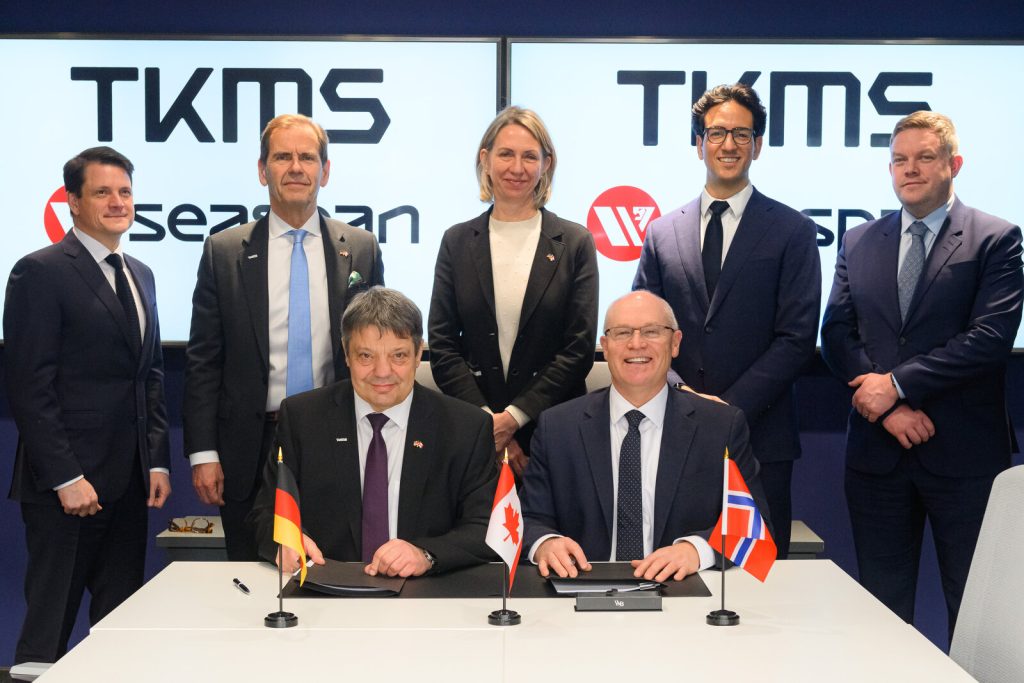
In January 2026, TKMS signed a Teaming Agreement with Seaspan Shipyards to establish a Canadian-led integrated sustainment enterprise. It’s a partnership that combines TKMS’s global submarine lifecycle expertise with Seaspan’s deep domestic in-service support capabilities. In tandem, the two will provide the RCN with robust Maintenance, Repair, and Overhaul (MRO) facilities to keep the CPSP in optimal operating condition.
A month later, TKMS partnered with EllisDon (a proven Canadian defence infrastructure contractor) to design and construct the 212CD’s highly specialized maintenance and training facilities. This partnership will ensure that this infrastructure delivery complies with Canadian regulatory standards, budgets, and operational timelines.
“Through these partnerships, TKMS guarantees that Canadian industry and RCN personnel will be fully trained and ready to take over operations and sustainment from Day One,” Keupp told CDR.
READ: Canadian Submarine History: CPSP Marks Bold Break from the Past
CONTRAST WITH THE COMPETITION
As the CPSP procurement narrows, the only competition to TKMS’s European offering comes from South Korea’s Hanwha Ocean KSS-III submarine. Philipp Schön is frank about how TKMS’s legacy of technology transfer compares to its competitor.
“Let us be objective: we offer a level of technology and know-how transfer that is simply unparalleled,” said Schön. “Our record is built on more than 140 submarines exported to 20 countries, with 40 percent of those vessels actually constructed in the customer’s home shipyards. At TKMS, we are not merely selling hardware; we are providing a proven methodology for domestic industrial empowerment. Furthermore, our delivery record is a matter of fact: since the 1960s, we have successfully delivered over 185 submarines to 20 navies worldwide.”
In fact, the very industrial base that South Korea relies on today was born from TKMS’s willingness to share its technology. “We built their first submarine in Germany, and the next 17 were built in Korea—enabling them to be our competitor in Canada today,” Keupp said. “When we share technology, we deliver on our promises.”
In evaluating the South Korean bid for the CPSP, Keupp has noted a lack of historical export capability and meaningful domestic integration. “Korea has only exported three boats to Indonesia in 2018, and none of them are operational,” he told CDR. “Their strategy has been not to involve the Canadian defence industry at all—as they don’t currently have the experience or capability to do so—but to simply deliver more boats faster. So the Memorandums of Understanding we’ve seen from them lack any real substance. The same is, by the way, true for their In-Service Support.”
“For Canada, the choice is clear,” said Würtz. “South Korea is offering to sell Canada a submarine. TKMS is offering to teach Canada how to build, sustain, and innovate upon one, integrating Canadian SMBs into a global supply chain that services the bulk of NATO.”
CONCLUSION: A GENERATIONAL IMPERATIVE
The Canadian Patrol Submarine Project is one of the largest and most complex naval procurements in modern Canadian history. Whichever company selects for the CPSP will dictate the operational readiness of the Royal Canadian Navy, and the economic vitality of Canada’s maritime defence sector, until well into the 2080s.
“Given the generational stakes for Canada, the 212CD stands out as the most logical, strategically sound choice,” Keupp concluded. “TKMS isn’t just pitching a submarine to Canada. We are offering a sovereign industrial legacy.”
James Careless is CDR’s Ottawa Bureau Chief
